
Words don’t live alone. They breathe, bend, and change shape depending on where you place them. That invisible force shaping meaning is context. Without it, communication falls apart fast. With it, even simple words gain depth and clarity.
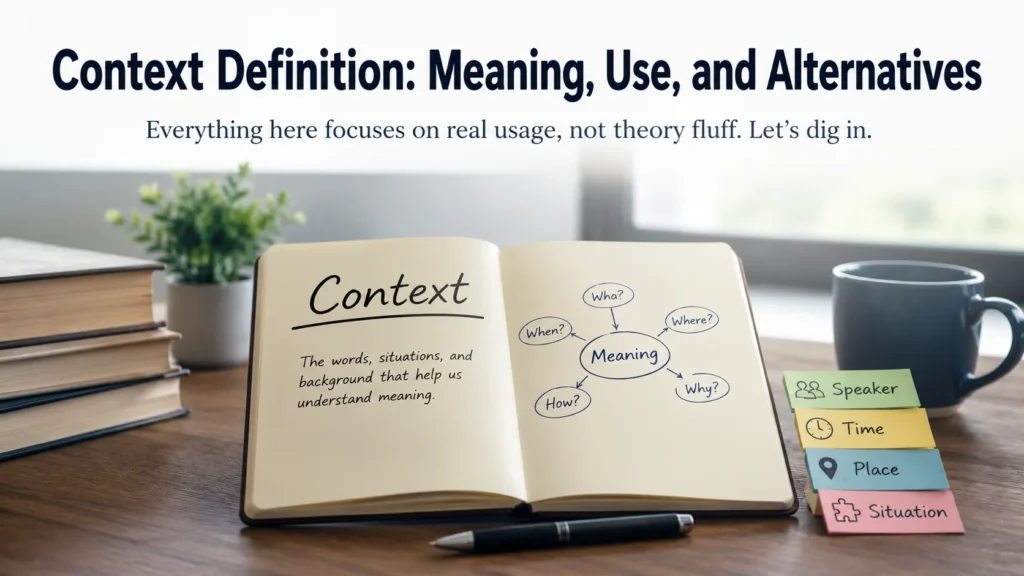
This in-depth guide breaks down the context definition, explains how context works in real life, shows why it matters more than ever, and explores practical alternatives you can use correctly. Everything here focuses on real usage, not theory fluff. Let’s dig in.
Why Context Changes Everything
Imagine someone texts you one word: “Fine.”
Does it mean agreement, frustration, or quiet anger?
You already know the answer. It depends on context.
Context explains how, why, and what something means. It helps you decode intent, emotion, and purpose. Without it, even honest words can mislead. With it, communication becomes precise and human.
This article explains the definition of context, its types, real-world applications, and practical alternatives. By the end, you’ll read, write, and interpret information with sharper clarity.
What Does Context Mean? A Clear Context Definition
At its core, context refers to the surrounding conditions that give meaning to something.
Context definition:
Context is the set of circumstances, information, or conditions that surround a word, event, or idea and help explain its true meaning.
The word comes from the Latin contextus, meaning “to weave together.” That origin fits perfectly. Meaning forms when words, situations, and background details weave together.
A sentence without context is like a map without landmarks. You can look at it, but you won’t know where you are.
Types of Context and How They Work
Context shows up in several forms. Each type influences interpretation in a unique way.
Linguistic Context
Linguistic context includes the words and sentences surrounding a specific word or phrase.
Example:
- “Bank” could mean a financial institution
- Or the side of a river
The surrounding words tell you which meaning fits.
Key fact:
Over 70% of English words have multiple meanings depending on linguistic context, according to corpus linguistics studies.
Situational Context
Situational context refers to the environment where communication happens.
This includes:
- Location
- Time
- Relationship between speakers
- Purpose of interaction
Saying “We need to talk” feels very different at a coffee shop than in a manager’s office.
Cultural Context
Cultural context shapes meaning through shared beliefs, customs, and social norms.
Example:
- In the US, direct speech often signals honesty
- In many Asian cultures, indirect speech signals respect
Ignoring cultural context leads to misunderstandings, especially in global communication.
Real-world impact:
International business negotiations fail more often due to cultural misinterpretation than language barriers.
Historical Context
Historical context explains meaning through time.
Words, laws, and texts written decades ago reflect the values and realities of their era. Reading them through a modern lens without historical context leads to false conclusions.
Example:
- Political speeches
- Religious texts
- Old literature
Understanding when something was written matters as much as what was written.
Emotional and Psychological Context
Emotional context comes from a speaker’s mental state.
Tone, stress, sarcasm, and mood all shape meaning.
Example:
- “Great job” can be praise or criticism
- The difference lies in emotional delivery
This context often matters more than the words themselves.
Why Context Matters in Everyday Life
Context isn’t academic theory. It shapes daily decisions and relationships.
Communication and Relationships
Misunderstandings rarely happen because of bad intentions. They happen because context goes missing.
Context helps you:
- Interpret tone accurately
- Avoid unnecessary conflict
- Respond with empathy
Healthy relationships rely on contextual awareness.
Education and Learning
Students remember information better when it’s contextualized.
Research-backed insight:
Learners retain up to 60% more information when lessons include real-world context instead of isolated facts.
Context turns memorization into understanding.
Business and Workplace Communication
Emails, reports, and meetings fail without context.
Common workplace issues:
- Vague instructions
- Misinterpreted feedback
- Confusing priorities
Clear context improves productivity, reduces errors, and builds trust.
Media, News, and Social Platforms
Out-of-context content spreads faster than truth.
Short clips, headlines, and quotes often strip away essential background.
Fact:
Most viral misinformation relies on context removal, not false statements.
Critical readers always ask, “What’s missing here?”
Context in Language and Writing
Writers guide readers using context, whether intentionally or not.
Context in Vocabulary and Meaning
Words shift meaning based on usage.
Example:
- “Charge” in law
- “Charge” in physics
- “Charge” in daily conversation
Dictionaries list definitions, but context selects the correct one.
Context in Grammar and Sentence Structure
Pronouns depend entirely on context.
Example:
- “They said it was late.”
Who is they? What is it?
Without prior context, grammar collapses.
Context in Creative and Academic Writing
Strong writing anticipates reader questions.
Good writers:
- Introduce background early
- Use examples to anchor ideas
- Control pacing and tone
Context builds clarity and trust.
Context in Technology and Data
Context now shapes how machines interpret the world.
Also Read This: Pedrovazpaulo Real Estate Investment: Proven Strategies
Context in Artificial Intelligence and NLP
Natural Language Processing relies on contextual cues.
AI struggles when:
- Sarcasm appears
- Cultural references emerge
- Emotional tone shifts
That’s why human review still matters.
Context in Data Analysis
Numbers mislead without context.
Example:
- A 20% sales drop sounds alarming
- But if the market dropped 40%, performance improves
Context turns data into insight.
Context-Aware Systems
Modern technology adapts using context.
Examples include:
- GPS recommendations
- Personalized ads
- Smart assistants
These systems adjust behavior based on location, history, and timing.
Common Mistakes People Make About Context
Ignoring context causes avoidable errors.
Frequent Context Errors
- Assuming shared understanding
- Taking quotes literally
- Ignoring emotional cues
- Applying one meaning everywhere
These mistakes lead to conflict, confusion, and misinformation.
How to Identify Context Correctly
Before interpreting meaning, pause.
Practical Context Checklist
Ask yourself:
- Who is speaking?
- Where is this happening?
- What happened before?
- What is the goal?
- What emotions are present?
Context becomes clearer when you slow down.
Context vs Related Concepts
| Term | Meaning | Difference from Context |
| Content | The message itself | Context explains meaning |
| Background | Prior information | Context includes current conditions |
| Subtext | Implied meaning | Context clarifies surface meaning |
| Perspective | Point of view | Context surrounds all viewpoints |
Alternatives and Synonyms for Context
Sometimes “context” isn’t the best word.
Accurate Alternatives
| Term | Best Use Case |
| Situation | Immediate conditions |
| Background | Historical details |
| Framework | Structural understanding |
| Circumstances | External factors |
| Environment | Physical or social setting |
Choosing the right alternative improves clarity.
Real-Life Examples Where Context Changed Everything
Legal Interpretation
Courts evaluate intent, not just words. Context decides guilt or innocence.
Marketing Campaigns
Brands have faced backlash by ignoring cultural context in ads.
Personal Communication
A poorly timed joke can offend, even if the words seem harmless.
Meaning lives in context, not vocabulary.
Why Context Matters More Than Ever Today
Information moves fast. Attention spans shrink.
Short-form content removes nuance. Algorithms reward speed over depth.
Context now acts as a filter. Those who understand it think critically. Those who don’t react emotionally.
Faqs:
What is context in simple terms?
Context explains what something means by showing its surroundings.
Can meaning exist without context?
Rarely. Even basic words rely on situation and usage.
Why does context change word meaning?
Because words adapt to environment, intent, and audience.
How can I improve contextual understanding?
Ask better questions, observe tone, and avoid assumptions.
Conclusion
Understanding the context definition is essential for clear communication, accurate interpretation, and effective decision-making. Whether in writing, conversations, education, business, or technology, context provides the background and circumstances that help people understand the true meaning of words, actions, and events. Without context, information can easily be misunderstood or misinterpreted.
By recognizing how context influences meaning, readers and communicators can improve their comprehension skills and express ideas more effectively. Additionally, knowing alternatives such as setting, background, framework, environment, and circumstances allows for more varied and precise language use. Ultimately, context is the key element that connects information to meaning, making communication clearer, more relevant, and more impactful in everyday life.