
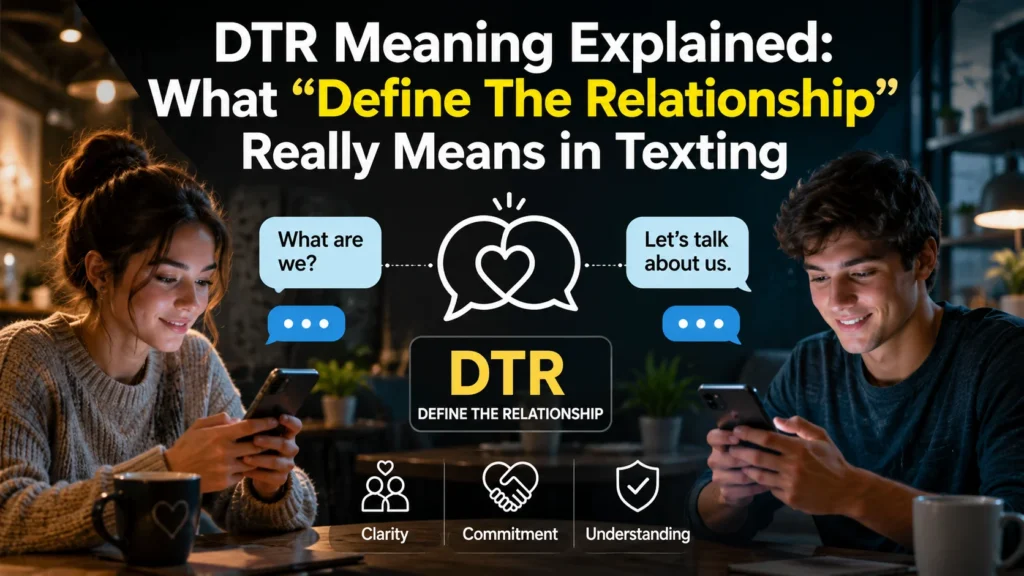

Understanding modern dating terms can be confusing, especially when communication isn’t clear. DTR Meaning Explained breaks down what “DTR” really means, why it matters in relationships, and how it’s commonly used in dating conversations. In this article, we’ll explore the definition of DTR, its origins, and when you should have a DTR conversation.
Whether you’re casually dating or seeking commitment, this guide will help you navigate relationship clarity with confidence and avoid misunderstandings.
What Does DTR Stand For and Why It Matters
DTR stands for Define The Relationship. People use it when they want to stop guessing and start agreeing on what they are.
Why this matters:
- It turns vague feelings into clear expectations.
- It protects time and emotional energy.
- It reduces the chance of misread signals and heartbreak.
Think of a DTR conversation as a short contract between two people. The terms aren’t legal, but they shape behavior. When people define the relationship, they name labels, commitments, and boundaries that guide future interactions.
DTR Meaning in Text Messaging: How It Shows Up (and How to Read It)
Texting makes DTR both easier and trickier. You can say it in nine words or nine minutes. Tone is limited, so misunderstandings flare up.
Common ways DTR appears in texts:
- “Do you want to DTR?”
- “Can we DTR?”
- “Are we DTR?”
- “We should talk about DTR.”
Tone matters. A playful “wanna DTR?” is different from a serious “we need to DTR.” Read the whole text thread before reacting.
Example text conversations showing real usage
Scenario 1: Casual → Exclusive
Alex: I love hanging out. You free tomorrow?
Jordan: Yup. Also, can we DTR sometime this week?
Alex: Yeah. I want to be exclusive if you do.
Jordan: Same. Let’s make it official.
Scenario 2: Awkward, one-sided
Sam: Hey, are we DTR or nah?
Taylor: Wait… I thought we were just having fun.
Sam: Oh. Okay. Thanks for being honest.
Scenario 3: Playful
Riley: DTR = define the relationship?
Casey: DTR = do tacos, right?
Riley: Fine. Let’s DTR over tacos.
These examples show how DTR texts can be direct, ambiguous, or lighthearted. Context and follow-up matter.
DTR Meaning in Dating and Relationships: Emotional and Practical Effects
DTR isn’t just a label. It defines expectations, time investments, and emotional risk.
Emotional implications
- Clarity reduces anxiety. Knowing where you stand eases second-guessing.
- Commitment sometimes increases vulnerability. Naming the relationship can deepen attachment.
- Rejection becomes concrete. If someone says they don’t want the same thing, closure arrives.
Practical implications
- Dating frequency changes. Partners may prioritize time differently.
- Introductions happen. People often introduce partners to friends and family after DTR.
- Future planning starts. Vacations and holiday plans get simpler after terms are set.
Signs It’s Time to Have a DTR Conversation
You don’t need a timer. But certain signs say it’s smart to ask.
Look for these signs:
- You consistently spend weekends together.
- You’ve met each other’s close friends.
- Jealousy or confusion keeps popping up.
- You’re investing the same effort and want the same future.
- One person asks for exclusivity indirectly (canceling dates with others, for example).
If more than two signs show up, a DTR talk can save time and pain.
When DTR Is Premature or Unnecessary
Timing matters. Push too early and you can scare someone off. Wait too long and resentment builds.
Don’t DTR when:
- You’ve known each other less than a few dates and haven’t spent significant time together.
- One person is traveling or under major stress.
- You’ve clearly agreed to stay casual and both are satisfied.
You also don’t need a formal DTR for every short-term relationship. If both people like casual dating and have discussed boundaries, that counts as a shared understanding.
How to Start a DTR Conversation Without Making It Awkward
You can be straightforward and kind. Preparation helps.
Before you talk
- Check your motives. Are you asking to control or to clarify?
- Decide what outcome you want. Exclusivity? Dating openly? A break?
- Choose a private, relaxed setting — in person is best, but a thoughtful video call works.
What to say
- Use I statements. They reduce defensiveness.
- Be clear and specific. Vagueness invites misinterpretation.
- Allow space for the other person to respond honestly.
Examples of DTR openers
- “I enjoy spending time with you. I’d like to talk about where this is heading.”
- “I’ve started to feel serious about us. Are we on the same page?”
- “I’m not sure what we are. Can we define what ‘together’ looks like for us?”
What to avoid
- Blaming or demanding language.
- Public confrontations.
- Pressuring for an immediate answer if the other person needs time.
DTR Outcomes: What Usually Happens Next
After you define the relationship, one of several logical outcomes follows. Each has practical and emotional effects.
| Outcome | What it Means | Typical Next Steps |
| Exclusive | Both agree to date only each other | Introductions, future planning, clearer calendars |
| Still Casual | Both prefer non-exclusive dating | Boundaries on seeing others, open communication |
| Situationship | Vague label, inconsistent expectations | Risk of mismatched assumptions and resentments |
| Break/End | People decide to part ways | Closure, quiet period, emotional processing |
| One-sided | Only one person wants the relationship defined | Re-negotiation, compromise, or a breakup |
Fact: Exclusivity doesn’t automatically mean long-term commitment. It simply narrows dating to one partner.
DTR vs. Similar Relationship Terms: Clear Differences
The dating lexicon includes lots of phrases. Here’s a practical comparison.
Table — DTR compared to related terms
| Term | Short definition | Difference from DTR |
| Exclusive | Only dating each other | A possible DTR outcome, not the conversation itself |
| Talking stage | Getting to know someone | Earlier phase than a DTR; informal |
| Situationship | Undefined, inconsistent relationship | Could exist after a failed or avoided DTR |
| Seeing someone | Casual but regular dating | Could become exclusive with a DTR |
| Committed/Partner | Long-term, mutual responsibility | A deeper result that may follow DTR |
Use these labels deliberately. Words shape behavior.
DTR Meaning on Social Media and Dating Apps
Social platforms compress relationship signals into a few actions: bios, profile badges, and posts.
How DTR plays out
- Dating app bios sometimes say “Not ready to DTR” or “Ready to DTR.”
- Public posts or “official” relationship announcements act as post-DTR signals.
- Ghosting can happen when someone avoids the DTR conversation and disappears online.
Practical tip: If your partner changes relationship status online before you’ve DTR-ed, bring it up. Social announcements can create pressure and confusion.
Also Read This: Green FN Meaning: Everything You Need to Know
Other Meanings of DTR (Context Matters)
Not every DTR in the wild means “define the relationship.” Context flips the meaning.
| Context | Acronym Meaning | Use case |
| Tech or IT | Data Terminal Ready | A serial communication signal in hardware |
| Business | Daily Time Record | Employee attendance logs |
| Fitness | Deadlift to Row (informal) | A hybrid workout acronym |
| Slang | Don’t Text/Reply (rare) | Casual chat shorthand in some groups |
Always read the surrounding conversation before assuming meaning.
Misunderstandings and Myths About DTR
People bring assumptions. Here are common myths and the truth.
Myth: DTR always leads to marriage.
Truth: DTR clarifies status. It rarely guarantees long-term outcomes.
Myth: You must DTR in person.
Truth: In-person DTR is ideal, but honest DTR over video or text can work when distance or safety is a factor.
Myth: If you don’t DTR, nothing counts.
Truth: Behavior speaks loudly. Repeated exclusivity often implies a defined relationship, though it’s best to verbalize it.
The Psychology Behind DTR: Fear, Attachment, and Power
DTR conversations engage deep emotions. Understanding psychology eases tension.
Attachment styles
- Anxious individuals often push for DTR early.
- Avoidant types may resist labeling or delay.
- Secure people tend to communicate directly and calmly.
Fear of rejection
Naming the relationship risks saying “no” aloud. That fear can freeze people. Recognize it. You can reduce pressure by framing the conversation as curiosity rather than demand.
Power dynamics
Who initiates DTR may feel more vulnerable. That vulnerability can flip into perceived power if someone uses DTR to manipulate. Keep the conversation mutual and respectful.
Mini Case Studies: Realistic Outcomes and Lessons
Case Study 1 — A Successful DTR
Background: Maya and Chris dated for three months, met family, and spent weekends together.
DTR: Maya asked, “Do we want to be exclusive?”
Outcome: Chris said yes. They set simple boundaries and planned a trip.
Lesson: When actions match feelings, DTR confirms intent and speeds progress.
Case Study 2 — A Misaligned DTR
Background: Leo thought they were exclusive. Ava saw others.
DTR: Leo texted, “Are we exclusive?” Ava said no.
Outcome: They parted ways. Leo felt hurt but grateful for clarity.
Lesson: A DTR prevents prolonged mismatch and wasted emotional effort.
Case Study 3 — The Gray Zone
Background: Sami and J- met online, texted daily but hadn’t met in person.
DTR: J- asked to define the relationship via text. Sami hesitated.
Outcome: They agreed to wait until meeting in person. Both respected the delay.
Lesson: It’s okay to postpone DTR until you have enough shared data.
How to Handle Common DTR Scenarios: Scripts You Can Use
Scripts help you start strong. Use them, tweak them, or throw them away.
If you want exclusivity
- “I’ve been thinking about us. I like you and want us to be exclusive. How do you feel?”
If you want clarity but fear the answer
- “I care about you. I want to know what ‘us’ looks like for you.”
If someone asks and you’re unsure
- “I like where this could go, but I’d like a few more weeks to see how it feels. Can we check in then?”
If it’s over text and you want to meet
- “This feels important. Can we talk about this on a call tonight?”
How DTR Language Has Evolved
Dating tools and culture shaped the DTR. Before phones, couples talked face-to-face more often. Texting created shorthand and delays.
Trends
- Dating apps produce faster introductions but also more ambiguity.
- Social media normalizes public signaling, sometimes replacing conversation.
- Millennials and Gen Z use labels more often, yet many prefer fluidity in relationships.
Language evolves, but the human desire for clarity doesn’t.
Practical Table: When to DTR (Decision Guide)
| Situation | Suggested Action |
| You spend consistent weekends together | Ask to DTR within a few weeks |
| You’ve met family/friends | DTR soon; expectations likely aligned |
| You’ve only texted twice | Wait; gather more data |
| One partner shows jealousy | DTR to clarify boundaries |
| Long-distance and uncertain | Plan a DTR after meaningful visits or steady calls |
Quick Tools: Checklist Before You DTR
- I’ve reflected on what I want
- I can explain my boundaries calmly.
- I choose a private and timely moment.
- I’m ready to listen to their view.
- I accept any honest answer.
Use the checklist to stay grounded. It keeps the conversation productive and empathetic.
FAQs:
Can you DTR over text?
Yes. Good DTR over text is clear, respectful, and gives time for reflection. For sensitive reactions, follow up with a call or in-person talk.
How long should you wait before DTR?
No fixed rule. Generally, a few consistent months of dating or repeated signs of commitment are reasonable reasons.
What if only one person wants to DTR?
You can express your feelings, ask for a timeline, or walk away. A one-sided DTR typically requires either compromise or separation.
Does DTR equal exclusivity?
Not automatically. DTR is the conversation. Exclusivity is a possible result.
Is DTR childish or unnecessary?
No. DTR is practical. It reduces confusion and helps both people make informed choices.
Conclusion:
Understanding modern dating language is essential for building healthy and honest relationships. With DTR Meaning Explained, it becomes clear that defining the relationship is not about pressure, but about clarity, respect, and mutual understanding. A DTR conversation helps both partners align expectations, reduce confusion, and move forward with confidence. Whether the goal is commitment or simply clear boundaries, knowing when and how to DTR can strengthen communication and prevent misunderstandings. In today’s fast-paced dating culture, clarity is key—and DTR plays a crucial role in creating meaningful connections.