
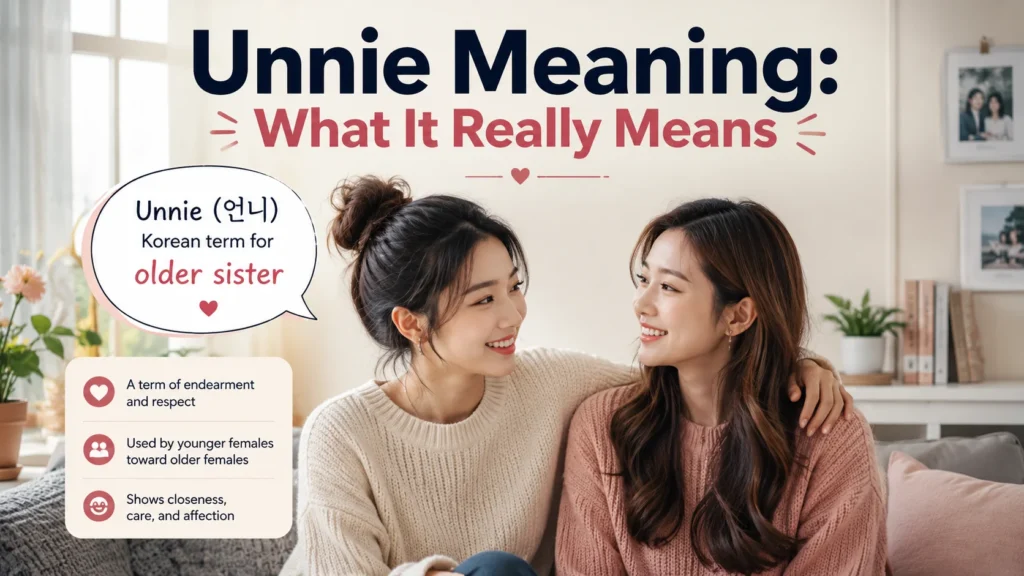

Unnie Meaning: What It Really Means and How People Use It in Text and Speech explores the true definition of the popular Korean word “unnie” and how it’s commonly used today. In this article, you’ll learn the cultural background of the term, who can use it, and how it appears in everyday conversations, K-dramas, K-pop fandoms, and online texting.
Whether you’re new to Korean language trends or already familiar with Korean culture, this guide will help you understand the correct and modern usage of “unnie.”
What Does “Unnie” Mean?
In everyday Korean, Unnie (언니) refers to an older sister. But that’s only part of the story.
Here’s the core idea:
- Unnie = older sister used by females talking to another female who is older.
- A male wouldn’t call an older sister Unnie. Instead, a male would say Noona (누나) for an older female.
This distinction hinges on gender and age — key aspects of Korean communication.
Quick Breakdown
| Korean Word | English Equivalent | Used By | Refers To |
| 언니 (Unnie) | Older sister | Female | Older female |
| 누나 (Noona) | Older sister | Male | Older female |
| 오빠 (Oppa) | Older brother | Female | Older male |
| 형 (Hyung) | Older brother | Male | Older male |
| 동생 (Dongsaeng) | Younger sibling | Any | Younger person |
So the Unnie meaning isn’t just familial. It reflects social relationships and respect based on age, a big deal in Korean culture.
Why “Unnie” Matters in Korean Culture
Korean language doesn’t stand alone. It’s woven into the culture’s values — respect, hierarchy, and connection.
In English, you might just say “older friend” or “big sister,” but in Korean, age difference matters. That difference shapes not only pronunciation but social behavior.
Here’s How the Culture Shapes Usage
- Respect for elders: Calling someone Unnie signals that you see them as older and deserving of polite interaction.
- Group harmony: Using the right title helps maintain social balance.
- Emotional closeness: Among friends, calling someone Unnie can show warmth and affection.
Korean doesn’t just describe age — it embeds it into everyday speech.
When Koreans Use “Unnie” in Daily Life
You’ll hear Unnie everywhere in Korea. Not just at home, but on the streets, in school hallways, and at coffee shops.
Let’s see where it shows up most.
Common Real-Life Settings
Family vs Friends
- At home: A younger sister calls her big sister Unnie.
- Among friends: Girls in school or college use Unnie to talk to older friends.
School and Clubs
- Older female seniors often get called Unnie by juniors.
Social Event
- At parties or group outings, Unnie becomes a respectful term among peers.
It’s casual yet polite — perfect for everyday use.
Unnie in Text Messages and Online Conversations
Digital chats add a twist to how people use Unnie. Tone, emojis, and context shape meaning.
Let’s explore how it changes online.
Digital Usage Patterns
- Emojis help show tone: 😊💕
- Casual spelling may appear, like 언니~~ with playful tildes.
- Short text like:
“Unnie, coffee later?”
shows familiarity and closeness.
Tone Shift Online
In person, you hear voice inflection, facial cues, and body language. Online? All you have is text.
So Unnie can sometimes feel:
- More affectionate
- More playful
- Sometimes even flirtatious (especially with emojis)
That doesn’t happen in spoken Korean as often.
“Unnie” in K-Dramas and K-Pop Culture
You can’t escape Unnie if you watch K-dramas or listen to K-pop. Characters and idols use it all the time.
Here’s why it matters:
- Helps establish relationship dynamics instantly
- Signals age ranking among characters
- Makes the world feel authentically Korean
Case Study: K-Drama Dialogue
A character says:
“Unnie, you’re too funny!”
Right away, you know:
- The speaker is female
- She’s younger
- There’s a close, friendly vibe
These subtleties matter!
In K-Pop
Fans often call group seniors Unnie:
- Members of a group use Unnie to address older members
- Fans may also call their favorite female idols Unnie as a sign of endearment
That’s Unnie evolving from everyday Korean into global fan culture.
Can Non-Koreans Use “Unnie”?
A big question: Can you use it if you aren’t Korean?
The Short Answer
Yes — but with awareness.
Here’s what matters:
- Context makes all the difference.
- Using it with Korean friends can feel natural.
- Using it with strangers might feel awkward or presumptive.
Think of it like nicknames in English. Some people welcome them. Others don’t.
Do Koreans Mind Foreigners Saying “Unnie”?
Often, they find it:
- Cute
- Polite
- A sign you’re trying to understand
But some may think it’s too familiar if you don’t know them well.
So watch how others respond — and adjust.
Also Read This: DTR Meaning Explained: What “Define The Relationship” Really Means in Texting
Common Mistakes with “Unnie”
Even eager learners get tripped up. Let’s clear up the biggest mistakes.
Top Errors
- Using it regardless of age
“Unnie” isn’t just friendly slang. - Males calling someone “Unnie”
That’s incorrect — use Noona instead. - Calling strangers “Unnie
Can feel too personal or presumptuous.
Easy Correction Tips
- Check age difference first.
- Use the term only among friends or acquaintances.
- Avoid it in formal or professional settings.
Unnie vs Other Korean Relationship Terms
Korean doesn’t have one word for “older sibling.” It has several, and each depends on who you are and who you’re talking to.
Here’s a clearer comparison:
Comparison Table
| Word | Used When | Meaning |
| Unnie (언니) | Female to older female | Older sister |
| Noona (누나) | Male to older female | Older sister |
| Oppa (오빠) | Female to older male | Older brother |
| Hyung (형) | Male to older male | Older brother |
| Dongsaeng (동생) | Anyone to younger person | Younger sibling |
Understanding this table helps you use titles correctly, whether you’re chatting or watching media.
How “Unnie” Differs from English Words Like “Sis”
Translation often fails to capture nuance.
In English:
- “Sis” can be short for sister or a close friend.
- Age doesn’t change the word.
In Korean:
- Age matters.
- Your gender changes what you say.
Side-by-Side Feelings
| Feature | English “Sis” | Korean “Unnie” |
| Age-specific | No | Yes |
| Gender-specific | No | Yes |
| Formal respect | Low | Moderate |
| Emotional closeness | Can be strong | Often strong |
That table shows why Unnie meaning runs deeper than a direct translation.
Modern Evolution of “Unnie”
Language moves fast — and Unnie isn’t immune.
How the Term Has Changed
- Younger generations use it more casually.
- Internet slang and memes sprinkle new flavors.
- Fans use it beyond strict age differences.
People now might say Unnie to someone almost the same age, driven by tone rather than age.
Still, the core cultural rule stays strong — age and gender matter.
Real Examples of “Unnie” in Context
Seeing examples helps everything click. Here are real-style lines you might read or hear:
“Unnie, let’s meet for lunch!”
Casual and friendly.
“언니가 최고야!” (Unnie is the best!)
Playful praise with emotion.
“Unnie, you’re amazing.”
Shows affection and respect.
Each line carries subtle tone shifts depending on who’s speaking and how well they know each other.
Is “Unnie” Formal or Informal?
This gets tricky.
- In everyday speech, Unnie is informal but polite.
- In professional or formal settings, you’d use Ms. or full names instead.
So Unnie fits best in:
- Casual conversations
- Friendly group settings
- Personal chats
Not in:
- Business meetings
- Formal texts
- Academic environments
Tone matters here more than grammar.
Why Understanding “Unnie” Helps You Understand Korean Culture
By now, you’ve seen that Unnie isn’t just a translation. It’s a cultural lens.
Here’s what the term reveals:
- Social hierarchy & respect
- Gender roles in language
- Nuance in everyday relationships
- How media spreads language globally
Understanding Unnie meaning isn’t about memorizing a definition. It’s about feeling how Korean speakers relate to one another — in text, in speech, and in heart.
FAQs:
What does “Unnie” literally mean?
It literally means older sister used by a female toward another female who is older.
Can men say “Unnie”?
No. Men use Noona for older females instead.
Is “Unnie” rude to use?
Not by itself. But using it with strangers or in formal settings can feel too casual.
Do Koreans use “Unnie” at work?
Usually not. In formal workplaces, people stick to titles and last names.
Why do idols call each other “Unnie”?
It shows age hierarchy, closeness, and sometimes playful affection.
Conclusion
Understanding the Unnie Meaning: What It Really Means and How People Use It in Text and Speech goes beyond just knowing a word—it’s about appreciating Korean culture, social relationships, and modern communication trends. Whether in K-dramas, K-pop fandoms, or casual texting, knowing how to use “unnie” correctly helps you connect better and avoid misunderstandings. By learning its proper usage, you can join conversations confidently and show respect for cultural nuances. So next time you see “unnie” in a text or hear it in speech, you’ll know exactly what it means and how to use it naturally.