
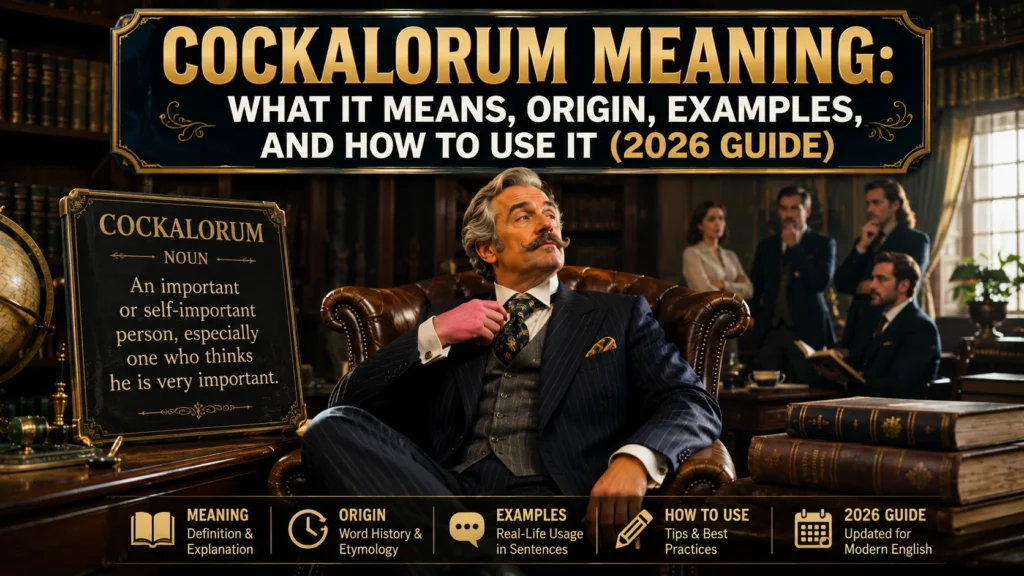

Cockalorum Meaning refers to a self-important or boastful person who has an exaggerated opinion of their own importance. The word is often used humorously or critically to describe someone who acts arrogant or overly confident despite having little real authority or significance.
The confusion comes from its uncommon usage. Many readers aren’t sure about the cockalorum definition, cockalorum pronunciation, or how to use it correctly in a sentence. But here’s the kicker: once you understand its meaning, you’ll start recognizing it in literature, conversations, and even humorous descriptions of overconfident people.
The good news? It’s much simpler than it sounds.
In this guide, you’ll discover the Cockalorum Meaning, learn the definition of cockalorum, explore its pronunciation, origin, and etymology, and see real cockalorum examples in sentences. You’ll also find synonyms of cockalorum, understand when to use the word, and learn why it remains a fascinating part of the English vocabulary.
By the end, you’ll know exactly what cockalorum means, how to pronounce it confidently, and when it’s the perfect word to describe someone with an exaggerated sense of importance.
What Does Cockalorum Mean?
The cockalorum meaning is surprisingly vivid despite the word’s rarity.
A cockalorum is a self-important person who has an exaggerated opinion of their own abilities, status, or importance. The word usually describes someone who behaves as though they are much more influential or impressive than they actually are.
Unlike words that express outright cruelty, cockalorum often carries a touch of humor or gentle mockery. It points out inflated pride rather than genuine authority.
For example:
The new supervisor acted like a cockalorum even though he’d only been in the role for a week.
In this sentence, the person isn’t necessarily powerful. Instead, they believe they’re far more important than everyone else.
Quick Definition
Cockalorum (noun): A vain, boastful, or self-important person who greatly overestimates their own importance.
Cockalorum Meaning at a Glance
| Feature | Details |
| Word | Cockalorum |
| Pronunciation | kok-uh-LOR-um |
| Part of Speech | Noun |
| Meaning | A self-important person with an exaggerated sense of importance |
| Tone | Humorous, literary, mildly critical |
| Common Usage | Literature, satire, descriptive writing |
| Modern Popularity | Rare but still recognized |
| Word Type | Countable noun |
Cockalorum Pronunciation
Many people hesitate when they first encounter this unusual word. Fortunately, it’s easier to pronounce than it looks.
Pronunciation:
kok-uh-LOR-um
IPA:
/ˌkɒk.əˈlɔː.rəm/
Break it into four parts:
- Cock
- uh
- LOR
- um
The emphasis falls on the third syllable.
Pronunciation Tip
Imagine saying:
cock + a + LORE + um
Repeating it aloud a few times makes it feel much more natural.
Origin and Etymology of Cockalorum
One of the most interesting parts of understanding cockalorum meaning is exploring where the word came from.
Linguists trace cockalorum back to 18th-century Britain. The exact origin isn’t completely certain, but most language historians agree that it developed from the word cock, which has long symbolized pride, confidence, swagger, and dominance.
Roosters often strut around confidently as if they own the entire farmyard. That image became a natural metaphor for people who display exaggerated self-confidence.
Over time, speakers added the playful ending -alorum, creating a humorous noun that sounded both memorable and slightly ridiculous. The word itself almost mocks the kind of person it describes.
Originally, it referred to a little man with a very big opinion of himself. Eventually, the meaning broadened to include anyone whose ego greatly exceeded their actual importance.
Unlike many old English words that disappeared entirely, cockalorum survived because human nature hasn’t changed. Every generation produces people whose confidence outweighs their achievements.
Why Is Someone Called a Cockalorum?
Calling someone a cockalorum doesn’t necessarily mean they’re evil or unintelligent.
Instead, it highlights certain personality traits.
Common characteristics include:
- An inflated ego
- Constant self-promotion
- Speaking as if they know everything
- Demanding attention
- Overestimating their authority
- Looking down on others
- Seeking admiration
- Believing they’re always right
Imagine a junior employee who constantly interrupts meetings, corrects senior colleagues, and behaves like the company’s CEO despite having very little experience. Many people would describe that behavior as cockalorum-like.
The word focuses more on attitude than actual success.
How to Use Cockalorum Correctly
Although the word isn’t common in everyday conversation, you can still use it naturally.
The key is understanding the right context.
In Literature
Authors often use cockalorum to describe arrogant characters.
Example:
The cockalorum merchant believed the entire town admired him.
In Conversation
The word works well among people who enjoy advanced vocabulary.
Example:
Don’t be such a cockalorum. We’re all working together.
In Opinion Writing
Journalists sometimes revive older words to create colorful descriptions.
Example:
The columnist described the politician as a cockalorum who loved hearing his own speeches.
In Satire
Satirical writing frequently uses unusual vocabulary because it creates humor while criticizing someone’s behavior.
Cockalorum Meaning in Modern English
Is cockalorum still used today?
Yes—but not often.
Most modern English speakers choose simpler words such as:
- arrogant
- conceited
- egotistical
- boastful
- pompous
However, writers, historians, editors, crossword creators, and lovers of classic English still appreciate cockalorum because it expresses a very specific personality.
Using an uncommon word like this can also make your writing more engaging when your audience understands it.
That said, avoid overusing rare vocabulary. Like a strong spice in cooking, it works best in moderation.
Example Sentences Using Cockalorum
The best way to understand cockalorum meaning is through real examples.
Everyday Conversation
- Everyone laughed when the neighborhood cockalorum began giving life advice.
- He acts like a cockalorum despite having little experience.
- Nobody enjoys working with a cockalorum for very long.
- Her confidence crossed the line into cockalorum territory.
Workplace
- The new manager quickly earned a reputation as the office cockalorum.
- Clients preferred humble experts over loud cockalorums.
- His constant bragging made him seem like a cockalorum.
Politics
- Critics labeled the candidate a cockalorum because of his exaggerated promises.
- Every debate featured at least one political cockalorum.
Social Media
- Online platforms often reward cockalorum behavior with attention.
- Some influencers appear confident while others simply come across as cockalorums.
Literature
- The novel’s cockalorum became its funniest character.
- Victorian authors enjoyed mocking the wealthy cockalorum who believed money bought wisdom.
Humor
- Even the family dog ignored the household cockalorum.
- Every reunion seems to include one cockalorum telling unbelievable stories.
- His speeches lasted longer than anyone’s patience, proving he was the true cockalorum of the club.
These examples show how flexible the word can be while maintaining the same core meaning.
Cockalorum vs Similar Words
Many English words describe pride or arrogance. However, each has its own shade of meaning.
| Word | Meaning | Key Difference |
| Cockalorum | Self-important person | Literary and humorous |
| Arrogant | Excessively proud | General adjective |
| Conceited | Thinks too highly of themselves | Common everyday word |
| Egotist | Focuses excessively on self | Centers on self-interest |
| Braggart | Constantly boasts | Highlights bragging |
| Pompous | Self-important and formal | Often sounds pretentious |
| Snob | Looks down on others | Based on social status |
| Know-it-all | Acts like they know everything | Informal expression |
The biggest difference is that cockalorum combines vanity, inflated importance, and comic exaggeration in a single word.
Synonyms of Cockalorum
Depending on the context, these words can express a similar idea.
Close Synonyms
- Egotist
- Conceited person
- Braggart
- Show-off
- Bighead
- Peacock
- Blowhard
- Windbag
- Know-it-all
- Pompous individual
Contextual Alternatives
| Situation | Better Word |
| Everyday speech | Arrogant |
| Academic writing | Egotistical |
| Humorous writing | Cockalorum |
| Informal conversation | Bighead |
| Satire | Pompous fool |
| Character description | Blowhard |
Not every synonym carries the same tone. Choosing the right one depends on your audience and purpose.
Antonyms of Cockalorum
Understanding the opposite of cockalorum meaning helps clarify the word even further. While a cockalorum exaggerates their own importance, the following traits reflect humility and self-awareness.
| Antonym | Meaning | Typical Context |
| Humble | Doesn’t think they’re better than others | Everyday conversation |
| Modest | Avoids boasting about achievements | Professional settings |
| Unassuming | Doesn’t seek attention or praise | Personal descriptions |
| Self-effacing | Downplays personal accomplishments | Formal writing |
| Down-to-earth | Practical and realistic | General usage |
| Respectful | Treats others as equals | Workplace and social situations |
A humble leader earns respect by listening and learning. A cockalorum, on the other hand, often demands respect before earning it.
Is Cockalorum an Insult?
Yes, cockalorum can be an insult, but it’s usually a mild and humorous one rather than a harsh attack.
Unlike offensive words that are meant to hurt, cockalorum often pokes fun at someone’s oversized ego. It suggests that the person takes themselves far too seriously.
For example:
“He’s a bit of a cockalorum, isn’t he?”
This statement criticizes someone’s attitude while still sounding playful. In many cases, it carries more wit than hostility.
When It’s Appropriate
You might use cockalorum when:
- Describing a fictional character.
- Writing satire or humorous commentary.
- Referring to someone who constantly boasts.
- Discussing personality traits in literature.
Also Read This: Frescade Meaning: What It Means and How to Use It (2026 Guide)
When to Avoid It
Avoid using the word if:
- You’re writing formal business documents.
- Your audience may not recognize the term.
- The situation requires neutral or respectful language.
- You’re trying to avoid sounding sarcastic.
Choosing the right word always depends on your audience. While cockalorum is colorful, it isn’t universally understood.
Cockalorum in Literature and Popular Culture
Although cockalorum isn’t a household word today, it has appeared in English literature for centuries.
Classic authors often favored expressive vocabulary to paint memorable characters. A single unusual word could tell readers everything they needed to know about a person’s personality.
A cockalorum character usually:
- Walks with exaggerated confidence.
- Talks more than they listen.
- Believes they know best.
- Expects admiration from everyone.
- Often becomes the source of comedy.
These characters appear in:
- Historical novels
- Victorian literature
- Satirical essays
- Classic British humor
- Crossword puzzles
- Vocabulary books
Modern authors occasionally revive the word because it instantly creates a vivid image without requiring a lengthy description.
Cockalorum in Everyday Life
Even if you’ve never heard the word before, you’ve almost certainly met a cockalorum.
Here are a few examples from everyday situations.
At Work
A coworker constantly interrupts meetings, dismisses everyone’s ideas, and behaves like the smartest person in the room despite having limited experience.
In School
A student refuses to accept corrections because they believe they’re always right.
On Social Media
Someone posts endless self-congratulatory updates and insists they’re an expert on every topic.
In Sports
A player celebrates every minor achievement while blaming teammates for every mistake.
In each case, the defining feature isn’t confidence itself. Healthy confidence is valuable. The problem begins when confidence grows into exaggerated self-importance.
Common Mistakes When Using Cockalorum
Since cockalorum is an uncommon English word, people occasionally misuse it.
Here are the most frequent mistakes and how to avoid them.
Using It as an Adjective
❌ He is very cockalorum.
✅ He is a cockalorum.
Remember that cockalorum is a noun, not an adjective.
Assuming It Means Successful
Being successful doesn’t make someone a cockalorum.
The word refers to attitude, not achievement.
Someone can be:
- Highly successful and humble.
- Completely inexperienced yet still behave like a cockalorum.
Confusing It with Confidence
Confidence is positive.
Cockalorum behavior is excessive self-importance.
Here’s a simple comparison:
| Confidence | Cockalorum Behavior |
| Believes in personal abilities | Believes they’re better than everyone |
| Accepts feedback | Rejects criticism |
| Encourages others | Looks down on others |
| Learns from mistakes | Rarely admits mistakes |
Using It Too Often
Because the word is unusual, using it repeatedly can make your writing feel forced.
Instead, mix it naturally with related terms such as:
- arrogant
- boastful
- pompous
- egotistical
- conceited
Variety improves readability and keeps your writing engaging.
When Should You Use Cockalorum?
One reason this word has survived for hundreds of years is its precision. It describes a very specific type of personality.
You can use cockalorum in several situations.
Character Descriptions
Writers often need a quick way to establish personality.
Instead of saying:
“He believed he was more important than everyone else.”
You can simply write:
“He was a cockalorum.”
One word creates a vivid mental picture.
Creative Writing
The word works especially well in:
- Historical fiction
- Fantasy novels
- Mystery stories
- Satirical essays
- Humor writing
Its slightly old-fashioned tone can add charm and originality.
Book Reviews
When reviewing literature, cockalorum can describe characters whose arrogance drives the plot.
For example:
The novel’s central cockalorum spends the entire story chasing recognition instead of earning respect.
Opinion Articles
Editorial writers sometimes revive uncommon words because they communicate criticism with humor rather than anger.
Why Rare Words Like Cockalorum Still Matter
English contains hundreds of thousands of words. Many have faded from everyday speech, yet they continue to enrich the language.
Rare words like cockalorum remain valuable because they:
- Add precision to writing.
- Capture ideas common words sometimes miss.
- Make storytelling more expressive.
- Preserve the history of English.
- Expand your vocabulary.
Learning uncommon vocabulary doesn’t mean replacing everyday language. Instead, it gives you more choices when the right situation appears.
Think of vocabulary as a toolbox. Most jobs require a hammer, but occasionally you need a specialized tool. Cockalorum is one of those specialized tools.
Quick Reference: Cockalorum Cheat Sheet
| Question | Answer |
| Meaning | A self-important, boastful person |
| Part of Speech | Noun |
| Tone | Humorous, literary, mildly critical |
| Pronunciation | kok-uh-LOR-um |
| Common Today? | Rare but still recognized |
| Positive or Negative? | Usually negative with a humorous tone |
| Best Used In | Literature, satire, descriptive writing, advanced vocabulary |
Real-Life Case Study: When Confidence Turns Into Cockalorum
Imagine two newly promoted team leaders.
Sarah thanks her coworkers, asks questions, and listens carefully before making decisions. Her confidence helps the team grow.
James, however, immediately begins acting as though he knows everything. He interrupts experienced colleagues, ignores feedback, and insists that only his ideas matter.
After a few weeks, Sarah earns trust and respect.
James earns a different reputation. People begin describing him as a cockalorum because his self-importance overshadows his actual experience.
This example highlights the key difference between healthy confidence and inflated ego. One builds relationships. The other often damages them.
“True confidence inspires others. False importance only seeks applause.”
That simple distinction captures the essence of cockalorum meaning.
FAQs:
What does cockalorum mean?
Cockalorum refers to a self-important, boastful person who has an exaggerated opinion of their own importance or abilities. The term is usually used in a humorous or mildly critical way to describe someone whose confidence exceeds their actual status or achievements.
Is cockalorum a real English word?
Yes, cockalorum is a genuine English word. It has been part of the English language since the 18th century and appears in respected dictionaries. Although it is uncommon in everyday conversation today, writers, editors, and language enthusiasts still use it to describe an overly arrogant or pompous person.
How do you pronounce cockalorum?
Cockalorum is pronounced kok-uh-LOR-um (IPA: /ˌkɒk.əˈlɔː.rəm/). The emphasis falls on the third syllable, making it easier to remember when spoken aloud.
Is cockalorum considered an insult?
It can be, but it is generally a mild and humorous insult rather than a harsh one. Calling someone a cockalorum suggests they take themselves too seriously or act more important than they really are. The tone often depends on the context and the relationship between the people involved.
Can I use cockalorum in everyday conversation?
You can, but keep in mind that cockalorum is a rare word, so many people may not recognize it. It works best in conversations with language enthusiasts, in creative writing, satire, literary discussions, or whenever you want to add a colorful and expressive word to your vocabulary.
Conclusion
Understanding cockalorum meaning gives you more than just the definition of an unusual word—it introduces you to a fascinating piece of English vocabulary that has remained relevant for centuries. A cockalorum is someone who displays an exaggerated sense of self-importance, excessive pride, and misplaced confidence, often becoming the subject of gentle humor or satire.
Although the word is uncommon in modern English, it remains a powerful choice for describing characters, writing engaging stories, or expanding your vocabulary with precise and expressive language. By learning its meaning, pronunciation, origin, synonyms, and correct usage, you’ll know exactly when—and when not—to use it. The next time you encounter cockalorum in a book, article, or conversation, you’ll recognize its rich history and appreciate the colorful way it captures a timeless human trait.