
Have you ever heard someone say, “Heads up, the meeting starts in five minutes” or “Just giving you a heads up about the schedule change”?
If you have, you already know the phrase is common in everyday English. People use “heads up” when they want to alert someone, share important information, or help another person prepare for something before it happens.
The phrase sounds simple, but many English learners wonder about its exact meaning, correct usage, and whether it fits formal situations. Does it mean “look upward”? Is it a warning? Is it polite? Can you use it at work?
The answer depends on the context.
In modern English, heads up meaning is usually connected to advance notice, a quick warning, or a helpful reminder. It gives someone time to react instead of being surprised.
For example:
“Heads up, the store closes early today.”
This sentence does not mean someone should physically raise their head. It means:
“I want you to know this before it happens.”
This guide explains the full meaning of heads up, where the expression came from, how native speakers use it, common mistakes, examples, alternatives, and when you should choose a different phrase.
Heads Up Meaning: What Does “Heads Up” Mean?
The phrase “heads up” means a warning, notice, or piece of information given to someone before an event, change, or situation happens.
It is a way of saying:
- “Pay attention.”
- “Be aware.”
- “I want to inform you.”
- “Prepare for something coming.”
Unlike a serious warning, heads up usually has a friendly and helpful tone.
Someone saying “heads up” is often trying to make your life easier.
Simple Definition of Heads Up
| Phrase | Meaning |
| Heads up | A quick notice or warning before something happens |
| Give someone a heads up | Inform someone in advance |
| Need a heads up | Need advance information before taking action |
Examples of “Heads Up” in Sentences
- “Heads up, your appointment is tomorrow morning.”
- Meaning: I am reminding you before the appointment.
- “Heads up, the website will be unavailable tonight.”
- Meaning: I am informing you about a planned problem.
- “Can you give me a heads up before you arrive?”
- Meaning: Please tell me before you come.
- “Just a heads up, parking is limited near the building.”
- Meaning: I want you to prepare for a possible issue.
The phrase works because it combines information with consideration. Instead of letting someone discover something at the last moment, you give them time to respond.
The Origin and History of the Phrase “Heads Up”
The heads up meaning today comes from an older, more literal idea: keeping your head raised so you can notice what is happening around you.
When someone keeps their head up, they can:
- See obstacles ahead.
- Notice danger.
- Stay alert.
- React quickly.
The expression likely developed from situations where people needed a quick verbal signal to warn others.
Imagine workers carrying heavy objects, soldiers moving through dangerous areas, or athletes playing fast-moving games. A person shouting “Heads up!” would tell others to look out immediately.
Over time, the phrase moved from a physical warning into a broader communication tool.
Instead of only meaning:
“Look out for something physically coming toward you.”
It became:
“Here is information you should know before something happens.”
How the Meaning Changed Over Time
| Earlier Meaning | Modern Meaning |
| Raise your head and pay attention | Be aware of upcoming information |
| Avoid physical danger | Prepare for changes or updates |
| Immediate warning | Advance notice |
Today, someone might say:
“Heads up, the manager changed the deadline.”
No object is falling. No danger is coming. The phrase simply prepares someone for new information.
How to Use “Heads Up” Correctly in a Sentence
The phrase heads up appears in several common sentence structures. Understanding these patterns will help you use it naturally.
Using “Heads Up” as a Warning
The most common use is placing heads up at the beginning of a sentence.
Structure:
Heads up + information
Examples:
- “Heads up, the elevator is out of service.”
- “Heads up, traffic is heavier than usual today.”
- “Heads up, the presentation time has changed.”
This structure works well because it immediately tells the listener:
“Pay attention. This information matters.”
Using “Give Someone a Heads Up”
Another very common expression is:
Give someone a heads up
This means telling someone something before it happens.
Examples:
- “Please give me a heads up before you make any changes.”
- “I wanted to give you a heads up about the new policy.”
- “She gave her team a heads up about the upcoming deadline.”
This version often appears in workplaces because it sounds cooperative rather than demanding.
Example:
Instead of saying:
“You should have told me earlier.”
A more positive approach is:
“Next time, please give me a heads up.”
The second sentence focuses on better communication instead of blame.
Using “Just a Heads Up”
Native speakers frequently add “just a” before the phrase.
Examples:
- “Just a heads up, the meeting room has changed.”
- “Just a heads up, your order may arrive tomorrow instead.”
- “Just a heads up, the road is closed after 8 PM.”
The word “just” makes the phrase sound softer and more casual.
Compare:
“Heads up, the deadline changed.”
with:
“Just a heads up, the deadline changed.”
The second sounds slightly more friendly.
Heads Up Meaning in Different Situations
The phrase appears in many parts of daily life. However, the tone and purpose can change depending on where you use it.
Heads Up Meaning in the Workplace
In professional conversations, heads up usually means sharing useful information with coworkers before they need it.
It is especially common in:
- Team chats
- Emails
- Project updates
- Meetings
- Internal communication
Workplace Examples
“Heads up, the client requested two additional changes.”
Meaning:
The team should know about new client expectations.
“Just a heads up, I’ll be working remotely tomorrow.”
Meaning:
A coworker or manager should prepare for your absence from the office.
“Can you give me a heads up if the project timeline changes?”
Meaning:
Please tell me early so I can adjust my plans.
Why “Heads Up” Works Well at Work
The phrase creates a sense of teamwork.
A simple update can prevent confusion.
For example:
Without notice:
A team member discovers the deadline changed the night before submission.
Result:
- Stress increases.
- Mistakes become more likely.
- People feel unprepared.
With a heads up:
The team learns about the change several days earlier.
Result:
- Everyone adjusts.
- Work stays organized.
- Communication improves.
A small phrase can prevent a big problem.
When Not to Use “Heads Up” at Work
Although common in offices, heads up is still informal.
Avoid using it in:
- Legal documents
- Official contracts
- Formal government communication
- Serious disciplinary notices
For example:
Less suitable:
“Heads up, your account has been suspended.”
Better:
“Please be advised that your account has been suspended.”
The situation determines the right level of formality.
Heads Up Meaning in Everyday Conversations
Outside work, heads up is one of the most natural phrases in casual English.
Friends, family members, and neighbors often use it to share helpful information.
Everyday Examples
Before a visit:
“Heads up, I’m going to arrive about 20 minutes late.”
Meaning:
I want you to know before you wait for me.
About a purchase:
“Heads up, that store is having a big sale this weekend.”
Meaning:
I am sharing useful information.
About a problem:
“Heads up, your phone battery is almost dead.”
Meaning:
You should prepare for a possible issue.
The phrase works because it feels personal. It sounds like someone is looking out for you.
Heads Up Meaning in Text Messages, Emails, and Online Chats
Digital communication has made heads up even more common.
People use it in:
- Text messages
- Slack
- Microsoft Teams
- Group chats
- Informal emails
Because online communication often lacks facial expressions and tone, small phrases like “heads up” help make messages sound more friendly.
Examples:
“Hey, just a heads up that I uploaded the updated document.”
“Heads up everyone, the server will restart tonight.”
“Giving you a heads up that I may respond slowly today.”
These messages feel less demanding than direct statements.
Compare:
“The server will restart tonight.”
with:
“Heads up, the server will restart tonight.”
The second version feels like a helpful announcement rather than a cold notification.
Heads Up vs Similar Expressions: Understanding the Differences
Although “heads up” is a simple phrase, it does not mean exactly the same thing as every similar expression. Many words overlap in meaning, but the tone and purpose can change.
Knowing the difference helps you choose the right phrase for the situation.
Heads Up vs Warning
Both heads up and warning tell someone about something important. However, they create different feelings.
A warning usually suggests danger, risk, or a serious problem.
A heads up usually sounds lighter. It gives someone information so they can prepare.
Also Read This: Down to Earth Meaning: What’s The Correct Spelling?
| Phrase | Meaning | Tone | Example |
| Heads up | Advance notice or helpful information | Friendly and casual | “Heads up, the road is busy today.” |
| Warning | Alert about danger or a serious issue | Serious | “Warning: slippery surface.” |
Compare These Examples
Heads up:
“Heads up, the restaurant gets crowded after 7 PM.”
This helps someone plan.
Warning:
“Warning: Do not enter this area.”
This signals possible danger.
A useful way to remember the difference:
A heads up helps you prepare. A warning tells you to be careful.
Heads Up vs Reminder
Many people confuse heads up with a reminder because both provide information.
However, the timing and purpose are different.
A reminder tells someone about something they already know.
A heads up often introduces new information.
| Phrase | Purpose | Example |
| Heads up | Share new information before it happens | “Heads up, the meeting location changed.” |
| Reminder | Help someone remember existing information | “Reminder, the meeting starts at 10 AM.” |
Example Situation
Imagine a team meeting.
A reminder:
“Reminder: The meeting is tomorrow at 2 PM.”
Everyone already knows about the meeting.
A heads up:
“Heads up: The meeting will now happen in a different room.”
The team receives new information.
Heads Up vs FYI
FYI means “for your information.” It is another common phrase used in professional communication.
However, there is a small difference.
| Phrase | Main Purpose | Example |
| Heads up | Prepare someone for something upcoming | “Heads up, the software update starts tonight.” |
| FYI | Share information that may or may not require action | “FYI, the company published a new report.” |
A heads up often suggests:
“You may need to do something.”
An FYI often suggests:
“You should know this, but action may not be necessary.”
Heads Up vs Notice
The word notice is broader and more formal.
A notice can appear on:
- Signs
- Official announcements
- Workplace documents
- Public information boards
Examples:
Formal notice:
“Notice: The building will close at 6 PM.”
Casual heads up:
“Heads up, the building closes early today.”
Both communicate information, but the tone is different.
Is “Heads Up” Formal or Informal?
The phrase heads up is generally considered informal English.
Native speakers use it often in everyday conversations because it sounds friendly and approachable.
It works well in:
✅ Conversations with friends
✅ Team communication
✅ Casual emails
✅ Workplace chats
✅ Messages between coworkers
It may sound too relaxed in:
❌ Legal writing
❌ Academic papers
❌ Official announcements
❌ Formal business letters
Formal Alternatives to “Heads Up”
If you need a more professional phrase, you can replace heads up with:
| Informal Phrase | Formal Alternative |
| Heads up | Please be advised |
| Just a heads up | I would like to inform you |
| Give me a heads up | Please notify me in advance |
| Heads up about the change | Please note the following change |
Example:
Informal:
“Just a heads up, the report deadline moved.”
Formal:
“Please note that the report deadline has changed.”
The message stays the same. Only the tone changes.
Common Mistakes When Using “Heads Up”
Although heads up is easy to understand, people sometimes use it incorrectly.
Here are the most common mistakes.
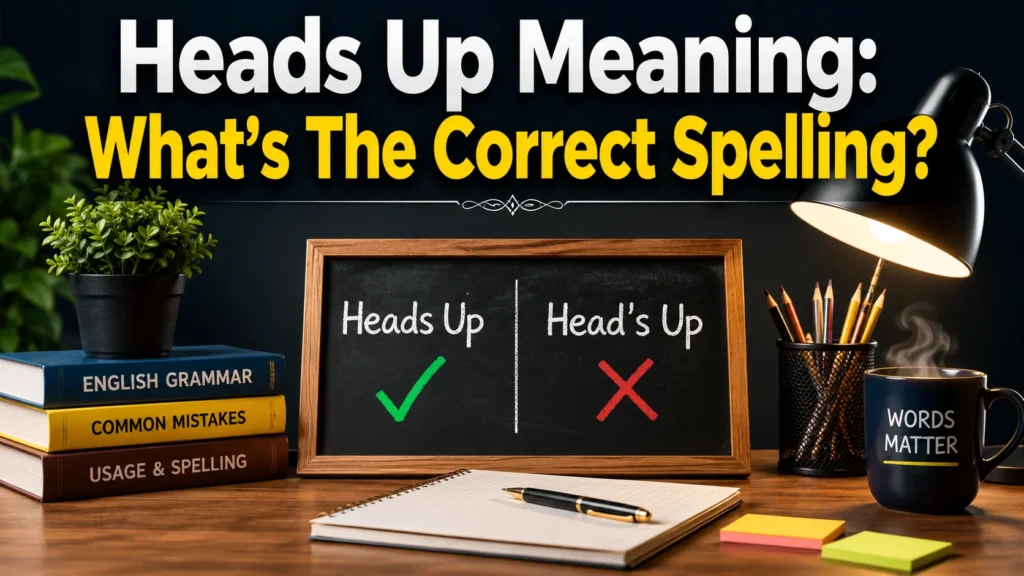
Mistake 1: Writing “Head’s Up”
A common spelling mistake is adding an apostrophe:
❌ Head’s up
✅ Heads up
The correct spelling is usually heads up.
The phrase does not mean something belongs to a single head. The word heads refers to people keeping their heads alert.
Mistake 2: Using “Heads Up” for Serious Situations
The phrase has a friendly tone, so it may not fit very serious situations.
For example:
Less appropriate:
“Heads up, there was a major security breach.”
A stronger phrase may be better:
“Important notice: There has been a security breach.”
The seriousness of the event should match the seriousness of the language.
Mistake 3: Thinking It Always Means Danger
Some people assume heads up only means “watch out.”
That is outdated.
Modern English uses it for many types of information.
Examples:
Danger:
“Heads up, a car is coming.”
Schedule:
“Heads up, tomorrow’s meeting starts earlier.”
Information:
“Heads up, the new menu is available online.”
The phrase has expanded beyond physical warnings.
Real-Life Examples of “Heads Up” in Different Contexts
Understanding examples is one of the fastest ways to learn how native speakers use expressions.
Examples at Work
Project Updates
“Heads up, the customer requested additional features.”
Meaning:
The team should prepare for extra work.
Schedule Changes
“Just a heads up, our meeting moved to Thursday.”
Meaning:
The original plan changed.
Team Communication
“Heads up, I finished reviewing the document.”
Meaning:
I am informing you that something is complete.
Examples Between Friends
Making Plans
“Heads up, I might be a little late tonight.”
Meaning:
Do not expect me exactly on time.
Sharing Helpful Information
“Heads up, your favorite coffee shop opened a new location.”
Meaning:
I thought you would appreciate knowing this.
Examples in Customer Service
Businesses often use the phrase to create a friendly relationship.
Example:
“Just a heads up, your order may arrive one day later because of weather.”
This sounds more personal than:
“Your order is delayed.”
The information is identical, but the first message feels more considerate.
Why “Heads Up” Is Effective Communication
The popularity of heads up comes from a simple human need: people want time to adjust.
Unexpected changes create stress.
Advance information creates control.
Consider these two situations:
Situation One: No Notice
A manager changes a deadline without telling the team.
Employees discover the change at the last moment.
Possible results:
- Confusion
- Rushed work
- Frustration
Situation Two: A Heads Up
The manager says:
“Heads up, the deadline may move forward by two days.”
The team has time to prepare.
Possible results:
- Better planning
- Fewer mistakes
- Clear expectations
A short phrase can improve communication because it respects another person’s time.
“Heads Up” in American English
The phrase is especially common in American English.
You will hear it frequently in:
- Offices
- Schools
- Sports
- Restaurants
- Family conversations
- Online communities
Americans often use casual expressions like heads up because they make communication feel more cooperative.
For example:
Instead of:
“You need to update the file.”
Someone might say:
“Heads up, the file needs an update before Friday.”
The second version feels less like a command and more like teamwork.
How Native Speakers Naturally Use “Heads Up”
Native speakers usually use heads up in one of three ways:
1. Before Sharing Important Information
Example:
“Heads up, I have some news about the project.”
Purpose:
Prepare the listener.
2. Before a Possible Problem
Example:
“Heads up, parking is difficult around this area.”
Purpose:
Help someone avoid trouble.
3. Before a Change
Example:
“Just a heads up, the office hours are changing next month.”
Purpose:
Allow adjustment.
Quick Reference Guide: Heads Up Meaning and Usage
| Question | Answer |
| What does heads up mean? | A warning, notice, or advance information |
| Is heads up formal? | No, it is mostly informal |
| Can you use heads up at work? | Yes, especially in casual workplace communication |
| Is heads up polite? | Usually yes |
| What does give me a heads up mean? | Tell me beforehand |
| What is a synonym for heads up? | Notice, alert, warning, update |
FAQs
1. What does “Heads Up” mean?
Heads up is an informal English expression used to warn, alert, or inform someone in advance about something important. It gives people time to prepare for a situation. For example, “Just a heads up, the meeting starts 30 minutes earlier today.”
2. What is the correct spelling: “Heads Up” or “Heads-Up”?
Both spellings are correct, but they are used differently:
- Heads up (two words) is the standard expression used as a phrase.
- Heads-up (hyphenated) is used as an adjective before a noun, such as “a heads-up message” or “a heads-up warning.”
3. Is “Heads Up” formal or informal?
Heads up is generally considered informal and is commonly used in conversations, emails, text messages, and workplace communication. In very formal writing, alternatives like advance notice, warning, or notification may be more appropriate.
4. How do you use “Heads Up” in a sentence?
Here are a few common examples:
- Just a heads up, the store closes early today.
- Thanks for the heads up about the traffic.
- I wanted to give you a heads-up before we announced the changes.
5. What are some synonyms for “Heads Up”?
Depending on the context, you can use words and phrases such as:
- Warning
- Alert
- Advance notice
- Notification
- Reminder
- Forewarning
- Tip
- Caution
These alternatives can help you choose the most suitable expression for formal or informal communication.
Conclusion
The phrase “heads up” may contain only two words, but it plays an important role in everyday communication.
The heads up meaning is simple: to give someone advance notice, a warning, or useful information before something happens.
People use it because it is quick, friendly, and practical.
Whether you are talking with coworkers, texting friends, or making plans with family, a simple “heads up” can prevent confusion and help people prepare.
When you need to share information before it becomes a surprise, this phrase is one of the most natural choices in modern English.