
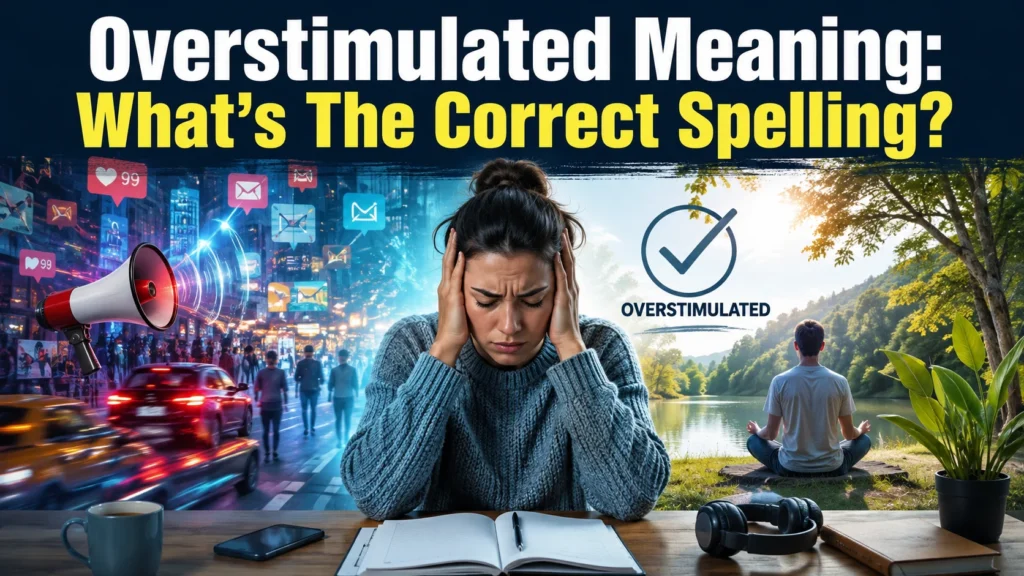

Have you ever walked into a crowded store, heard music blasting from every corner, felt your phone buzzing nonstop, and suddenly wanted to leave?
Or maybe you’ve spent an entire day jumping between emails, meetings, social media, and family responsibilities until even a simple question felt overwhelming.
If that sounds familiar, you may have been overstimulated.
The term has become increasingly common in conversations about mental health, parenting, ADHD, autism, and modern life. Yet many people still wonder what it actually means. Is overstimulation simply another word for stress? Is it the same as anxiety? Can anyone experience it, or does it only affect certain people?
What Does Overstimulated Mean?
Being overstimulated means your brain has reached its limit for processing incoming information. That information may come from your surroundings, your emotions, your thoughts, or several sources at the same time.
Imagine trying to hold a conversation while:
- Music plays loudly.
- Multiple people speak at once.
- Bright lights flash overhead.
- Your phone vibrates every few seconds.
- You’re worried about tomorrow’s deadline.
Each stimulus demands attention. Eventually, your brain struggles to filter what’s important from what’s not.
Rather than processing everything smoothly, your nervous system begins reacting as though it’s under pressure.
In simple terms:
Overstimulated means your brain and nervous system are receiving more input than they can comfortably handle at that moment.
This doesn’t necessarily indicate a medical condition. It’s a normal human response when demands exceed your current capacity.
Healthy Stimulation vs. Overstimulation
Not all stimulation is harmful. In fact, humans need stimulation to stay engaged, learn new skills, and remain mentally active.
| Healthy Stimulation | Overstimulation |
| Keeps you alert | Leaves you mentally exhausted |
| Improves learning | Reduces concentration |
| Feels motivating | Feels overwhelming |
| Supports creativity | Causes mental blocks |
| Encourages productivity | Leads to mistakes and frustration |
Think of stimulation like sunlight.
A little sunlight helps plants grow. Too much sunlight without water causes them to wilt.
Your brain works similarly.
How the Brain and Nervous System Respond
Your brain constantly filters enormous amounts of information.
Researchers estimate that your senses receive millions of bits of information every second. Fortunately, your brain ignores most of it automatically.
For example, while reading this article, you’re probably ignoring:
- The feeling of your shirt against your skin
- Background sounds
- The temperature of the room
- The weight of your phone or laptop
- Countless visual details around you
This filtering process allows you to focus.
However, when sensory information arrives faster than your brain can organize it, that filter becomes less effective.
Several parts of the brain become involved.
The Prefrontal Cortex
This area helps with:
- Decision-making
- Planning
- Concentration
- Self-control
- Problem-solving
When overstimulation occurs, the prefrontal cortex becomes less efficient. That’s why simple decisions suddenly feel difficult.
The Amygdala
The amygdala detects threats.
Although loud noises or crowded rooms aren’t dangerous in themselves, excessive stimulation can make the amygdala react as though something is wrong.
That reaction increases alertness and emotional intensity.
The Autonomic Nervous System
Your autonomic nervous system controls automatic body functions like:
- Heart rate
- Breathing
- Sweating
- Digestion
When overstimulation builds, the sympathetic nervous system—often called the fight-or-flight response—can become more active.
Common physical changes include:
- Faster heartbeat
- Muscle tension
- Rapid breathing
- Increased sweating
- Heightened awareness
These responses evolved to protect humans from danger. Modern life, however, often activates them because of constant information rather than physical threats.
Overstimulated vs. Overwhelmed
People often use these words interchangeably, but they describe different experiences.
| Overstimulated | Overwhelmed |
| Caused by too much sensory or mental input | Caused by too many responsibilities or demands |
| Often triggered by noise, crowds, lights, or multitasking | Often triggered by deadlines, finances, work, or relationships |
| Can happen quickly | Usually builds gradually |
| Relief often comes from reducing stimulation | Relief usually comes from reducing responsibilities |
For example:
Overstimulated
You’re at a birthday party where children are shouting, music is playing loudly, several conversations happen at once, and bright decorations cover every wall. After twenty minutes, you want complete silence.
Overwhelmed
You have:
- Three work projects
- Household chores
- Bills due tomorrow
- A sick family member
- Multiple appointments
Nothing around you is especially loud, yet your mental workload feels impossible.
Sometimes these experiences overlap. Someone may feel overwhelmed by responsibilities and overstimulated by the environment at the same time.
What Does Being Overstimulated Feel Like?
Overstimulation affects far more than your senses.
It often changes how you think, feel, and behave.
Emotional Symptoms
Many people notice emotional changes before physical ones.
Common emotional symptoms include:
- Irritability
- Anxiety
- Feeling “on edge”
- Sudden frustration
- Mood swings
- Emotional exhaustion
- Feeling trapped
- Increased sensitivity
A small inconvenience that normally wouldn’t matter may suddenly feel enormous.
For example, someone asking a simple question after a stressful day might trigger unexpected irritation—not because of the question itself, but because the brain has already reached its limit.
Physical Symptoms
Your body often signals overstimulation before your mind fully recognizes it.
Common physical symptoms include:
- Headaches
- Tight shoulders
- Jaw clenching
- Racing heartbeat
- Dry mouth
- Upset stomach
- Fatigue
- Restlessness
- Difficulty sitting still
- Sensitivity to bright light
- Sensitivity to loud sounds
- Increased startle response
Some people also experience trembling or feel unusually warm because stress hormones temporarily increase.
Also Read This: MYF Meaning in Text: What Does MYF Really Mean in Chats?
Mental Symptoms
As cognitive resources become depleted, thinking clearly becomes harder.
People frequently report:
- Brain fog
- Forgetfulness
- Racing thoughts
- Difficulty concentrating
- Reduced patience
- Slower decision-making
- Trouble following conversations
- Difficulty completing tasks
It’s similar to opening dozens of browser tabs on a computer.
Eventually, everything slows down.
Behavioral Signs
Behavior often changes in predictable ways.
Someone who is overstimulated might:
- Leave a crowded room early.
- Put on headphones.
- Turn off lights.
- Ask for quiet.
- Avoid conversation.
- Cry unexpectedly.
- Snap at loved ones.
- Withdraw socially.
- Scroll aimlessly without focusing.
- Seek complete solitude.
These behaviors aren’t signs of weakness.
Instead, they’re often attempts to reduce incoming stimulation.
Common Causes of Overstimulation
Overstimulation rarely has a single cause.
Instead, multiple forms of input accumulate until the nervous system reaches capacity.
Understanding these triggers helps people recognize patterns before symptoms become severe.
Sensory Overload
One of the most common causes involves the senses.
Examples include:
- Loud concerts
- Construction noise
- Busy shopping malls
- Bright fluorescent lighting
- Flashing screens
- Strong perfumes
- Crowded public transportation
- Constant background conversations
Each stimulus competes for attention.
Individually they may seem harmless. Together, they can become exhausting.
Digital Overload
Modern technology has dramatically increased daily stimulation.
Consider how many times the average person shifts attention during a typical day:
- Email notifications
- Text messages
- Social media alerts
- Breaking news
- Streaming videos
- Video meetings
- Calendar reminders
- Smartwatch vibrations
Every interruption forces the brain to refocus.
Psychologists call this attention switching, and it consumes mental energy.
Even brief interruptions can reduce concentration and increase mental fatigue.
Emotional Stress
Not all stimulation comes through the senses.
Strong emotions also require processing.
Examples include:
- Relationship conflict
- Financial uncertainty
- Workplace pressure
- Caring for aging parents
- Parenting challenges
- Academic demands
- Major life transitions
Emotional processing uses many of the same cognitive resources needed for concentration and decision-making.
When emotional demands remain high, tolerance for additional stimulation often decreases.
Lack of Sleep
Sleep allows the brain to recover from the day’s experiences.
Without enough sleep:
- Emotional regulation becomes harder.
- Attention declines.
- Sensory sensitivity increases.
- Patience decreases.
- Stress hormones remain elevated.
Someone who slept four hours may find ordinary office noise unbearable, while the same environment feels perfectly manageable after a full night’s rest.
Busy Environments
Some locations naturally bombard the senses.
Examples include:
- Airports
- Theme parks
- Music festivals
- Sporting events
- Shopping centers
- Open-plan offices
- Large conferences
These settings combine:
- Noise
- Movement
- Bright lighting
- Crowds
- Constant decision-making
Even people who enjoy these environments often feel drained afterward.
Parenting and Family Life
Parents, particularly those caring for infants or toddlers, frequently describe feeling overstimulated.
A typical morning might include:
- A crying baby
- Breakfast preparation
- Toys scattered across the floor
- Television noise
- Multiple questions from children
- Time pressure
- Household chores
Each task requires attention.
As interruptions continue throughout the day, opportunities for mental recovery become scarce.
Many parents report that they don’t simply feel tired—they feel as though their brains never get a chance to “switch off.”
FAQs
What does overstimulation mean?
Being overstimulated means your brain and nervous system are processing more sensory, emotional, or mental input than they can comfortably handle. This can happen after exposure to loud noises, bright lights, crowded places, constant digital notifications, or prolonged stress. As a result, you may feel mentally drained, emotionally reactive, or physically tense until your brain has time to recover.
Is overstimulation the same as anxiety?
No. Although they share some symptoms, they aren’t the same. Overstimulation occurs when too much input overwhelms your brain’s ability to process information. Anxiety, on the other hand, is a mental health condition or emotional response characterized by excessive worry, fear, or anticipation of future events. However, overstimulation can trigger anxiety in some people, and anxiety can make someone more sensitive to sensory input.
What are the most common signs of being overstimulated?
Common signs include:
- Feeling irritable or unusually emotional
- Difficulty concentrating or making decisions
- Headaches or muscle tension
- Sensitivity to noise, light, or touch
- Wanting to leave busy or crowded environments
- Feeling mentally exhausted after social interactions
- Racing thoughts or brain fog
- Snapping at others over minor issues
Recognizing these signs early can help you take a break before the symptoms become more intense.
How can I calm down when I’m overstimulated?
The quickest way to recover is to reduce the amount of incoming stimulation. Helpful strategies include:
- Move to a quiet, low-distraction environment.
- Silence unnecessary notifications.
- Practice slow, controlled breathing for several minutes.
- Dim bright lights or wear sunglasses if needed.
- Stay hydrated and eat a balanced snack if you haven’t eaten recently.
- Take a short walk or do gentle stretching.
- Give yourself permission to rest instead of pushing through exhaustion.
Recovery time varies from person to person. Some people feel better within minutes, while others may need several hours of quiet and rest.
When should I seek professional help for overstimulation?
Occasional overstimulation is a normal part of life. However, consider speaking with a healthcare professional if:
- Symptoms happen frequently or become more severe.
- They interfere with work, school, or relationships.
- You experience regular panic attacks or intense anxiety.
- Sensory sensitivity significantly limits your daily activities.
- Rest and lifestyle changes no longer provide relief.
A medical or mental health professional can determine whether another condition, such as an anxiety disorder, ADHD, autism spectrum disorder, migraines, or another health issue, may be contributing to your symptoms.
Conclusion
Understanding the overstimulated meaning goes beyond recognizing that life sometimes feels busy. It describes a state where your brain and nervous system receive more sensory, emotional, or mental input than they can comfortably process. Whether it’s constant notifications, a crowded environment, lack of sleep, or ongoing stress, too much stimulation can leave you feeling exhausted, distracted, and emotionally drained.
The good news is that overstimulation is often manageable. Learning to identify your personal triggers, taking regular breaks, creating quieter environments, improving your sleep habits, and setting healthy boundaries with technology can make a significant difference. Small, consistent changes often prevent sensory overload before it reaches a breaking point.
Most importantly, remember that everyone has different limits. What feels energizing to one person may feel overwhelming to another. Paying attention to how your mind and body respond allows you to recover more quickly and protect your overall well-being.