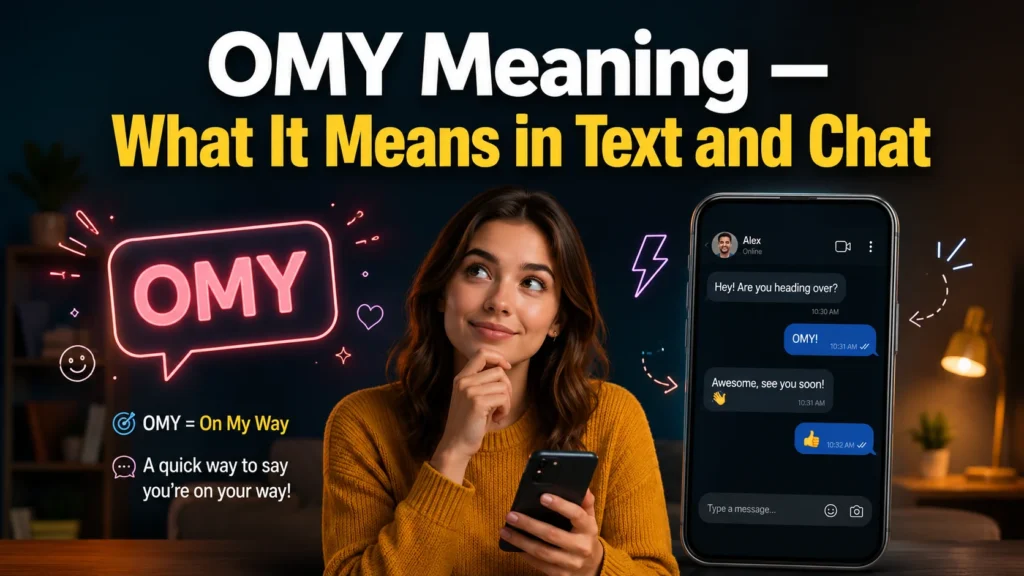

Short version: OMY most often stands for “Oh My” or “Oh Myyy” in casual texts and chats. It’s a flexible little acronym that signals surprise, delight, disbelief, or playful exaggeration. In this deep guide you’ll learn the exact meanings, how it evolved, when to use it, how to reply, and how it compares with similar acronyms like OMG and OMFG.
You scroll through your messages and see OMY. You pause. What does it mean here? Is it serious? Is it a typo? Does it need a response? Internet shorthand can feel like a secret language when you don’t know the code.
This article gives you a clear, no-fluff breakdown of OMY meaning in text and chat. You’ll get real examples, quick rules for replying, and a comparison table that shows how OMY differs from other acronyms. By the end, you’ll be confident reading and using OMY in the right tone and context.
What Does OMY Stand For?
Primary meaning: OMY = “Oh My.”
People use OMY as a compact way to express surprise, mild shock, delight, or playful emphasis. Often it’s the tone, punctuation, or extra letters that define how strong the reaction is.
Common variations and nuances
- OMY — neutral-to-playful surprise.
- OMYYY / OMYyy — elongated, extra emphasis, often playful or flirty.
- o my — stylized, spaced for dramatic effect.
- OMY GOD? — sometimes used conflated with OMG in casual typing but technically “oh my” remains the core.
Example uses
- “OMY that cake looks amazing” — surprised delight.
- “OMY you did not just say that” — disbelief, possibly playful.
- “omyy stoppp” — flirty or exaggerated reaction in a chat.
Why “Oh My” and not something else? Because many short internet acronyms reduce common speech to first letters or compact syllables. OMY preserves the sound of “oh my” while saving keystrokes.
Origins of OMY
Where it likely came from
- Spoken phrase → typed shorthand. People have said “oh my” for ages. As texting and instant chat grew, folks shortened common phrases for speed. OMY likely arose naturally in casual DMs and comment threads.
- Platform spread. Microchats like Twitter, Instagram comments, Snapchat, and group chats onboarded it early because short reactions suit limited character spaces and fast conversation.
Why the origin matters
Understanding that OMY evolved from normal speech helps you read tone. It’s not a formal acronym with institutional roots. It’s conversational shorthand. That means context defines the meaning more than any dictionary entry.
How and When People Use OMY
People use OMY across platforms. The tone shifts with the setting and surrounding words. Below we break down the main contexts and the tone you can expect.
Contexts and typical platforms
- Text messages (SMS / iMessage) — quick reactions to friends and family. Casual, often paired with emojis.
- Instagram comments — reactionary shorthand for posts, especially photos and reels. Often playful.
- Twitter/X replies — fast reaction or mild scandalized surprise.
- Snapchat / TikTok DMs — exaggerated forms like OMYYY appear frequently.
- Discord / Slack (informal channels) — casual reaction or short reply thread starter when conversation is relaxed.
Tone analysis
- Neutral surprise: “OMY that’s neat.”
- Excited celebration: “OMY congrats!!!” (paired with emojis).
- Sarcastic disbelief: “OMY sure Jan” (tone comes from previous message).
- Flirty/Playful: “omyy stop you’re cute” (elongated spelling + emojis).
Quick rule: read the context. Tone depends more on punctuation emojis and preceding lines than the acronym itself.
Examples: real-life-style conversations
Example 1 — Friend group chat (celebration)
- A: “I got the job!”
- B: “OMY congrats!!
- C: “OMY that’s huge. Drinks soon?”
Example 2 — Instagram comment (flirty)
- User: posts beach selfie
- Follower: “omyy the view 👀”
Example 3 — Sarcastic reply on Twitter
- A: “They canceled the show again”
- B: “OMY, shocking”
These examples show how OMY molds itself to tone.
Common Misunderstandings About OMY
People often mistake OMY for other acronyms or read the wrong tone. Here are the frequent errors and how to avoid them.
Mistake 1: Confusing OMY with OMG
- OMG explicitly means “Oh My God”. It tends to be stronger than OMY. When you see OMY, don’t assume extreme outrage or religious connotation.
Mistake 2: Reading it as serious when it’s playful
- OMY is often playful. If someone texts OMY after a joke, they likely mean mild amusement not offense.
Mistake 3: Assuming universal meaning
- Not everyone uses OMY. In some regions or age groups it’s rare. Don’t rely on it as universal shorthand.
How to guess meaning from context
- Check nearby emojis.
- Read punctuation and capitalization.
- Look at the message they replied to.
- If uncertain, ask a short clarifying question like: “OMY — do you mean surprised or joking?”
Similar Acronyms to Know
People use a range of acronyms that look or sound similar. This table helps you compare them at a glance.
| Acronym | Full form | Typical tone | Intensity compared to OMY | Example |
| OMY | Oh My | Mild surprise, playful | Baseline | “OMY that cake looks amazing” |
| OMG | Oh My God | Strong surprise or shock | Higher | “OMG I can’t believe it” |
| OMFG | Oh My F***ing God | Extreme shock or humor | Much higher | “OMFG did that just happen” |
| OML | Oh My Lord (or Life) | Can be dramatic or humorous | Varies | “OML this is messy” |
| OMW | On My Way | Logistics, not emotion | Different use | “OMW, see you in 10” |
Key differences
- Intensity: OMG and OMFG are typically stronger.
- Meaning: OMW is unrelated although visually similar.
- Tone: OMY leans casual and less intense.
Also Read This: LWK Meaning — Hiatus Meaning, Usage, and Alternatives Explained
How to Respond to OMY in Text
Knowing how to reply keeps the conversation smooth. Below are practical responses for different contexts.
Quick response templates
- Surprised/positive context
- “Right?! I can’t wait”
- “I know, right?”
- “Told you!” + emoji
- Playful/flirty context
- “Stop it you” + wink emoji
- “All that for me?” + heart emoji
- Sarcastic/disbelief
- “Yeahhhh sure”
- “Classic”
- “Totally not surprised” (use dry emoji)
- Professional or ambiguous
- Avoid slang. Respond with clarity instead: “That’s surprising. Can you share more details?”
- If you must mirror, keep it minimal: “Oh wow” rather than “OMY”
Emoji and punctuation recommendations
- Pair OMY with emoji to clarify tone.
- comedic surprise.
- slightly shocked.
- delighted or flirty.
- Use capitalization and repetition for emphasis: OMY!!! vs omyy
- Prefer plain words in professional messages to avoid misinterpretation.
Short list: do’s and don’ts
Do
- Read context before replying.
- Match tone with the sender if you know them well.
- Add a clarifying emoji when tone could be ambiguous.
Don’t
- Use OMY in formal or professional emails.
- Assume it signals offense unless the message clearly indicates it.
- Overuse it in a single conversation thread or it loses impact.
Why Understanding Internet Acronyms Matters
Internet acronyms shape meaning. They speed up communication but also create room for misread signals. Here’s why you should care.
Practical reasons
- Clarity: Misreading acronym tone can lead to awkward replies or missed cues.
- Social fluency: Knowing common shorthand makes you feel included in fast chats.
- Avoiding miscommunication: Acronyms can carry cultural or generational weight.
Communication skills you build
- Context reading: You’ll get better at scanning messages for mood.
- Tone matching: You learn to mirror language for smoother interactions.
- Concise replies: Short acronyms teach you to be brief when needed.
Quick tips for staying current
- Keep a mental list of acronyms you see often.
- When you encounter unfamiliar shorthand, search or ask briefly.
- Notice how people you like to chat with use acronyms and adapt.
Case Study — Analyzing OMY in a Viral Comment Thread (Illustrative)
Context: A popular creator posts a behind-the-scenes video. The comment section explodes. Among thousands of replies, several users write OMY while others use OMG and elongated forms like OMYYY.
What happened
- OMY comments clustered under lighthearted behind-the-scenes clips.
- OMG comments dominated over shocking reveals.
- Users who used OMY often added playful emojis like or .
- Replies to OMY comments tended to be short, friendly, and conversational.
Interpretation
- OMY served as a casual, friendly reaction. It signaled engagement rather than outrage.
- Creators replying with short thanks or emojis kept the tone positive and encouraged more comments.
Lesson
- On social platforms, OMY works best when you want to join the playful vibe. If you want to express serious shock, choose OMG or choose words for clarity.
Quotes and Perspectives
“Short forms like OMY let us react fast and keep the vibe light. You learn the tone by where you see it.” — Social chat moderator (illustrative)
“A little punctuation and one emoji can flip the tone of OMY from shocked to affectionate.” — Community manager (illustrative)
These quotes reinforce that context and small signals shape meaning.
Quick Reference Table — Responses Based on Context
| Context | Suggested response | Why it works |
| Friend celebrates good news | “OMY congrats!! ” | Short, excited, supportive |
| Flirty DM | “omyy stop you’re sweet ” | Mirrors tone and signals playfulness |
| Sarcastic tweet | “OMY, sure” | Dry, matches sarcasm |
| Professional Slack | “Wow, that’s surprising. Can you summarize?” | Clarity and professionalism |
| Unsure tone | “Do you mean surprised or joking?” | Prevents misunderstanding |
Practical Exercises to Get Comfortable with OMY
Try these in real life or practice chats to build instinct.
Exercise 1: Tone matching
Scan 10 recent social posts. Note one where someone used OMY. Guess the tone before reading replies. Did your guess match?
Exercise 2: Reply practice
Write three different replies to a hypothetical “OMY you got promoted” message. Try excited, skeptical, and professional styles.
Exercise 3: Emoji pairing
Practice changing tone by swapping emojis while keeping the same text. Notice how meaning shifts.
FAQ:
Is OMY the same as OMG?
No. OMY stands for “Oh My” and tends to be milder. OMG is stronger and explicitly includes “God” which may carry different emotional weight.
Can I use OMY professionally?
Avoid it in formal emails. In casual team channels where you know the culture, it may be fine. When in doubt use full words.
What does OMYYYY mean?
Elongation adds emphasis and playfulness. More Ys usually mean higher excitement or flirtiness.
How should I respond if I don’t know the tone?
Ask a short clarifying question or reply with a neutral phrase like “Wow, really?” Add an emoji only if you’re comfortable.
Is OMY offensive?
Not inherently. Tone or the content of the message could make it feel sharp but the acronym itself is neutral.
Conclusion
OMY meaning in text and chat is simple yet nuanced. At its core OMY = “Oh My” and it acts as a quick, conversational signal of surprise, delight, or playful reaction. The real power of OMY lies in context — emojis, punctuation, and platform shape what it says.
Use OMY when you want a light, friendly reaction. Avoid it in formal or ambiguous situations. With the examples, tables, and practice exercises in this guide you’ll read and reply to OMY like a pro.
Call to action: Try replying to the next message you see that uses OMY. Match tone, add one emoji, and notice how the conversation flows. If you want, paste a message here and I’ll help you craft the perfect response.