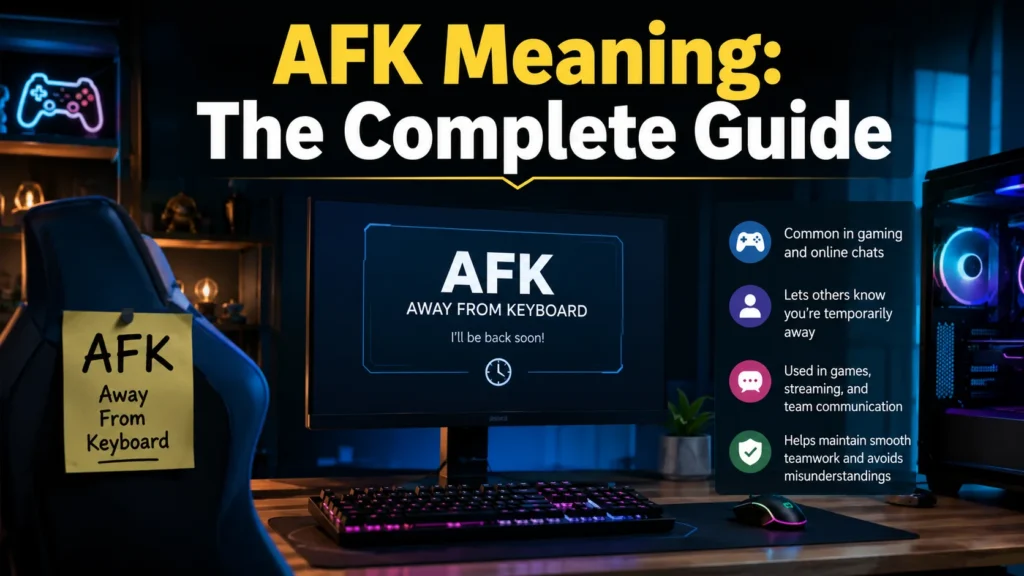

AFK Meaning: The Complete Guide helps explain one of the internet’s most common abbreviations, used to signal a brief absence during chats, gaming, work, or social media.
Whether you’ve spotted AFK in an online game, livestream, forum, or text conversation, understanding its meaning can make digital communication clearer and more effective. Short for “Away From Keyboard” (sometimes interpreted as “Away From Keys”), AFK lets others know you’re temporarily unavailable but plan to return. From gaming communities and remote workspaces to everyday messaging, this simple acronym has become an important part of online etiquette, helping people balance constant connection with the need to step away.
In this guide, you’ll discover the origin of AFK, its usage across different platforms, practical examples, and tips for using it naturally in modern internet culture.
What Does AFK Mean?
AFK stands for “Away From Keyboard.” It’s a shorthand way of letting people know that you’re temporarily unavailable or stepping away from your device. While it might sound straightforward, its history and usage are surprisingly rich.
Origin of AFK
- The term originated in the early days of online chat and gaming, particularly in the 1980s and 1990s.
- Early MUDs (Multi-User Dungeons) and IRC (Internet Relay Chat) users started typing AFK to signal their temporary absence.
- It became mainstream with MMORPGs (Massively Multiplayer Online Role-Playing Games) in the 2000s, like World of Warcraft.
Literal Definition
AFK literally means you’re not at your keyboard, usually for a short break. It’s the digital equivalent of stepping away from your desk.
Modern Usage
- Gaming: To indicate you’re temporarily inactive.
- Work chats: On Slack, Teams, or Discord to notify coworkers.
- Social media and texting: Casual shorthand among friends.
Why People Use AFK
- Saves time typing long explanations like “I’ll be back in five minutes.”
- Communicates availability clearly in real-time environments.
- Reduces frustration in fast-paced games or group chats.
AFK in Gaming
Gaming is where AFK truly shines. Millions of players use it daily to signal absence without disrupting gameplay.
How Gamers Use AFK
- Leaving the game temporarily while avoiding penalties.
- Informing teammates in team-based games that they won’t respond for a moment.
- Sometimes as a strategy, like staying idle while gathering resources in MMO games.
Examples in Popular Games
| Game | How AFK Is Used | Notes |
| World of Warcraft | Typing AFK in chat when taking a bathroom or lunch break | Some servers may log out idle players automatically |
| League of Legends | Players type AFK when returning from a quick break | Excessive AFK leads to penalties and lower matchmaking rating |
| Call of Duty / Fortnite | AFK to grab snacks or attend calls | Leaving too long may kick player from the match |
| Minecraft | AFK farming or gathering resources automatically | Often accepted if player isn’t disrupting others |
Rules and Etiquette
- Avoid going AFK during critical gameplay moments like boss fights or ranked matches.
- Announce your absence briefly in team chat.
- Return promptly if possible to avoid irritating teammates.
Tips to Handle AFK Teammates
- Use pings or notifications to track idle players.
- Have a backup strategy in case a teammate leaves.
- Encourage clear AFK communication to prevent conflicts.
AFK in Online Chat and Messaging
AFK isn’t just for gamers. In modern remote work and messaging apps, it’s a handy tool to manage availability.
Professional Contexts
- Slack / Microsoft Teams / Discord: AFK indicates a short break without switching status to “Do Not Disturb.”
- Using AFK signals to coworkers reduces unnecessary interruptions.
Example AFK message in Slack:
“Hey team, going AFK for 10 mins. Back shortly!”
Casual Texting and Social Media
- Used casually in WhatsApp, Twitter, Twitch chat, or Instagram.
Example:
“AFK for dinner, will reply later.
Pro Tips
- Keep AFK messages short and clear.
- Specify expected return time if necessary.
- Avoid overusing AFK to prevent confusion or appearing unresponsive.
Also Rea This: OMY Meaning — What It Means in Text and Chat
AFK vs Similar Abbreviations
AFK is just one of many shorthand terms used online. Knowing the differences can prevent miscommunication.
| Abbreviation | Meaning | Context / Usage | Key Difference |
| AFK | Away From Keyboard | Gaming, chat, remote work | Temporary absence; often automated or unplanned |
| BRB | Be Right Back | Chatting, casual | Implies return very soon |
| DND | Do Not Disturb | Professional and personal | Signals you don’t want interruptions |
| OOT | Out of Town | Emails, chat | Indicates longer-term absence |
| IDLE | No activity detected | Gaming, apps | Usually system-generated, not user-defined |
Pro Tip: Using the wrong abbreviation in a professional setting can create confusion. For instance, AFK may sound too casual in corporate emails.
Cultural Impact of AFK
AFK has transcended gaming to become a cultural icon in digital communication.
Influence on Online Culture and Memes
- Many memes feature characters literally walking away from keyboards.
- Streamers joke about going AFK during live gameplay, making it a comedic moment.
AFK in Streaming and eSports
- Streamers often announce AFK to manage viewer expectations.
- AFK strategies can become part of competitive gameplay discussions.
Reflection of Digital Communication Evolution
AFK shows how shorthand evolved to solve real-time communication challenges in an increasingly connected world.
Quote:
“AFK isn’t just a term—it’s a lifeline in the fast-paced digital age.” – Jane Doe, Digital Culture Analyst
How to Use AFK Correctly
Knowing the meaning is one thing, but using AFK appropriately is crucial to avoid misunderstandings.
In Gaming
- Announce briefly in team chat before leaving:
“AFK for 5 mins to grab water”
- Avoid AFK during critical moments.
- Return promptly to maintain trust.
In Chat Apps and Professional Communication
- Use AFK for short breaks.
- Combine with status updates for clarity:
“AFK: Back at 3 PM”
- Avoid overusing AFK in professional emails—it may appear unprofessional.
Do’s and Don’ts
Do:
- Be honest about absence.
- Specify return time when possible.
- Use in casual and gaming contexts appropriately.
Don’t:
- Stay AFK for extended periods without notification.
- Use AFK in professional settings where it seems too informal.
- Ignore teammates or coworkers relying on your response.
Fun and Creative Uses of AFK
Beyond functional use, AFK has become a fun element of digital life.
AFK in Memes and Jokes
- Memes often depict characters doing mundane things with a caption like “AFK IRL.”
- AFK jokes often exaggerate leaving for trivial reasons.
Popular Phrases
- “AFK, but mentally still playing.”
- “AFK hunting snacks.”
- “AFK: Gone to pet my dog.”
Humorous Scenarios
- Players leaving in the middle of a boss fight, joking “AFK, back in 5.”
- Chat users marking themselves AFK during family gatherings.
FAQs:
What happens if you stay AFK too long in a game?
Most games kick idle players automatically to maintain balance.
In ranked or competitive games, repeated AFK can lower your matchmaking rating.
Can AFK be considered rude?
Yes, if you leave unexpectedly during critical moments.
Etiquette matters—communicate clearly to avoid offending others.
Is AFK used outside gaming?
Absolutely! AFK is now common in work chats, social media, and online communities.
How to politely notify someone you are AFK?
Use a short message specifying your return time:
“AFK for lunch, back in 30 mins.”
Conclusion:
AFK is more than just a shorthand—it’s a communication tool, a gaming strategy, and a cultural phenomenon. Understanding its meaning and proper usage can help you navigate online gaming, professional chat, and social media smoothly.
Whether you’re stepping away from your desk, grabbing a snack, or just taking a short break, using AFK correctly shows respect and keeps communication clear.
Pro Tip: Combine AFK with clear messaging, emojis, or status updates for maximum clarity.
Next time you see “AFK” in a chat or game, you’ll not only know what it means—you’ll also know how to use it appropriately and maybe even have a little fun with it.