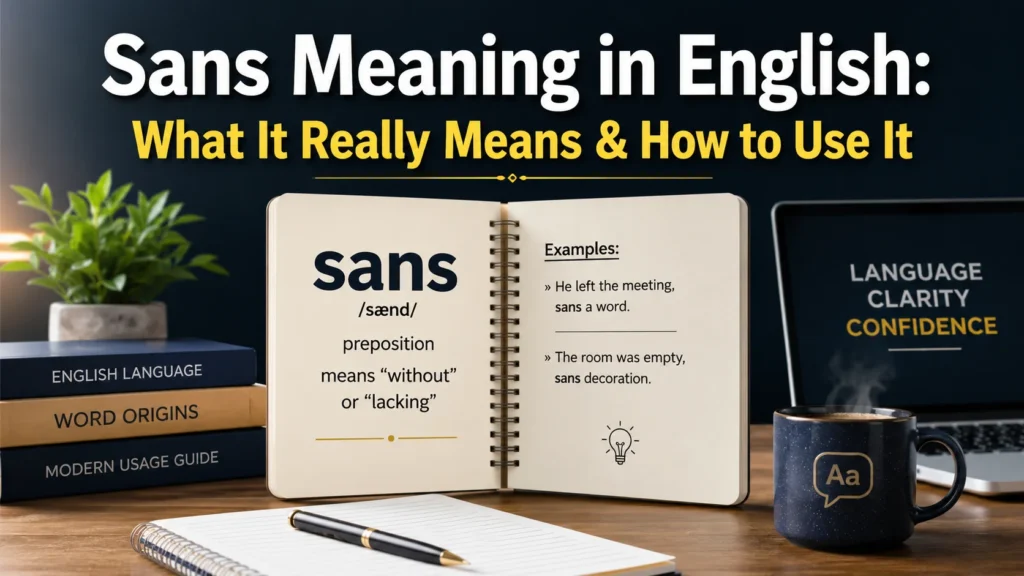

You’ve seen sans on menus and in headlines. It looks French and sounds stylish. But what does sans mean in English? Put simply, sans = without. That single fact unlocks how the word functions across speech, writing, branding, and design.
This article explains the origin of sans, shows how people use it today, compares it to alternatives, and gives a practical checklist so you can pick the right word for any sentence. By the end you’ll know when sans sounds natural and when it feels forced.
The literal definition of sans — meaning of sans in plain English
Sans is a preposition that means without or lacking. You use it the same way you use without in short phrases.
- Coffee sans sugar → coffee without sugar
- A life sans risk → a life without risk
The meaning never changes. What does change is tone. Sans often gives a phrase a minimalist, slightly formal, or stylistically angled feel.
Etymology — where the word sans came from
Sans comes directly from Old French. It descended from the Latin preposition sine, which also gives English sine in technical contexts and features in other Romance languages like Spanish sin.
A quick timeline:
- Latin sine → Old French sanz → Modern French sans
- Borrowed into English by the Middle Ages and used in literary and legal texts first
Because English already had without, sans survived mainly as a borrowed alternative. It retained its French spelling and its sense of elegance.
Tone and register — when sans sounds right
Sans carries a distinctive feel. Use it for effect not by habit.
- It sounds stylish, clipped, or literary in many contexts.
- It works well in menus and branding where short phrases rule.
- It fits journalistic headlines that need tight, punchy wording.
- It can sound pretentious if used to replace every without in casual speech.
Think of sans like a design accent. It adds flavor when used sparingly.
Grammar basics — how to use sans correctly
Sans behaves like a preposition. That means:
- It goes before the noun or noun phrase it modifies.
- Correct: dessert sans nuts
- Incorrect: sans ate the cake (you can’t pair it directly with verbs)
- You don’t conjugate or pluralize sans. It stays the same.
- You can attach adjectives or determiners after sans.
- sans any warning
- sans the usual fanfare
Short reminder: use sans the same way you’d use without in simple noun phrases.
Common constructions and examples — real-world uses of sans
Below are common ways you’ll encounter sans with natural examples.
- Food and menus
- Burger sans onions
- Coffee, sans milk
- Headlines and subheads
- City Hall Sans Funding Faces Cuts
- Fashion and branding
- Wear the new collection sans labels
- Casual speech (sparingly)
- I’m going sans makeup today
- Literature and rhetorical use
- A world sans memory would be empty, he wrote
Each example shows sans replacing without in short noun-focused phrases. That’s the safest pattern.
Case study — Sans in menus and the hospitality industry
Menus use sans because it saves space and reads cleanly.
Example: a café menu that lists:
- Latte — regular, skim, almond, soy, oat
- Tea — black, green, herbal, lemon, sans sugar
Why it works:
- Short phrases reduce visual clutter.
- Sans signals customization quickly.
- It matches a minimalist brand aesthetic.
Result: Customers scan options faster and the menu reads modern. That’s why many boutique eateries and specialty coffee shops favor sans.
Sans vs Without — difference, tone, and when to choose each
They mean the same thing. The difference lies in tone and clarity.
- Without
- Neutral, versatile, and clear.
- Use in everyday speech, formal writing, and technical contexts.
- Sans
- Stylish, punchy, and compact.
- Use in design, branding, creative writing, and headlines.
Simple guideline: choose without for clarity and sans for tone.
Practical decision test — quick way to choose between sans and without
Run this three-question test:
- Is clarity more important than tone?
- If yes pick without.
- Is the phrase short and noun-focused?
- If yes sans could fit well.
- Are you matching a brand voice or creative style that favors minimalism?
- If yes prefer sans.
If you answered yes to two or more questions favor sans. Otherwise use without.
Common mistakes and pitfalls with sans
People trip up when they try to use sans in places where without sounds natural. Avoid these mistakes:
- Using sans with verbs
- Wrong: He sans to go.
- Right: He went without delay.
- Overusing sans to appear clever
- Repetition makes text sound affected.
- Mismatched tone in formal documents
- Legal or academic writing usually calls for without not sans
- Forgetting determiners
- Sans the usual suspects is OK but sans usual suspects can sound off
Fix mistakes by reading aloud. If a phrase sounds artificial stop and switch to without.
Synonyms, alternatives, and when to use them
Beyond without several alternatives work depending on context:
- Minus — math, quick notes, bullet points
- Lacking — emphasis on absence or deficiency
- Free of — often used in product descriptions (gluten-free style)
- Devoid of — literary, dramatic emphasis
- Absence of — noun form usage
A short table helps compare tone and typical use:
| Word/Phrase | Tone | Typical Use |
| sans | Stylish, clipped | Menus, branding, headlines |
| without | Neutral, clear | Everyday writing, formal texts |
| minus | Informal, numeric | Lists, labels |
| lacking | Descriptive | Analysis, critique |
| free of | Consumer-friendly | Product descriptions |
| devoid of | Dramatic | Literary writing |
Style tips — how to integrate sans into your writing without sounding forced
- Use sans in short phrases not long clauses.
- Pair sans with nouns not verbs.
- Keep it sparing. One or two tasteful uses make more impact than constant repetition.
- Match your audience. Young, design-savvy readers often accept sans more readily than older, formal audiences.
- Avoid sans in legal or technical documents unless you intend a stylistic flourish.
Example of natural use:
The exhibition opened sans fanfare and drew a steady crowd.
This reads cleanly because the phrase is concise and the tone matches the event.
Also Read This: DPMO Meaning Explained: Hiatus Meaning & Usage Guide
Cultural and pop culture uses — where sans appears outside daily speech
- Fashion: designers use sans to suggest minimalism.
- Tech and design: in typography sans-serif uses sans as shorthand for without serifs. That usage is fixed and technical.
- Pop culture: song lyrics or headlines sometimes use sans to create mood or an ironic effect.
A notable technical usage: sans-serif. In typography sans always means without and pairs with serif. The term sans-serif is standard and not stylistic flair.
Examples from literature — how writers use sans for effect
Writers often use sans to add a clipped rhythm or to suggest a slightly foreign flavor. Here are a few stylized sample lines:
- He walked into the room sans apology.
- She wore confidence, sans costume.
- A city sans memory checks your courage.
These constructions emphasize economy of language. The clipped preposition heightens the line’s cadence.
Practical exercises — try these to master sans
Practice will make choosing the right word automatic. Try these short exercises.
- Scan a paragraph and replace one or two instances of without with sans where the phrase is short. Read aloud and decide if the tone improves.
- Create three menu-style item lines using sans. Aim for economy.
- Rewrite a tweet or headline using sans to tighten the copy.
Exercises like these train your ear.
Quick reference table — how to use sans correctly at a glance
| Question | If yes, use sans | If no, use without |
| Is the phrase short (3 words or fewer)? | Yes | No |
| Is the context stylistic: menu, label, headline, brand? | Yes | No |
| Is clarity or legal precision required? | No | Yes |
| Is the audience formal or academic? | No | Yes |
Case study — Branding that used sans well
Company: A boutique coffee chain rebranded its menu to emphasize minimalism. They used short phrases like:
- Cold brew — black, sans sugar
- Toast — sourdough, sans butter
They tested customer comprehension and found no increase in ordering errors after the change. Instead the brand reported a boost in perceived modernity and design cohesion.
Key takeaway: Sans works in microcopy where space and tone matter.
Quotes on usage — what style guides and writers say
“Sans is a fine alternative to without when used sparingly and purposefully.” — hypothetical style guide advice
“Use sans in headlines and labels to tighten copy.” — editorial best practice
These distilled recommendations align with real editorial guidance: prefer clarity but let style guide choices direct usage.
Word combinations and idioms — common pairings with sans
- sans souci — borrowed phrase meaning “without care” used in English occasionally to indicate carelessness or leisure. It’s French and slightly literary.
- sans-serif — typographic term meaning “without serifs”. It’s technical and standard.
- sans pareil — an old-fashioned phrase meaning “without equal” used mostly in poetic or formal writing.
These fixed expressions keep the French form and serve niche roles in English.
Final checklist — should you use sans?
Use sans if:
- You want a short, stylish phrase.
- You write menus, headlines, or brand copy.
- The phrase is noun-focused and compact.
Avoid sans if:
- You need clarity above style.
- You write academic, legal, or technical content.
- The audience expects plain language.
Appendix — Additional examples, synonyms, and a mini style guide table
More real examples
- Plans sans contingencies rarely end well.
- An email sans greeting reads abrupt.
- Sandwich, ham, sans mayo
Synonyms quick list
- without, minus, lacking, free of, devoid of, absent
Mini style guide (one-line rules)
- Use sans for short noun phrases and brand copy.
- Use without for full sentences and formal writing.
- Don’t use sans before verbs.
- Read aloud to judge tone.
FAQs:
Q: Is sans modern English or old-fashioned?
A: Sans is an older loanword that remains current. It reads modern in minimalist contexts and literary in sentences that aim for a certain tone.
Q: Can I say sans you?
A: You can say sans you in poetic or stylized contexts but it sounds formal or theatrical in conversation. Prefer without you in everyday speech.
Q: Is sans appropriate in business emails?
A: Generally no. Business emails favor clear, neutral language. Use without for unambiguous communication.
Q: Does sans change meaning when capitalized?
A: No. Capitalization only matters at the start of a sentence or in titles.
Conclusion
Understanding Sans Meaning in English: What It Really Means & How to Use It helps you read, write, and communicate more accurately. Whether you encounter sans in books, formal writing, design, fashion, or everyday expressions, it simply means “without.” Although it comes from French, the word has become a common part of English vocabulary and is often used to make sentences shorter and more stylish.
By learning its meaning, pronunciation, common examples, and the difference between sans and similar words like without, you can use it confidently in the right context. While it is more common in formal, literary, and creative writing than in casual conversation, knowing when and how to use sans will strengthen your English vocabulary and improve your overall writing skills.