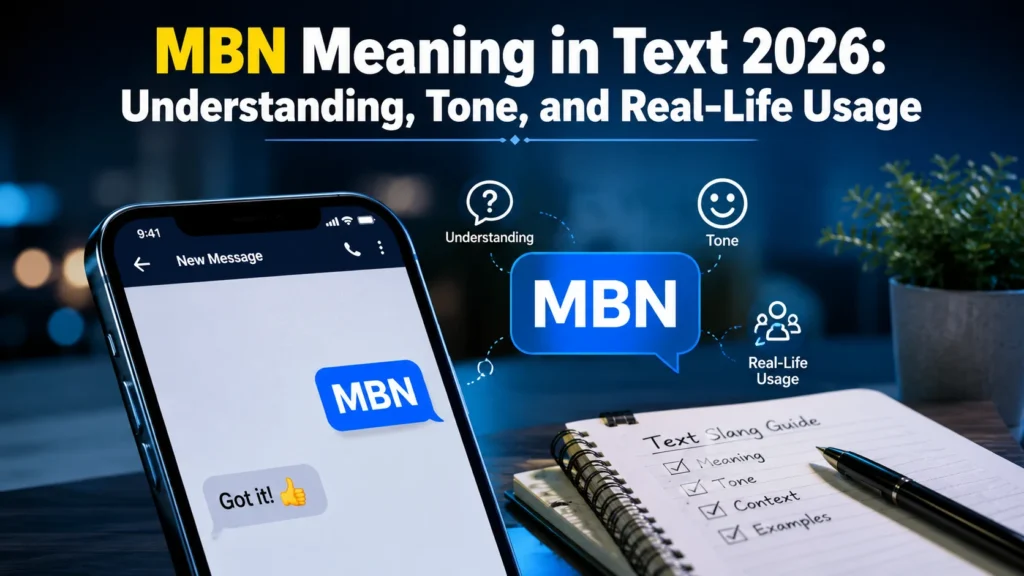

Texting slang changes fast. What feels everywhere today can vanish tomorrow. Yet some abbreviations stick around because they fill a real gap in how people talk online. MBN is one of those terms.
You’ve probably seen it dropped into a group chat, tossed into an Instagram comment, or slipped into a DM right after someone shares good news. At first glance, it looks simple. Three letters. Short. Casual. But like most modern slang, MBN meaning in text depends heavily on context, tone, and timing.
This guide breaks it all down in plain English. You’ll learn what MBN actually means, how people use it in 2026, when it sounds friendly, when it sounds shady, and how to respond without making things awkward.
Let’s get into it.
What Does MBN Mean in Text?
MBN most commonly stands for “Must Be Nice.”
On its own, that phrase sounds harmless. Even polite. But in texting and online conversations, MBN meaning in text can shift quickly depending on how it’s used.
At its core, MBN expresses envy, admiration, or commentary on someone else’s good situation. The speaker notices that something good happened to someone else and reacts to it.
That reaction can be:
- Playful
- Genuinely happy
- Lightly jealous
- Dry
- Sarcastic
- Passive-aggressive
The words stay the same. The meaning doesn’t.
That’s why understanding tone matters more than memorizing a definition.
The Core Meaning of MBN (Must Be Nice)
In everyday conversation, “must be nice” usually means:
“That sounds enjoyable.”
“I wish I had that.”
“Good for you.”
In text form, MBN compresses all of that into three letters. It’s quick. It’s casual. It fits perfectly into fast-moving digital conversations.
Here’s the key idea:
MBN reflects comparison.
Someone else has something good. The speaker notices the gap.
Sometimes that gap feels lighthearted. Other times, it stings.
The Origin of MBN in Digital Language
The phrase “must be nice” existed long before texting. People used it sarcastically or sincerely in spoken English for decades.
The abbreviated form MBN started appearing in:
- Early internet chat rooms
- Online forums
- SMS texting when character limits mattered
As texting culture evolved, abbreviations became a social shortcut. Saying “MBN” let people react instantly without typing a full sentence.
By the early 2010s, MBN became common in:
- Group chats
- Twitter replies
- Instagram comments
By 2026, it remains popular because:
- It’s short
- It’s flexible
- It carries emotional nuance
Not many abbreviations do all three well.
How People Use MBN in Text Conversations Today
To really understand MBN meaning in text, you need to see how people actually use it.
Below are real-world-style examples that show how tone changes everything.
MBN in Casual, Friendly Texts
This is the most common use.
Example conversation:
Alex: “I finally booked my vacation. Two weeks in Italy.”
Sam: “MBN”
Here, MBN means:
- “That sounds amazing.”
- “I’m jealous, but in a friendly way.”
- “Enjoy it.”
No negativity. No tension.
Another example:
Friend: “Got off work early today.”
You: “MBN lol”
That “lol” softens the message. It signals playfulness.
MBN as Light Jealousy
Sometimes MBN carries real envy. Not mean. Just honest.
Example:
Coworker: “They gave me a raise today.”
Reply: “MBN.”
This response can mean:
- “I wish that were me.”
- “I’m happy for you, but it stings a little.”
The relationship between the speakers determines how it lands.
MBN Used Sarcastically
Here’s where things get tricky.
Example:
Person A: “Didn’t have to work overtime again.”
Person B: “MBN.”
Depending on history and tone, this could mean:
- “Lucky you.”
- “Must be nice while the rest of us suffer.”
- “That’s unfair.”
No emoji. No softener. The sarcasm feels heavier.
Passive-Aggressive MBN
In some cases, MBN becomes a quiet jab.
Example:
Influencer: “Another free brand trip!”
Comment: “MBN.”
Here, MBN might imply:
- Privilege
- Resentment
- Criticism
It’s not openly hostile. But it isn’t praise either.
MBN on Social Media Platforms
The MBN meaning in text shifts slightly depending on where it appears.
MBN on Instagram
On Instagram, MBN often appears in comments.
Common situations:
- Vacations
- New cars
- Luxury purchases
- Lifestyle upgrades
Example comment:
“Private chef every night? MBN”
The crying emoji signals humor and envy, not anger.
MBN on Twitter (X)
Twitter favors sarcasm and commentary.
Example tweet reply:
“You own a house at 25? MBN.”
This version leans toward:
- Social commentary
- Economic frustration
- Generational humor
MBN on TikTok
On TikTok, MBN often shows up in captions or comments reacting to lifestyle videos.
Example:
“Working from home in pajamas all day? MBN.”
Tone depends on the creator’s audience. Usually playful. Sometimes pointed.
How Emojis Change the Meaning of MBN
Emojis do heavy lifting when it comes to tone.
Here’s a clear breakdown.
| Emoji Used With MBN | Typical Tone | What It Communicates |
| 😩 | Playful envy | “I’m jealous, but laughing about it.” |
| 😂 | Joking | “Not serious at all.” |
| 😭 | Dramatic humor | “Why not me?” |
| 😒 | Annoyed | “That’s irritating.” |
| 🙂 | Polite | “Good for you.” |
| No emoji | Ambiguous | Tone depends on context |
Rule of thumb:
No emoji = higher risk of misunderstanding.
MBN Across Different Age Groups
Slang usage isn’t universal. Age and culture matter.
MBN Among Gen Z
Gen Z uses MBN:
- Casually
- Frequently
- With emojis and exaggeration
For them, MBN often equals:
- Humor
- Relatable envy
- Shared struggle
MBN Among Millennials
Millennials tend to use MBN:
- More sparingly
- With sarcasm
- In commentary on work or finances
Here, MBN often reflects:
- Burnout
- Economic stress
- Dark humor
MBN and Older Users
Older users may:
- Interpret MBN literally
- Miss sarcasm
- See it as dismissive
That’s why knowing your audience matters.
Also Read This: Sans Meaning in English: What It Really Means & How to Use It
Grammar and Proper Usage of MBN
MBN is informal slang. Treat it accordingly.
Best places to use MBN:
- Text messages
- Group chats
- Social media comments
- Casual DMs
Avoid using MBN in:
- Work emails
- Professional messages
- Academic writing
- Customer communication
Using MBN in a formal setting can feel dismissive or unprofessional.
Common Misunderstandings Around MBN
Even simple slang causes confusion.
Here are the most common mistakes.
Assuming MBN Is Always Positive
It’s not.
Sometimes it means:
- “Lucky you.”
- “That’s unfair.”
- “I’m annoyed.”
Context decides.
Reading Sarcasm Where There Is None
A close friend texting “MBN” probably means affection, not resentment.
Using MBN With the Wrong Audience
Sending “MBN” to someone who doesn’t use slang can feel rude or confusing.
Related Slang and Abbreviations Similar to MBN
Understanding related terms helps decode tone faster.
| Slang | Meaning | Typical Tone |
| FOMO | Fear of missing out | Anxious, humorous |
| SMH | Shaking my head | Disapproval |
| TBH | To be honest | Blunt honesty |
| ICYMI | In case you missed it | Informative |
| Must be nice | Full phrase | Spoken sarcasm or praise |
These often appear alongside MBN in the same conversations.
Real-Life Examples: MBN in Action
Let’s look at realistic chat scenarios.
Example One: Friendly Envy
Jess: “My boss surprised us with a bonus.”
Lena: “MBN”
Meaning:
Happy for you. Slight jealousy. No tension.
Example Two: Workplace Frustration
Coworker: “I’m done for the day.”
You: “MBN.”
Meaning:
That must be nice… because I’m not.
Tone depends on relationship.
Example Three: Social Media Commentary
“Bought my third rental property this year.”
Reply: “MBN.”
Meaning:
Could be admiration. Could be critique. Context matters.
When You Should Use MBN (and When You Shouldn’t)
Ask yourself three quick questions.
- Do you know the person well?
- Is the situation casual?
- Will sarcasm be understood?
If yes, MBN works.
If not, consider clearer language.
Safer alternatives:
- “That’s awesome.”
- “Lucky you.”
- “Sounds great.”
How to Respond When Someone Says MBN to You
Your response can defuse or escalate.
Friendly responses:
- “Haha, yeah, I got lucky.”
- “I know, right?”
- “Come with me next time.”
If it feels sarcastic:
- Keep it light.
- Don’t overexplain.
- Avoid defensiveness.
Why MBN Is Still Relevant in 2026
Despite constant slang turnover, MBN survives because it captures a universal feeling.
People compare.
People react.
People joke about it.
Three letters do the job efficiently.
That’s why MBN meaning in text still matters in 2026.
Faqs:
1. What is the MBN meaning in text?
The MBN meaning in text usually stands for “Must Be Nice.” It’s commonly used to react to someone sharing good news, achievements, or enjoyable experiences.
2. Is MBN always positive?
Not always. While MBN can be genuine and friendly, it can also sound sarcastic or passive-aggressive depending on the context and tone of the conversation.
3. Where is MBN most commonly used?
MBN is widely used in text messages, social media comments, and online chats, especially on platforms like Instagram, Snapchat, and Twitter (X).
4. How do I know if MBN is sarcastic?
Context matters. If it’s followed by emojis, exclamation marks, or supportive words, it’s likely positive. Short or blunt replies may suggest sarcasm.
5. Should I use MBN in professional conversations?
It’s best to avoid MBN in professional or formal communication, as it’s casual slang and may be misunderstood outside informal settings.
Conclusion:
Understanding the MBN Meaning helps you stay in tune with modern digital communication. While it may look simple, MBN carries different tones depending on context, emotion, and the relationship between people chatting. By learning how and when to use it, you can avoid misunderstandings and respond more naturally in texts and social media. As online language continues to evolve, knowing popular abbreviations like MBN makes conversations clearer, smoother, and more relatable in today’s fast-paced digital world.