
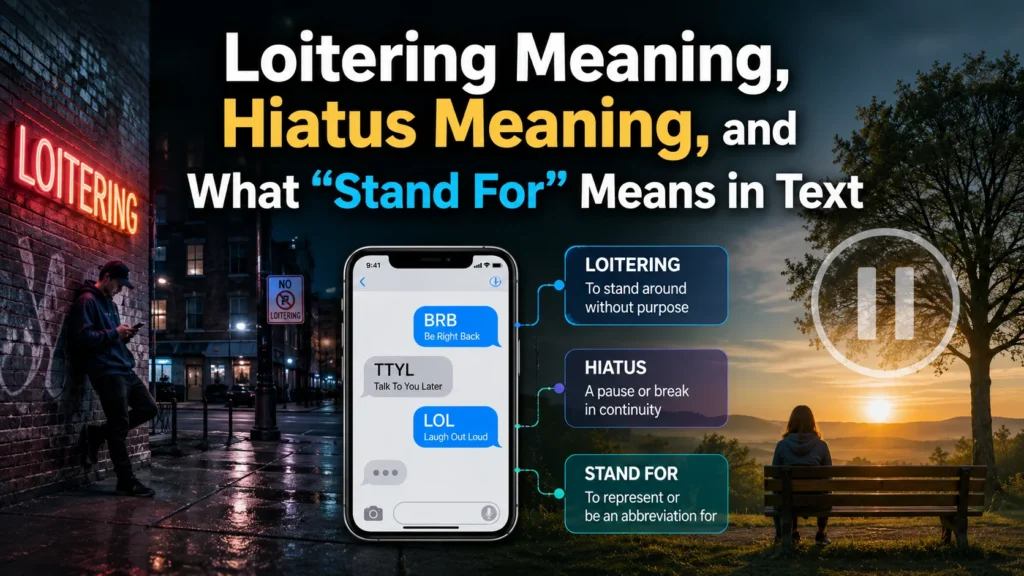

Understanding the language we see online and in texts has become more important than ever. Words like loitering, hiatus, and phrases such as stand for often pop up in messages, social media, or even official notices. If you’ve ever paused over a text wondering, “Wait, what does this mean?”, you’re not alone. This guide dives deep into the meanings, usage, and context behind these words, helping you communicate clearly and decode messages like a pro.
Loitering Meaning
Definition of Loitering
Loitering refers to lingering or remaining in a place without a clear purpose. While it might seem harmless in casual conversation, the word has legal and social connotations.
- Origin: The word comes from the Middle English loteren, meaning “to wander.”
- Modern Use: In contemporary usage, it can mean both aimlessly hanging out and, in legal contexts, staying in a place without permission.
Example in Text:
“Stop loitering near the mall; the security might ask you to leave.”
Common Usage of Loitering
Loitering appears in different contexts:
- Casual conversations: Friends joking about hanging around somewhere.
- Legal notices: Signs like “No Loitering” in parks, stores, or public areas.
- Social media: Posts describing someone staying in one place too long.
Example scenarios:
- Teenagers waiting outside a cinema without tickets.
- People sitting on benches in public areas for long hours.
- Crowds around a bus stop without intending to board.
Misconceptions About Loitering
Many people confuse loitering with simply “relaxing” or “hanging out.” Context matters.
- Casual hanging out: Positive or neutral, like meeting friends at a café.
- Loitering (negative): May involve suspicion or legal implications.
Fact: In some US cities, loitering can lead to fines or minor arrests if authorities suspect illegal intent.
Synonyms and Related Words
Here are some words similar to loitering, with subtle differences:
| Word | Meaning | Context |
| Lingering | Staying longer than necessary | Neutral |
| Dawdling | Wasting time | Casual/Negative |
| Idling | Being inactive | Neutral/Negative |
| Hovering | Staying around without purpose | Slightly negative |
Hiatus Meaning
Definition of Hiatus
A hiatus is a temporary break or pause in an activity, process, or sequence. Unlike loitering, hiatus has a neutral or even positive tone, often signaling rest or recovery.
- Origin: Derived from Latin hiatus, meaning “gap” or “opening.”
Example in Text:
“The podcast is on a brief hiatus, but new episodes will return next month.”
Also Read This : Gooning Meaning TikTok: The Complete Guide
Common Contexts for Hiatus
Hiatus is used widely across different domains:
- Entertainment: TV shows, podcasts, or YouTube channels taking a break.
- Example: “The series went on a six-month hiatus due to production delays.”
- Work: Sabbaticals or temporary pauses in projects.
- Example: “She took a hiatus from her job to travel the world.”
- Personal life: Any temporary pause for mental health, study, or self-care.
Fact: Studies show that taking a professional hiatus can boost creativity and reduce burnout.
Differences Between Loitering and Hiatus
| Word | Meaning | Common Use | Tone |
| Loitering | Hanging around aimlessly | Texts, law, social media | Negative/Neutral |
| Hiatus | Temporary break/pause | Work, entertainment, personal life | Neutral/Positive |
Key takeaway: While both involve “time spent,” loitering implies aimlessness, whereas hiatus implies intentional pause.
“Stand For” Meaning in Text
Definition
The phrase stand for often appears in texts, chats, and online posts. It can mean:
- Literal meaning: To represent or support something.
- Example: “This symbol stands for peace.”
- Acronym meaning: Referring to what letters in an abbreviation represent.
- Example: “LOL stands for ‘Laugh Out Loud.’”
Common Acronyms and Usage
Acronyms are everywhere in texting and social media. Understanding what they stand for improves clarity.
Examples:
| Acronym | Stands For | Context |
| LOL | Laugh Out Loud | Casual text/chat |
| ASAP | As Soon As Possible | Professional & casual |
| BRB | Be Right Back | Casual conversation |
| FYI | For Your Information | Work/email/text |
| IMO | In My Opinion | Social media/chat |
Tip: Always consider the tone and context before interpreting an acronym.
How to Interpret “Stand For” in Different Contexts
- Business emails: “FYI” usually conveys neutral information.
- Casual texts: “LOL” expresses humor, not literal laughter.
- Social media: Context + emoji can change meaning.
Understanding Meaning in Texts
Why Words Can Be Confusing
Online communication has evolved rapidly. Slang, abbreviations, and generational differences often lead to misinterpretation.
Example: The word hiatus in a friend’s post might mean a break from social media, not work or school.
Tips to Decode Words Quickly
- Look at context: What came before and after?
- Observe tone and punctuation: !, …, emojis, and capitalization matter.
- Use online resources: Urban Dictionary, slang dictionaries, and official sources for acronyms.
- Ask when unsure: Clarifying can save misunderstandings.
Practical Examples
Text Conversations Explained:
- Friend 1: “I’m on hiatus this week 😌”
Meaning: Taking a break, likely for rest. - Friend 2: “Don’t loiter outside my office!”
Meaning: Stop hanging around without purpose. - Friend 3: “BRB, grabbing coffee”
Meaning: Be right back; temporary absence.
Quick Reference Guide
| Word | Meaning | Example | Tone |
| Loitering | Hanging around aimlessly | “Stop loitering outside the store.” | Negative |
| Hiatus | Temporary break | “Podcast on hiatus until next month.” | Neutral/Positive |
| Stand For | Represents something / acronym | “LOL stands for Laugh Out Loud.” | Neutral |
| Lingering | Staying longer than needed | “He was lingering at the park.” | Neutral |
| Idling | Being inactive | “Car was idling too long.” | Negative/Neutral |
FAQs:
1. What does loitering mean in text messages?
- Loitering refers to staying in one place aimlessly or lingering without a purpose. In texts, it often implies someone hanging around unnecessarily.
2. How is hiatus used in texting?
- Hiatus is a temporary break or pause. In texts, it usually means taking a break from social media, work, or hobbies.
3. What does “stand for” mean in messages?
- It can mean literal representation or the meaning of an acronym. For example, “LOL stands for Laugh Out Loud.”
4. Can loitering be legal?
- In casual contexts, yes. Hanging with friends is fine. But legal loitering refers to remaining in public areas without a valid reason, which can lead to fines in some places.
5. How can I quickly understand slang or abbreviations?
- Observe context, tone, punctuation, and emojis. Use online references if needed and clarify with the sender when unsure.
Conclusion:
Words like loitering, hiatus, and stand for may seem simple, but context changes everything. Loitering carries legal or negative connotations, hiatus signals a pause or break, and stand for helps decode abbreviations in everyday texts. Observing context, tone, and examples allows you to communicate effectively and understand messages clearly.
Use this guide as a quick reference whenever you encounter these terms online, in texts, or on social media—it’ll save you time, confusion, and miscommunication.