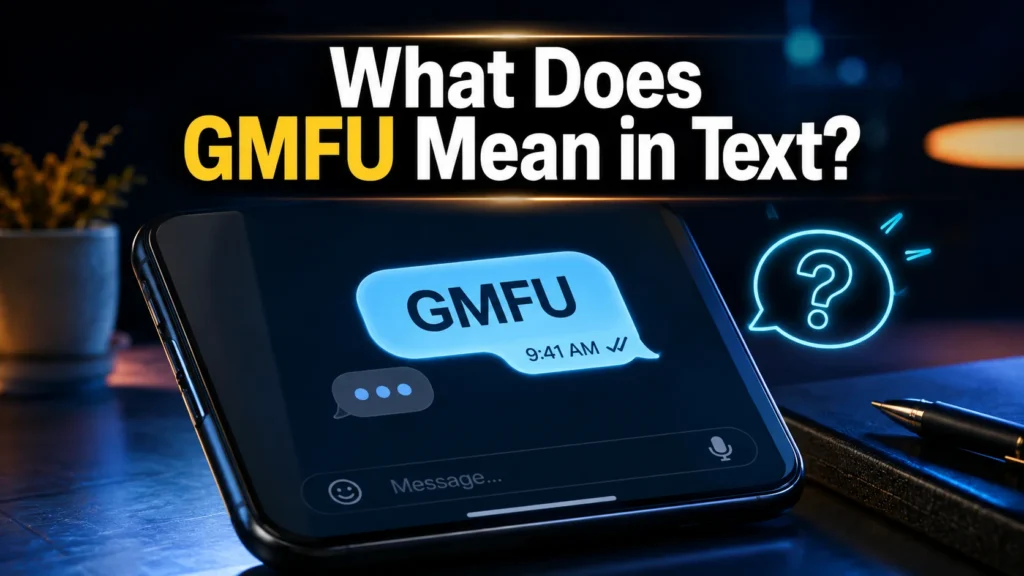

Have you ever received a text that says “ GMFU ” and wondered what those four letters actually mean? Internet slang can feel like a language of its own. Acronyms such as GMFU often appear in texts, comments, DMs, TikTok captions, and group chats without any explanation.
So, what does GMFU mean in text? In most casual conversations, GMFU stands for “got me fucked up.” People use it to express strong disbelief, frustration, annoyance, shock, or the feeling that someone has misunderstood or disrespected them. Depending on the situation, it can sound serious, playful, sarcastic, or confrontational.
The important part is context. For example, someone might write “You GMFU” because they think another person is seriously mistaken. Someone else might comment “That ending GMFU 😂” simply because a movie surprised them. The same acronym can carry different emotions even though the words remain the same.
Quick Answer: What Does GMFU Mean in Text?
GMFU usually means “got me fucked up.”
It is an informal slang acronym used when someone feels:
- Disrespected
- Misunderstood
- Frustrated
- Shocked
- Annoyed
- Surprised
- Disbelieving
- Playfully offended
For example:
“You think I’m paying $100 for that? GMFU.”
Here, GMFU means something like “You must be seriously mistaken” or “You’ve got me messed up if you think I’m doing that.”
Because the full phrase contains profanity, GMFU works best in casual texts, social media, memes, and conversations with friends. It generally doesn’t belong in professional emails, academic writing, job applications, or other formal settings.
Comparison Overview
GMFU belongs to a larger group of internet abbreviations that express strong reactions. However, each one has a slightly different purpose.
| Slang | Meaning | Typical Emotion | Formal? |
| GMFU | Got Me Fucked Up | Disbelief, frustration, offense | No |
| WTF | What the Fuck | Shock, confusion, disbelief | No |
| SMH | Shaking My Head | Disappointment, disbelief | No |
| WYM | What You Mean? | Confusion, clarification | Informal |
| STFU | Shut the Fuck Up | Anger or telling someone to stop | No |
| GTFO | Get the Fuck Out | Disbelief or rejection | No |
| TF | The Fuck | Emphasis, confusion, surprise | No |
| IDK | I Don’t Know | Uncertainty | Informal |
| FR | For Real | Agreement or emphasis | Informal |
The key distinction is that GMFU often focuses on how another person’s words or actions make you feel.
For instance:
“You really think I did that? GMFU.”
The speaker isn’t simply confused. They feel that the other person’s assumption is unreasonable or insulting.
Main Differences Between GMFU and Similar Slang
Understanding nearby slang terms makes the meaning of GMFU much easier to recognize.
GMFU vs. WTF
WTF usually expresses surprise, confusion, or disbelief.
“WTF just happened?”
GMFU, however, often carries a stronger personal reaction.
“You really thought I’d agree to that? GMFU.”
WTF asks, in effect, “What is happening?” GMFU can communicate “You must be seriously mistaken about me.”
GMFU vs. SMH
SMH means “shaking my head.” It commonly expresses disappointment or disbelief.
“He forgot his own birthday. SMH.”
GMFU tends to sound more emotionally charged.
“You canceled five minutes before we left. GMFU.”
The first statement communicates disappointment. The second sounds more like a direct emotional reaction.
GMFU vs. WYM
WYM means “what you mean?” or “what do you mean?”
Someone might write:
“WYM you don’t want to go?”
That’s mainly a request for clarification.
GMFU doesn’t necessarily ask for clarification. Instead, it can communicate that the speaker strongly disagrees with or rejects what they’ve heard.
GMFU vs. STFU
STFU means “shut the fuck up.” It directly tells another person to stop talking.
GMFU doesn’t necessarily tell someone to be quiet.
“You GMFU if you think I’m doing that.”
This means the speaker thinks the other person has the wrong idea.
GMFU vs. GTFO
GTFO literally means “get the fuck out.” Online, people also use it to express extreme disbelief.
“You won the lottery? GTFO!”
GMFU can also express disbelief, but its emotional focus differs.
“You think I would do that? GMFU.”
The speaker is reacting to a belief or assumption about them.
What Does GMFU Stand For?
The letters in GMFU represent:
- G = Got
- M = Me
- F = Fucked
- U = Up
Together, they form “got me fucked up.”
The phrase predates the acronym. People used the complete expression in informal speech before internet users began shortening it for digital communication.
That distinction matters because GMFU didn’t create the phrase itself. Instead, it turned an existing informal expression into a compact internet abbreviation.
Online communication encourages this kind of shortening. When people type quickly, four letters can replace an entire phrase.
For example:
“You really believe I would pay for that? You got me fucked up.”
becomes:
“You really think I’m paying for that? GMFU.”
The shorter version feels faster and more casual.
What Does “Got Me Fucked Up” Actually Mean?
The literal wording doesn’t always explain the intended meaning. In slang, “got me fucked up” usually means that someone’s actions, words, or assumptions have caused a strong emotional reaction.
Depending on context, it can mean:
“You’re seriously mistaken.”
“You think I’m going to apologize first? GMFU.”
“Don’t disrespect me.”
“You can’t talk to me like that. GMFU.”
“I can’t believe this.”
“They raised the price again? GMFU.”
“You’ve misunderstood me.”
“You GMFU if you think I said that.”
“That situation shocked me.”
“That plot twist GMFU.”
This flexibility explains why context matters so much. The acronym doesn’t have one single emotional setting.
How Is GMFU Used in Text Messages?
People commonly use GMFU as a reaction to something another person has said or done.
It can appear at the beginning, middle, or end of a message. It can also stand alone.
GMFU at the End of a Message
“You really want me to pay for your mistake? GMFU.”
Here, the acronym emphasizes the speaker’s disbelief and frustration.
GMFU as a Standalone Response
Someone might send:
“GMFU 😂”
This could mean that a friend’s statement was ridiculous or unexpectedly funny.
The laughing emoji changes the emotional temperature. Without it, the phrase may sound more confrontational.
GMFU With a Direct Statement
“You GMFU if you think I’m going back there.”
This construction directly challenges another person’s assumption.
GMFU as a Reaction to an Event
“That ending GMFU.”
Here, the speaker isn’t necessarily angry at another person. The event itself produced a strong reaction.
GMFU Meaning in Different Contexts
The same acronym can communicate different emotions depending on the situation.
GMFU When You’re Angry
One of the strongest uses involves anger or irritation.
“You really blamed me for that? GMFU.”
The speaker believes someone has crossed a line or made an unfair accusation.
In this context, GMFU can sound confrontational. If the relationship is already tense, sending it may escalate the conversation.
GMFU When You’re Shocked
GMFU can also describe intense surprise.
“He actually quit without telling anyone. GMFU.”
Here, the speaker isn’t necessarily angry. They’re simply stunned by what happened.
GMFU When You’re Disappointed
Imagine making plans with someone and having them cancel repeatedly.
“You canceled again? GMFU.”
The expression communicates more than simple disappointment. It suggests that the speaker feels the other person’s behavior has become unreasonable.
GMFU When Someone Misunderstands You
This is one of the most direct uses.
“You GMFU if you think I said that.”
The speaker essentially means:
“You’re seriously mistaken about what I said.”
This version is more personal because it targets another person’s assumption.
GMFU as a Joke or Sarcastic Reaction
Friends sometimes use strong slang humorously.
“You ate the last slice? GMFU 😂”
In a close friendship, this could be playful rather than genuinely angry.
However, sarcasm doesn’t always survive text. Without vocal tone or facial expressions, the recipient may interpret the message literally.
What Does GMFU Mean on Social Media?
On social media, GMFU generally keeps the same basic meaning: “got me fucked up.”
You may see it in:
- TikTok comments
- Instagram comments
- Instagram DMs
- Snapchat messages
- X posts
- Facebook comments
- Group chats
- Memes
- Reaction posts
Social platforms encourage short, expressive language. Acronyms like GMFU let people react quickly without writing a complete sentence.
For example, someone might post:
“My favorite character just betrayed everyone.”
A commenter could respond:
“GMFU 😭”
The commenter may mean that the plot twist completely shocked them.
Another person might write:
“Bro said he can beat me at basketball.”
The response:
“GMFU 😂”
could mean “You’ve got to be kidding me.”
The surrounding content tells you which interpretation makes sense.
Is GMFU Always Negative?
No. GMFU often carries a negative or confrontational tone, but it isn’t automatically angry.
The emotion can range from genuine irritation to playful disbelief.
| Context | Possible Meaning | Tone |
| Someone insults you | “Don’t disrespect me.” | Angry |
| Someone makes a wild claim | “You’re seriously mistaken.” | Disbelieving |
| A movie has an unexpected ending | “That shocked me.” | Surprised |
| A friend makes an absurd joke | “You can’t be serious.” | Playful |
| Someone breaks a promise | “This is frustrating.” | Disappointed |
| Someone misunderstands you | “That’s not what happened.” | Defensive |
Emojis can also change the tone.
Compare:
“You really did that? GMFU.”
with:
“You really did that? GMFU 😂”
The first sounds tense. The second may be teasing.
That doesn’t guarantee a friendly interpretation, though. Context always wins.
Is GMFU Rude or Offensive?
GMFU can be rude or offensive because the full phrase contains profanity.
That doesn’t mean everyone uses it offensively. In casual conversations, profanity can function as emotional emphasis rather than a direct insult.
Still, the safest approach is to consider who you’re talking to and where you’re communicating.
GMFU May Be Fine In:
- Casual conversations with close friends
- Private group chats
- Informal DMs
- Meme discussions
- Casual social media interactions
- Conversations where everyone already uses similar slang
Avoid GMFU In:
- Professional emails
- Job applications
- Interviews
- Academic assignments
- Business proposals
- Customer service messages
- Formal complaints
- Messages to unfamiliar people
For example, sending this to a manager isn’t a smart choice:
“GMFU if you think I’m working Saturday.”
A professional alternative would be:
“I don’t think I can work Saturday. Could we discuss the schedule?”
The second version communicates the same disagreement without unnecessary friction.
Also Read This: LWK Meaning in Text Explained: Full Symbolism & Usage Guide
Common GMFU Examples in Everyday Texting
Realistic examples make the meaning much easier to understand.
Example: Someone Raises the Price
“They charged us twice as much as last month. GMFU.”
Meaning: The speaker is shocked or frustrated by the unexpected price.
Example: A Friend Cancels Plans
“You canceled again? GMFU.”
Meaning: The speaker feels annoyed by repeated cancellations.
Example: An Unbelievable Accusation
“You think I stole it? GMFU.”
Meaning: The speaker strongly rejects the accusation.
Example: A Misunderstanding
“You GMFU if you think I was talking about you.”
Meaning: The speaker says the other person’s interpretation is completely wrong.
Example: A Movie Twist
“That ending GMFU 😭.”
Meaning: The ending was extremely surprising or emotionally overwhelming.
Example: A Friend Makes an Absurd Claim
“You think you can finish that whole pizza alone? GMFU 😂.”
Meaning: The speaker is jokingly challenging the friend’s claim.
Example: Broken Promise
“You said you’d be here at eight. GMFU.”
Meaning: The speaker is frustrated because the other person didn’t keep their word.
Example: Unexpected News
“She actually got the job? GMFU!”
Meaning: The speaker is genuinely surprised.
Example: Playful Disbelief
“Bro said pineapple belongs on every pizza. GMFU 😂.”
Meaning: The speaker is jokingly rejecting an opinion.
Example: Feeling Disrespected
“Don’t talk to me like that. GMFU.”
Meaning: The speaker believes the other person has crossed a boundary.
Case Study: How Context Changes the Meaning of GMFU
Consider this simple message:
“GMFU.”
Without context, it’s impossible to know exactly what emotion the sender intends.
Now imagine three different conversations.
Conversation A
Friend: “I ate the last cookie.”
You: “GMFU 😂”
This likely sounds playful.
Conversation B
Person: “You stole my money.”
You: “GMFU. I didn’t touch it.”
Now GMFU sounds defensive and angry.
Conversation C
Friend: “The main character died in the final episode.”
You: “GMFU 😭”
Here, it expresses shock and emotional disbelief.
The acronym didn’t change. The context did.
That’s one of the biggest lessons when reading internet slang. Don’t translate an acronym word-for-word before looking at the surrounding conversation.
How to Respond When Someone Says “GMFU”
Your response should depend on the situation.
If someone seems genuinely upset, avoid matching their aggression immediately.
If You’re Confused
“What do you mean?”
If They Misunderstood You
“That’s not what I meant.”
If You Accidentally Upset Them
“I didn’t mean it that way.”
If They’re Clearly Joking
“😂 Relax, I’m kidding.”
If They Feel Disrespected
“I get why you’re upset. Let me explain.”
If You Disagree
“I see it differently, but that’s not what I intended.”
A calm response can prevent a short slang phrase from turning into a much bigger argument.
How to Use GMFU Naturally
If you’re going to use GMFU, context matters more than memorizing the definition.
Match the Conversation’s Tone
If everyone in a group chat uses casual slang, GMFU may fit naturally.
If the conversation has been formal, suddenly using profanity can sound jarring.
Consider Your Relationship
Close friends may understand playful uses immediately.
A coworker or new acquaintance might interpret the same phrase as hostility.
Understand the Profanity
Don’t assume that abbreviating a swear word makes it formal.
It doesn’t.
GMFU still carries the profanity and emotional intensity of the complete phrase.
Let Context Carry the Meaning
Compare:
“You really paid $500 for that? GMFU.”
and:
“That ending GMFU 😭.”
The first sounds more confrontational. The second sounds like a dramatic reaction to entertainment.
Natural vs. Awkward Usage
Natural:
“You think I’m doing all that for free? GMFU 😂”
Natural:
“That plot twist GMFU.”
Awkward:
“Dear Professor, GMFU regarding your assignment.”
The last example fails because the slang clashes with the formal setting.
Where Did GMFU Come From?
The expression “got me fucked up” existed before people commonly used GMFU as an online acronym.
The phrase belongs to a broader tradition of informal American slang in which profanity adds emphasis to statements about disbelief, disrespect, frustration, or emotional reaction.
Online communication later shortened the expression into GMFU, following the same pattern seen with abbreviations such as WTF, STFU, and GTFO.
Sources documenting slang usage include Dictionary.com, which discusses the expression’s slang history, and Know Your Meme, which documents its internet usage and earlier online references.
It’s worth being careful with claims about the acronym’s exact origin. Slang rarely has a neat birth certificate. A phrase can circulate in spoken language, music, forums, and communities for years before someone records its earliest online appearance.
So, it’s more accurate to say that GMFU is a shortened internet form of an older expression rather than claim that one website or person invented it.
GMFU in Music and Internet Culture
The phrase has also appeared in popular internet culture and music.
A notable example is the song “GMFU” by Odetari and 6arelyhuman, released in 2023. Its title helped place the acronym in front of audiences who may have already encountered the phrase online.
Music and social media often reinforce one another. A slang term appears in a song, meme, caption, or video. People then repeat it in comments and messages. Eventually, the expression becomes recognizable far beyond its original conversational setting.
That doesn’t necessarily mean the song created GMFU. The phrase already existed before the song’s release.
Other Meanings of GMFU
Although “got me fucked up” is the meaning most relevant to casual texting, acronyms can have unrelated meanings in other fields.
For example, abbreviation databases such as list alternative expansions for GMFU.
Some possible non-slang interpretations include technical, organizational, or specialized uses.
However, if someone sends:
“GMFU 😂”
in an Instagram DM, it’s overwhelmingly likely that they’re using the slang meaning rather than a technical abbreviation.
Context determines the intended definition.
Before choosing an obscure expansion, look at:
- The platform
- The surrounding words
- The relationship between the speakers
- Emojis
- The subject being discussed
- Whether the conversation is professional or casual
GMFU Meaning at a Glance
| Question | Answer |
| What does GMFU mean? | Got Me Fucked Up |
| What does GMFU mean in text? | Usually expresses disbelief, frustration, shock, or offense |
| What does GMFU stand for? | Got Me Fucked Up |
| Is GMFU slang? | Yes |
| Is GMFU informal? | Yes |
| Does GMFU contain profanity? | Yes |
| Can GMFU be humorous? | Yes |
| Can GMFU express anger? | Yes |
| Can GMFU express surprise? | Yes |
| Is GMFU suitable for formal writing? | Generally no |
| Does context affect its meaning? | Yes, significantly |
| Can GMFU appear on social media? | Yes |
| Can “you GMFU” sound confrontational? | Yes |
What Does GMFU Mean on Instagram?
On Instagram, GMFU usually means “got me fucked up.”
Someone might use it in a comment, DM, caption, or reply when something surprises or annoys them.
For example:
“You really posted that picture of me? GMFU 😂”
Depending on the relationship, this could be playful teasing or genuine annoyance.
Instagram’s visual context often helps clarify the intended meaning. A laughing emoji, meme, or funny image can make GMFU feel much less serious.
What Does GMFU Mean on TikTok?
On TikTok, GMFU generally has the same meaning.
You may encounter it in comments reacting to:
- Unexpected videos
- Funny situations
- Relationship drama
- Surprising reveals
- Controversial opinions
- Unexpected endings
- Ridiculous claims
For example:
“The last five seconds GMFU 😭”
Here, the commenter probably means the ending caught them completely off guard.
Is GMFU a Bad Word?
GMFU itself isn’t a traditional dictionary word. It’s an acronym containing profanity.
The full phrase includes the F-word, so it carries a level of vulgarity.
Whether it’s considered offensive depends on the speaker, audience, and setting. Friends may use it casually without intending genuine offense. In a workplace or formal environment, however, it can sound inappropriate.
If you want a cleaner alternative, consider:
- You must be kidding.
- You’ve got to be joking.
- You’re seriously mistaken.
- No way.
- I can’t believe that.
- That’s unbelievable.
- You’ve got the wrong idea.
These alternatives preserve the general reaction without the profanity.
Can GMFU Be Used Jokingly?
Yes. GMFU can absolutely be playful.
For example:
“You ate my fries? GMFU 😂”
A close friend will probably understand that you’re joking.
However, humor depends heavily on shared context. Without a laughing emoji or familiar relationship, the same sentence could sound genuinely hostile.
Think of GMFU like a strong seasoning. A little can add personality. Too much can overwhelm the conversation.
Is GMFU Appropriate for Work?
Generally, no.
Even if coworkers casually use slang among themselves, GMFU remains a profanity-based expression.
Instead of:
“GMFU if you think I’m working another weekend.”
Try:
“I don’t think I can take on another weekend shift.”
The second message is clearer, more professional, and less likely to create unnecessary conflict.
Professional communication rewards precision. Slang can be useful in informal relationships, but it isn’t automatically appropriate simply because the recipient understands it.
FAQs:
What does GMFU mean in text?
GMFU usually means “got me fucked up.” People use it to express disbelief, frustration, shock, annoyance, or offense. The exact emotion depends on the surrounding conversation.
What does GMFU stand for?
GMFU stands for “got me fucked up.” It’s a shortened slang expression commonly used in texting and social media.
What does “you GMFU” mean?
“You GMFU” generally means “you’ve got me fucked up.” Depending on context, the speaker may mean that you’re seriously mistaken, misunderstanding them, disrespecting them, or making an unreasonable assumption.
Is GMFU rude?
It can be. The phrase contains profanity and can sound confrontational. However, friends sometimes use it jokingly to express playful disbelief.
What does GMFU mean on Instagram?
On Instagram, GMFU generally means “got me fucked up.” Users may write it in comments or DMs to react to something surprising, frustrating, funny, or unbelievable.
Conclusion:
So, what does GMFU mean in text? The most common meaning is “got me fucked up.” It’s a strong, informal expression that can communicate disbelief, frustration, anger, shock, disappointment, or playful disbelief.
The most important detail isn’t simply memorizing the four letters. Learn to read the context around them. “GMFU” after an insult may signal genuine anger. The same acronym followed by a laughing emoji could be nothing more than friendly teasing.
Because the expression contains profanity, save it for situations where casual language fits. Friends, group chats, memes, and social media are common places to see it. Professional emails and formal writing are better served by clearer, neutral alternatives.
In short, when someone texts “GMFU,” they usually aren’t giving you a mysterious code to crack. They’re making a strong emotional reaction in just four letters.