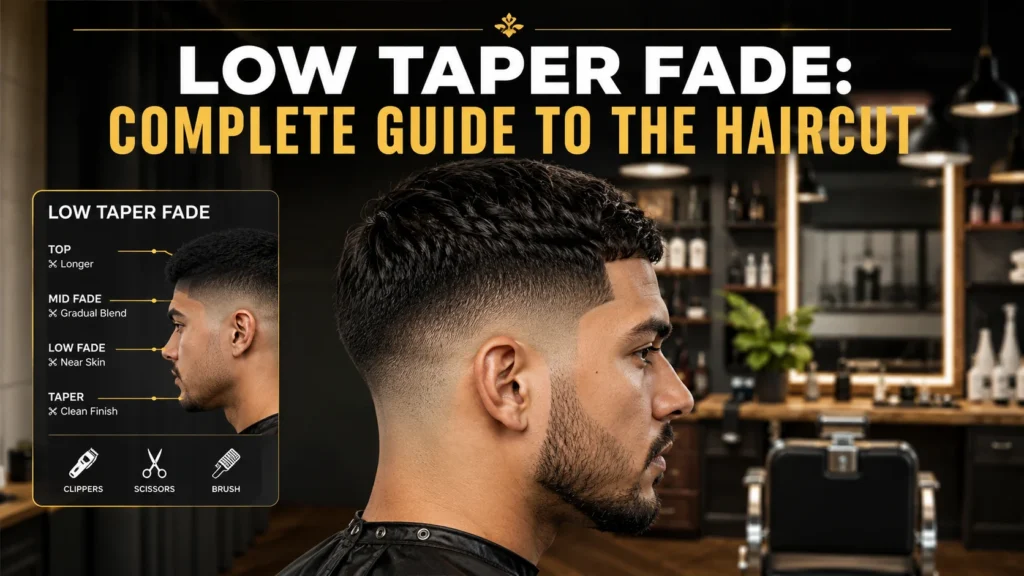

A low taper fade is one of those haircuts that looks simple until you see a really well-executed one. The sides stay relatively full while the hair gradually gets shorter around the temples, sideburns, and neckline. That small detail creates a clean outline without stripping away the natural shape of your hair.
The style has also become remarkably versatile. You can pair a low taper fade with curls, waves, straight hair, a textured crop, a quiff, a fringe, or longer hair on top. It can look relaxed on Saturday and polished enough for an office on Monday.
However, there’s an important catch: “low taper,” “low fade,” and “taper fade” don’t always mean exactly the same thing. Barber terminology can vary from one shop to another. Understanding the difference helps you avoid the classic haircut problem: showing your barber one thing and walking out with something noticeably different.
This guide explains exactly what a low taper fade is, how it compares with other fades, which variations work with different hair types and face shapes, how long it lasts, and what to tell your barber in 2026.
Quick Answer
A low taper fade is a haircut where the hair gradually becomes shorter around the sideburns, temples, and neckline, while most of the sides and back retain more length than they would in a traditional low fade.
The word “low” describes where the taper sits. It stays close to the natural hairline instead of climbing high toward the temples or upper sides of the head.
The result is usually:
- Subtle rather than dramatic
- Clean around the ears and neckline
- Easy to combine with different hairstyles
- Suitable for straight, wavy, curly, and coily hair
- Adaptable to casual and professional settings
- Less aggressive than many high-contrast fades
One important distinction matters. A taper generally leaves some visible hair at the shortest point, while a traditional skin fade can take the hair down to bare skin. Professional barbering sources also emphasize that the terminology can overlap in everyday conversation, which makes a reference photo especially useful.
Comparison Overview
Before choosing a haircut, it helps to see where the low taper fade fits among related styles.
| Haircut | Where the Shortening Happens | Contrast | Overall Appearance |
| Low Taper Fade | Temples, sideburns, neckline | Low–moderate | Subtle and clean |
| Mid Taper | Higher around the sides | Moderate | Balanced |
| High Taper | Higher on the head | Moderate–high | More noticeable |
| Low Fade | Around the lower sides and back | Moderate | More defined |
| Mid Fade | Around the middle of the sides | High | Stronger contrast |
| High Fade | High toward the temples | Very high | Bold |
| Skin Fade | Can reach bare skin | Very high | Sharp |
| Burst Fade | Curves around the ears | High | Distinctive |
| Drop Fade | Drops lower toward the back | Moderate–high | Contoured |
The biggest visual difference comes down to how much hair gets removed and how far the transition travels upward.
A low taper keeps the transition concentrated around the edges. A conventional fade generally affects a larger section of the sides and back.
Main Differences Between Low Taper Fade Styles
The phrase low taper fade covers several closely related looks. The basic technique stays similar, but the final appearance changes according to the length, texture, blending, and styling on top.
Low Taper vs. Low Fade
This is probably the most common source of confusion.
A low taper concentrates the shortening around the sideburns and neckline. Most of the side remains relatively full.
A low fade generally creates a broader faded area around the lower sides and back. The contrast becomes easier to see because more of the surrounding hair gets progressively shorter.
Think of it this way:
A low taper cleans the edges. A low fade reshapes more of the sides.
The exact result can vary because barbers use terminology differently. That’s why telling your barber exactly where you want the blend is more reliable than simply naming the haircut.
Low Taper vs. Mid Taper
A mid taper moves the transition higher than a low taper.
That extra height changes the silhouette. The sides appear cleaner and slightly tighter because the shorter section occupies more visual space.
Choose a low taper if you want:
- More natural side coverage
- A conservative appearance
- A softer transition
- More freedom with longer hairstyles
Choose a mid taper if you want:
- More visible tapering
- A cleaner side profile
- Greater contrast between the top and sides
Low Taper vs. High Taper
A high taper pushes the shortening farther upward.
That creates a stronger visual effect while exposing more of the head’s natural shape. A low taper does almost the opposite. It preserves more of the original silhouette.
If you’re nervous about going too short, a low taper is usually the safer starting point.
Low Taper vs. Skin Fade
A skin fade can reach the scalp at its shortest point. A taper doesn’t necessarily need to do that.
The distinction matters because exposed scalp creates more contrast. Dark, dense hair against visible skin can make a fade look dramatically sharper.
A low taper, by comparison, often creates a softer transition with more hair remaining around the edges.
What Does a Low Taper Fade Look Like?
From the front, a low taper fade can look surprisingly natural. The top remains the main visual feature while the edges appear cleaner.
From the side, you’ll notice the gradual reduction around the temple and sideburn.
From the back, the neckline receives the most attention. A good taper shouldn’t look like someone simply shaved a line into the bottom of your hair. The transition should flow naturally into the existing hair.
A well-executed low taper has three important qualities:
- Smooth blending
- Balanced symmetry
- Controlled length reduction
A visible horizontal line, abrupt jump in length, or uneven temple can make even an otherwise good haircut look unfinished.
The Main Parts of a Low Taper Fade
Temple Area
The temple is one of the defining areas of the haircut.
Your barber gradually reduces the hair around this region rather than taking the entire side extremely short. The goal is a clean transition that frames your face without creating an oversized bald area.
Sideburns
Sideburns connect your haircut with your facial hair.
If you wear a beard, your barber can blend the sideburn into it. If you’re clean-shaven, the taper can finish more naturally around the ear.
Around the Ears
This small area has a surprisingly large visual impact.
Stray hair around the ear can make a fresh haircut look messy quickly. A precise taper cleans this area while preserving the overall fullness of the sides.
Neckline
The neckline determines how the haircut finishes from behind.
You can ask for a:
- Tapered neckline
- Natural neckline
- Squared neckline
- Rounded neckline
A tapered neckline usually creates the softest appearance and pairs naturally with the low taper concept.
Popular Low Taper Fade Styles for 2026
The strength of the low taper fade comes from its ability to work with almost any top hairstyle.
Low Taper Fade With Textured Hair
A textured top creates movement without requiring a complicated hairstyle.
Ask your barber to preserve enough length for texture. You can then use a small amount of matte clay or styling cream to separate the strands.
This combination works especially well when you want a modern haircut that doesn’t look overly sculpted.
Low Taper Fade With Curly Hair
Curly hair can make the taper look completely different.
The curls provide volume and personality on top while the taper controls the areas around the ears and neckline. Your barber should consider curl shrinkage before deciding how much length to remove.
Don’t judge curly hair only by its wet length. Curls can contract considerably as they dry.
Low Taper Fade With Waves
A low taper is particularly useful for people who want to maintain the visual fullness of their waves.
Instead of removing large sections of hair, the barber cleans the perimeter. That keeps the wave pattern prominent while making the edges look sharper.
Low Taper Fade With Straight Hair
Straight hair gives you plenty of styling options.
You can wear it:
- Messy
- Textured
- Swept back
- Side-parted
- Forward
- With a fringe
- With a quiff
The taper handles the edges while the top determines the haircut’s personality.
Low Taper Fade With Thick Hair
Thick hair benefits from strategic bulk removal.
However, don’t assume that removing as much hair as possible will produce a better result. Excessive thinning can make the top lose its shape.
A skilled barber can reduce unwanted weight while keeping enough density for styling.
Low Taper Fade With Fine Hair
Fine hair needs a slightly different approach.
If your hair lacks density, an aggressive fade can make the top appear thinner by comparison. A low taper gives you more room to preserve fullness.
Textured styling can also make fine hair appear visually denser.
Low Taper Fade With a Quiff
A quiff needs enough length at the front to create lift.
The low taper keeps the sides controlled without competing with the height of the quiff. Use a lightweight volumizing product if your hair tends to fall flat.
Low Taper Fade With a Fringe
A textured fringe can create a youthful and relaxed appearance.
The low taper provides structure around the edges while the fringe becomes the focal point.
This combination works particularly well with straight, wavy, and curly textures.
Low Taper Fade With a Side Part
For a more classic appearance, combine the taper with a side part.
Keep the taper subtle and maintain enough length on top to establish a clean part. This version can easily move between casual and professional environments.
Low Taper Fade With Long Hair
You don’t need short hair on top to get a low taper.
In fact, longer hair can create an interesting contrast. The edges stay neat while the top remains long enough for a swept-back, messy, bro-flow, or textured style.
Low Taper Fade for Different Hair Types
Your hair texture should influence the haircut more than a generic trend photo.
Straight Hair
Straight hair reveals the blend clearly. Small imperfections can therefore become easier to notice.
Ask for a clean, gradual transition and explain how you normally style the top.
Wavy Hair
Wavy hair naturally creates movement.
A low taper lets that movement remain visible while controlling the edges. Avoid asking for excessive removal if you want to maintain a fuller, textured appearance.
Curly Hair
Curly hair needs careful consideration of density and shrinkage.
The barber should understand how your curls behave when dry. A taper can define the perimeter without interfering with the natural curl pattern.
Coily Hair
Coily textures can create striking contrast between the top and tapered edges.
The taper should respect the natural density of the hair. Precise detailing around the temple, ear, and neckline can make a major difference.
Thick Hair
With thick hair, the key is shape management.
You want enough weight to maintain the hairstyle while removing bulk that makes the sides appear too wide.
Fine Hair
With fine hair, preservation matters.
A low taper can be preferable to a high fade because it maintains more visual density around the sides.
Low Taper Fade for Different Face Shapes
A haircut doesn’t exist in isolation. Your face shape, forehead, jawline, and natural hairline all influence the final appearance.
| Face Shape | Low Taper Approach |
| Oval | Most variations work well |
| Round | Add controlled height on top |
| Square | Keep the style balanced and structured |
| Oblong | Avoid excessive height |
| Heart | Keep proportions balanced |
| Diamond | Control volume around the upper sides |
Oval Face
An oval face offers considerable flexibility.
You can experiment with textured tops, fringes, quiffs, curls, and longer hairstyles without needing to compensate for a particularly wide or narrow facial area.
Round Face
If your face looks wider than it is long, adding moderate height on top can create a more elongated appearance.
Avoid creating excessive width around the sides.
Square Face
A square face already has strong angles.
A clean low taper can emphasize that structure without making the haircut look overly aggressive.
Oblong Face
If your face is relatively long, excessive height on top may exaggerate that length.
A textured or moderately full top often works better than an extremely tall quiff.
Also Read This: HY Meaning in Text: What It Means
Low Taper Fade With a Beard
A beard can either complement or compete with a haircut.
The key is continuity.
Your barber can taper the sideburn into the beard so the transition looks intentional. You can also keep the sideburn shorter while allowing the beard to become fuller farther down.
Popular combinations include:
- Low taper + stubble
- Low taper + short boxed beard
- Low taper + full beard
- Low taper + shaped beard
- Low taper + connected mustache and beard
If you have a substantial beard, show your barber where you want the facial hair to remain full. Don’t assume the haircut and beard will automatically blend the way you imagine.
Is a Low Taper Fade Professional?
Yes. A subtle low taper fade can be highly suitable for professional settings.
The top and styling matter just as much as the taper itself.
For a conservative workplace, consider:
- Moderate top length
- Natural texture
- Clean neckline
- Subtle temple taper
- Minimal styling product
- No exaggerated designs
A textured top with a restrained taper can look polished without appearing overly formal.
Is a Low Taper Fade Good for Receding Hairlines?
It can work well, but the approach matters.
If your temples are receding, taking those areas extremely short can make the recession more noticeable. A subtle taper may preserve more surrounding hair and create a smoother visual transition.
Texture on top can also help redirect attention.
However, don’t treat the haircut as a way to hide every change in your hairline. The best result usually comes from working with your natural pattern rather than fighting it.
Is a Low Taper Fade Good for Thinning Hair?
A low taper can be a sensible option for thinning hair because it doesn’t require you to remove large sections from the sides.
The main objective should be visual balance.
If the top is becoming thinner, a very short fade can sometimes increase the contrast between the remaining hair and exposed scalp. Keeping the taper low gives you more coverage.
A textured crop, short quiff, or natural side-swept style can work well depending on your density.
How to Ask Your Barber for a Low Taper Fade
This is where many haircut mistakes happen.
Don’t simply say:
“Give me a low taper.”
That phrase tells the barber the general direction, but it doesn’t explain your desired length, blend, neckline, or top style.
Instead, describe the haircut in layers.
Tell Your Barber Where You Want the Taper
Say:
“I want the taper kept low around the temples, sideburns, and neckline.”
If you want the back to remain especially low, say so.
Explain Your Top Length
Tell your barber whether you want:
- Short
- Medium
- Long
- Textured
- Curly
- Swept back
- Side-parted
- Fringe
Explain How Subtle You Want It
You can say:
“Keep the taper subtle. I don’t want the sides taken too high.”
That sentence can prevent a major misunderstanding.
Specify the Neckline
If you prefer a natural finish, say:
“Keep the neckline tapered and natural.”
If you want a sharper shape, explain that before the barber starts detailing.
Bring a Reference Photo
A photograph can communicate details that words can’t.
Ideally, bring pictures showing:
- Front
- Side
- Back
A single front-facing image doesn’t always reveal how high the taper sits.
The Best Barber Script for a Low Taper Fade
Here’s a simple request you can actually use:
“I want a low taper around the temples, sideburns, and neckline. Keep the taper subtle and don’t take it too high. Leave the top about [your preferred length] and keep enough weight on the sides. I’d like a clean, natural blend rather than a strong skin fade.”
If you want a specific style, add it at the end:
“Keep the top textured so I can style it naturally.”
Modern barbering guides similarly recommend explaining the desired placement and amount of contrast rather than relying on the haircut name alone.
What Clipper Numbers Mean in a Low Taper Fade
Clipper guard numbers describe cutting length, but a guard number alone doesn’t define the haircut.
Common guard references include:
| Guard | General Result |
| #0 / zero | Extremely short |
| #0.5 | Very short transition |
| #1 | Short |
| #1.5 | Intermediate blend |
| #2 | Short but visibly fuller |
| #3 and above | Increasingly longer |
The exact cutting length can vary by clipper, blade, lever position, and barbering technique.
That’s why saying “give me a #1 taper” may not communicate enough.
Placement matters just as much as the guard.
How a Barber Creates a Low Taper Fade
A professional low taper isn’t created with one clipper pass.
The process generally involves several stages:
Consultation → Establish Length → Create Guideline → Blend → Detail → Shape Neckline → Check Symmetry → Style
Consultation
The barber evaluates your hair type, growth pattern, desired length, and reference photo.
Establishing the Taper Area
The barber determines how low the transition should sit.
This is crucial. If the initial guideline sits too high, the haircut may become much more aggressive than you wanted.
Creating the Blend
Different clipper lengths gradually remove the visible steps between longer and shorter hair.
Detailing
The barber checks:
- Temples
- Sideburns
- Around the ears
- Neckline
- Symmetry
Final Styling
Styling reveals how the haircut behaves outside the cutting chair.
That final stage matters because a haircut can look different once the hair moves naturally.
How Long Does a Low Taper Fade Take?
The time varies considerably.
A simple low taper with a short top may take less time than a detailed cut involving long curls, waves, beard shaping, or extensive scissor work.
Factors include:
- Hair density
- Hair length
- Curl pattern
- Top hairstyle
- Beard detailing
- Barber’s technique
- Amount of blending required
A basic taper can be relatively quick. A customized haircut with detailed styling can take substantially longer.
How Long Does a Low Taper Fade Last?
Hair grows continuously, so no taper remains freshly blended forever.
The edges usually lose their crisp appearance before the overall haircut becomes unusable.
Many people schedule a cleanup every couple of weeks when they want a consistently sharp outline. Others wait several weeks and allow the taper to grow naturally.
The right schedule depends on your hair growth rate and how precise you want the haircut to look.
One advantage of a subtle taper is that its grow-out can appear less abrupt than a highly exposed skin fade. Barber guidance also notes that tapers generally retain more coverage and can grow out more gracefully than stronger fades.
How to Maintain a Low Taper Fade
A fresh haircut is only half the equation.
Keep the Hair Clean
Wash according to your hair type rather than following a rigid daily schedule.
Curly and coily hair may need a different routine from straight, oily hair.
Don’t Overload the Hair With Product
Heavy product buildup can make textured hair appear greasy and flat.
Start with a small amount. Add more only if necessary.
Maintain the Top
The taper may remain attractive even when the top grows longer. Eventually, however, the top will change the overall proportions.
Tell your barber whether you want to preserve or reduce that length during each visit.
Keep the Neckline Tidy
The neckline often becomes visibly untidy before the rest of the haircut.
A professional cleanup can restore the sharp appearance without requiring a completely new hairstyle.
Best Styling Products for a Low Taper Fade
Choose the product according to the finish you want.
| Desired Result | Useful Product |
| Matte texture | Hair clay |
| Natural hold | Styling cream |
| Flexible definition | Wax |
| High shine | Pomade |
| Curl definition | Curl cream |
| Volume | Mousse |
| Textured movement | Sea salt spray |
For example, someone with straight hair who wants a messy textured top may prefer clay.
Someone with curly hair usually benefits more from a product designed to enhance curl definition rather than stiffening every strand.
Common Low Taper Fade Mistakes
Even a simple haircut can go sideways when communication breaks down.
Making the Taper Too High
This is probably the biggest mistake.
If you wanted a subtle low taper, a high starting point can completely change the haircut.
Removing Too Much Side Length
A taper should not automatically mean extremely short sides.
Tell your barber if you want to preserve fullness.
Ignoring the Neckline
The back is easy to overlook because you can’t see it while sitting in the chair.
Ask for the neckline finish you prefer.
Copying a Photo Exactly
Your hair texture and head shape may differ from the person in the reference image.
Use photos to communicate the concept, not necessarily an identical blueprint.
Using Too Much Product
A great haircut can look worse under a thick layer of styling product.
Start small.
Case Study: Choosing the Right Low Taper
Consider someone with thick, wavy hair, an oval face, and a professional office job.
A high fade would create stronger contrast and remove considerable side volume. That’s not necessarily bad, but it isn’t required.
A low taper with a textured medium-length top would preserve the natural wave while keeping the edges controlled.
The practical request could be:
“Keep the taper low around the temples and neckline. Leave the sides fairly full and keep enough length on top for my natural waves.”
That haircut gives the wearer styling flexibility without turning the sides into the dominant feature.
Low Taper Fade for Different Ages
Teenagers
A low taper works well when school rules allow modern fades.
A textured top, curls, waves, or short fringe can personalize the haircut without requiring an extreme design.
Young Adults
This is where the style becomes especially flexible.
You can pair it with casual texture, a quiff, side part, curls, waves, or longer hair.
Professionals
Keep the taper low and the top controlled.
The result can look sharp without appearing overly trendy.
Older Men
A low taper can work particularly well with gray or thinning hair because it doesn’t require a dramatic removal of side coverage.
The top can remain natural rather than heavily sculpted.
Low Taper Fade History and Cultural Influence
The history of tapering and fading doesn’t fit neatly into a single invention story.
Short tapered men’s hairstyles have deep roots in traditional barbering and military grooming. Modern fades later developed into distinct forms through barbering communities and popular culture.
The modern fade also has important roots in Black barbering and Black hair culture, particularly through the development and popularization of highly controlled clipper work and distinctive fade styles during the late 20th century.
Popular culture helped push these styles into the mainstream. The fade became associated with artists, athletes, entertainers, and streetwear culture while remaining common in professional barber shops.
The history is worth treating carefully because claims that one individual invented the fade often oversimplify a much longer evolution.
For example, media coverage surrounding NFL player Travis Kelce’s haircut highlighted this exact problem. Kelce himself rejected claims that he invented the fade, while his barber noted that similar cuts had existed for generations.
The broader history of fades also includes military grooming standards and influential styles from Black communities. A useful historical discussion from Allure notes the fade’s long-standing place in men’s grooming and its evolution across popular culture.
Low Taper Fade Trends in 2026
The 2026 version of the low taper trend is less about one rigid haircut and more about personalized blending.
Several looks remain especially relevant:
- Low taper with textured hair
- Low taper with curls
- Low taper with waves
- Low taper with longer hair
- Low taper with fringe
- Low taper with a short quiff
- Low taper with beard blending
- Natural-looking low tapers
- Low tapers with moderate side coverage
Current barbering coverage continues to distinguish low, mid, high, and taper variations according to placement and contrast. Modern guides also emphasize customization around individual hair texture and facial structure rather than simply copying a trend.
That shift makes sense. The best haircut isn’t necessarily the one dominating social media. It’s the one that works with your hair, your face, and your daily routine.
How to Choose the Right Low Taper Fade for You
Use this simple formula:
Hair Type + Face Shape + Top Length + Lifestyle + Maintenance = Better Haircut Choice
Before your next appointment, consider:
- Do you have straight, wavy, curly, or coily hair?
- How much length do you want on top?
- Do you prefer subtle or noticeable contrast?
- How often can you visit the barber?
- Do you need an office-friendly style?
- Do you wear a beard?
- Are you trying to preserve fullness?
- How much time do you spend styling your hair?
If you answer those questions first, choosing a variation becomes much easier.
Low Taper Fade Maintenance Checklist
Use this quick checklist before and after your haircut:
- Tell your barber exactly how low you want the taper.
- Bring front, side, and back reference photos.
- Explain your preferred top length.
- Mention your natural hair texture.
- Specify your neckline preference.
- Tell your barber whether you want a skin-close finish.
- Explain how you normally style your hair.
- Coordinate the taper with your beard if you have one.
- Use styling products sparingly.
- Schedule cleanups based on how quickly your hair grows.
FAQs
Is a low taper fade the same as a low fade?
No. A low taper generally concentrates the shortening around the temples, sideburns, and neckline. A low fade typically extends the faded transition farther across the sides and back.
However, terminology varies between barbers. Explain the placement you want instead of relying only on the name.
How low does a low taper fade go?
It generally stays around the lower temple, sideburn, ear, and neckline areas.
The exact height depends on the barber’s interpretation and your head shape. If you want the taper extremely low, say that clearly.
What should I tell my barber for a low taper fade?
Tell your barber:
“I want a low taper around the temples and neckline. Keep it subtle, don’t take it too high, and leave the top at [your preferred length].”
Then show a reference photo.
What clipper number should I ask for?
Don’t rely on a guard number alone.
Clipper numbers describe cutting length, but the final haircut also depends on placement, blending technique, lever position, hair density, and your natural growth pattern.
Does a low taper fade work with curly hair?
Yes. It can work extremely well with curly hair because it cleans the edges while allowing the curls to remain the main feature.
Your barber should account for shrinkage and curl density before deciding how much length to remove.
Conclusion:
The low taper fade succeeds because it doesn’t force your entire haircut into one shape.It cleans the edges without taking over the hairstyle. You can keep curls on top, build waves, add texture, create a quiff, wear a fringe, maintain longer hair, or choose a classic side part. That flexibility makes the low taper especially useful when you want a modern haircut without an overly aggressive fade.The smartest approach is simple: don’t choose the haircut name alone. Choose the placement, length, texture, and finish you actually want.