
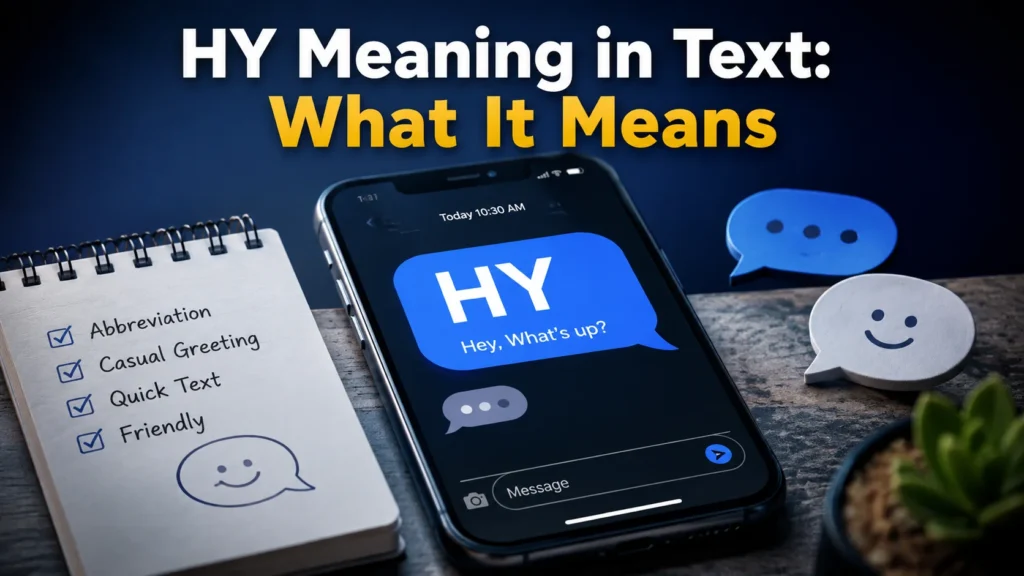

Have you ever received a text that simply says “HY” and wondered what the sender actually meant? Those two letters can look deceptively simple. In casual digital conversations, however, HY can carry different meanings depending on where it appears and what the other person says around it.
In most texting contexts, HY works as a quick greeting similar to “hey” or “hi.” In other conversations, especially when it appears as a direct response to a question or invitation, HY can mean “hell yeah” or “hell yes,” expressing strong agreement or excitement. Current slang references document both uses, which makes context the key to interpreting the abbreviation correctly.
If someone sends “HY, what’s up?”, they’re probably greeting you. If someone replies “HY!” to “Want to come with us?” they’re much more likely to mean “hell yeah!” That small difference can completely change the tone of the conversation.
Quick Answer
HY in text usually means “hey” or “hi” when it appears as a greeting. It can also mean “hell yeah,” “hell yes,” or “heck yeah” when someone uses it to show strong agreement, approval, or excitement.
The surrounding conversation usually tells you which meaning applies.
Quick examples
- “HY! How are you?” → “Hey!” or “Hi!”
- “HY, what are you doing?” → “Hey, what are you doing?”
- “Want to go out tonight?” — “HY!” → “Hell yeah!”
- “Did you like the concert?” — “HY!” → “Hell yeah!”
- “HY 👋” → Casual greeting
- “HY!!! 🔥” → Strong enthusiasm or agreement
Because HY has more than one informal interpretation, don’t treat it as a one-definition abbreviation. Context does the heavy lifting.
Comparison Overview
The easiest way to understand HY meaning in text is to compare its two major uses side by side.
| HY Meaning | Expanded Form | What It Communicates | Typical Position | Tone |
| Hey / Hi | Hey / Hi | A casual greeting | Beginning of a conversation | Friendly, relaxed |
| Hell Yeah | Hell Yeah | Strong agreement or excitement | Usually a reply | Enthusiastic |
| Hell Yes | Hell Yes | Strong approval | Usually a reply | Excited, emphatic |
| Heck Yeah | Heck Yeah | Strong agreement without profanity | Usually a reply | Positive, casual |
The first two interpretations matter most in ordinary texting. Several current online references describe HY as either a casual greeting or an enthusiastic affirmative expression.
One important point deserves attention: not every unusual expansion of HY should be treated as established texting slang. Acronyms can mean completely different things in specialized fields. Unless the surrounding conversation supports another interpretation, the common conversational meanings are the safest starting point.
Main Differences Between HY Meanings
The biggest difference between the two common meanings is what role HY plays in the conversation.
When HY starts a message, it often functions as a greeting:
“HY, how have you been?”
Here, the sender isn’t answering a question. They’re opening the conversation.
When HY appears as a response, especially after an invitation or yes-or-no question, it can work as an enthusiastic agreement:
“Want to grab burgers later?”
“HY!”
In this case, interpreting HY as “hey” wouldn’t make much sense. The conversation clearly calls for an affirmative response.
HY as “Hey” or “Hi”
This is the straightforward greeting use. Some people type HY as an informal shortened form of “hey,” while others use it almost like “hi.” Online examples and slang references describe this as a casual way to start a conversation.
For example:
“HY, what’s going on?”
means roughly:
“Hey, what’s going on?”
It can also appear with an emoji:
“HY 👋”
The emoji reinforces the greeting, making the intended meaning even clearer.
HY as “Hell Yeah”
The second major interpretation has a completely different function.
Here, HY expresses strong agreement rather than greeting someone.
For example:
“Are you coming to the game?”
“HY!”
The response means something like:
“Hell yeah!”
In less explicit language, the sender could also be expressing “Absolutely!”, “Definitely!”, or “Of course!”
Some slang references list hell yeah, hell yes, and heck yeah as variations of this affirmative use.
Why Context Matters So Much
Two letters aren’t enough to determine meaning by themselves.
Think of HY like a road sign with missing arrows. You need the surrounding conversation to know where it points.
Compare these messages:
Message A:
“HY! Haven’t talked to you in forever.”
Clearly a greeting.
Message B:
“You want to order pizza?”
“HY 🍕”
Clearly enthusiastic agreement.
The same abbreviation appears in both examples. The conversation structure changes the meaning.
What Does HY Stand For in Text?
When people ask “What does HY stand for in text?”, there isn’t one universal expansion.
The most relevant conversational interpretations are:
- Hey
- Hi
- Hell Yeah
- Hell Yes
- Heck Yeah
However, these aren’t equally interchangeable in every sentence.
HY as “Hey”
This interpretation works naturally when HY appears at the beginning of a message.
Examples include:
- “HY, are you awake?”
- “HY! Long time no see.”
- “HY, what’s up?”
- “HY everyone 👋”
In these examples, HY functions as a greeting rather than an acronym that requires a literal word-for-word expansion.
HY as “Hell Yeah”
This interpretation usually appears as a reaction.
Examples:
- “Want to watch the game tonight?” — “HY!”
- “Would you do that again?” — “HY.”
- “Are you excited?” — “HY 🔥”
- “You want the first pick?” — “HY!”
The emotional force comes from the phrase behind the abbreviation. A plain “yes” sounds neutral. “Hell yeah” sounds much more energetic.
How to Use HY in Text Messages
Using HY isn’t difficult once you understand the context.
The trick is knowing whether you’re starting a conversation or responding enthusiastically.
Use HY as a Casual Greeting
If you’re texting a friend, you might write:
“HY! What are you doing tonight?”
It’s short, relaxed, and informal.
You could also use:
“HY 👋”
or:
“HY, how’s your day going?”
This usage works best with people who already understand your casual texting style.
Use HY for Strong Agreement
When HY means “hell yeah,” it normally responds to a statement or question.
For example:
“Want to come to the beach tomorrow?”
“HY!”
The abbreviation adds energy to the response.
Compare the difference:
- “Yes.” → Neutral
- “Yeah.” → Casual agreement
- “Absolutely!” → Strong agreement
- “HY!” → Very casual, enthusiastic agreement
That’s why HY can feel more expressive than a simple “yes.”
Use Punctuation to Shape the Tone
Punctuation can influence how HY feels.
| Version | Possible Impression |
| hy | Very casual or understated |
| HY | Direct and clear |
| HY! | Energetic |
| HY!!! | Highly enthusiastic |
| HY 😂 | Playful |
| HY 🔥 | Excited or approving |
| HY? | Potentially confused or uncertain |
Punctuation doesn’t create a fixed dictionary definition. It simply gives the reader additional clues.
HY Meaning in Real Text Conversations
Seeing HY in complete conversations makes the distinction much easier.
Example: Starting a Conversation
Alex: HY! What are you up to?
Sam: Nothing much. Just relaxing.
Here, HY clearly means “Hey” or “Hi.”
Example: Responding to an Invitation
Alex: Want to grab dinner tonight?
Sam: HY! I’m starving 😂
Here, HY means “Hell yeah!”
Example: Talking About a Movie
Alex: Did you like that movie?
Sam: HY! The ending was crazy.
Again, HY expresses enthusiastic agreement.
Example: A Casual DM
Alex: HY 👋 I saw your post.
Sam: Haha, thanks!
This is simply a greeting.
Example: Group Chat
Alex: HY everyone! What’s the plan?
Sam: We’re meeting at 8.
The sender uses HY to address the group casually.
Example: Strong Approval
Alex: Should we book the tickets tonight?
Sam: HY 🔥
Here, the abbreviation conveys strong approval.
When Do People Say HY Online?
HY can appear in several types of casual digital communication. Its meaning doesn’t necessarily change because of the platform. The conversation itself matters more.
Text Messages
Friends may use HY as a quick greeting or enthusiastic reply.
For example:
“HY, you free?”
or:
“You coming?”
“HY!”
Instagram DMs
A person might send:
“HY 👋”
as a simple way to open a conversation.
Because DMs are usually informal, short slang can fit naturally.
Snapchat
Quick messages often favor abbreviated language. HY can therefore appear as either a greeting or an enthusiastic response.
TikTok Conversations
People may use short slang in comments and direct messages. However, a public comment provides less conversational context than a private chat.
Group Chats
HY works particularly well when someone wants to get everyone’s attention:
“HY guys, what are we doing tonight?”
The phrase feels much more casual than:
“Hello everyone. What are your plans for tonight?”
That difference illustrates why digital slang exists in the first place. It keeps conversation light and efficient.
Also Read This: TubeHalote Meaning, Review & Everything You Should Know in 2026
Is HY Formal or Informal?
HY is informal.
That’s the most important rule to remember.
Use it with people who are comfortable with casual digital language. Avoid it when your message needs a professional or formal tone.
| Situation | HY Recommended? | Better Choice |
| Texting a close friend | Yes | HY / Hey |
| Casual group chat | Yes | HY / Hey |
| Personal DM | Usually | Hi / Hey |
| Commenting casually | Sometimes | Hi / Hey |
| Email to a coworker | Usually no | Hi / Hello |
| Job application | No | Dear Hiring Manager |
| Academic writing | No | Standard wording |
| Formal business letter | No | Hello / Dear… |
A useful rule is simple: if you’d normally write “Hello” in the situation, HY probably isn’t the right choice.
Is HY Rude or Friendly?
By itself, HY isn’t inherently rude.
Its tone depends on the relationship between the people involved and the rest of the message.
For example:
“HY!! 😄”
looks friendly and energetic.
Compare that with:
“hy.”
The second version may feel distant or abrupt. That doesn’t necessarily mean the sender is annoyed. They may simply prefer minimal texting.
Factors That Change the Tone
Several details can influence how HY feels:
- Capitalization
- Punctuation
- Emojis
- The previous message
- The relationship between the speakers
- The topic being discussed
- Whether HY starts or ends the message
Don’t read too much into capitalization alone. Digital tone is slippery. A single abbreviation rarely tells the whole story.
HY Meaning in Different Contexts
Context gives you the best clue.
| Context | Likely Meaning | Example |
| Beginning of a chat | Hey / Hi | “HY, what’s up?” |
| Greeting a friend | Hey | “HY bro!” |
| Reply to an invitation | Hell Yeah | “Wanna come?” — “HY!” |
| Reply to good news | Hell Yeah | “I got the job!” — “HY!” |
| Group greeting | Hey | “HY everyone!” |
| Excited agreement | Hell Yeah | “That sounds fun.” — “HY!” |
| Formal message | Neither is ideal | Use “Hi” or “Hello” |
A Simple Context Test
When you’re unsure what HY means, ask yourself three questions:
- Is HY opening the conversation?
- Is HY answering a question?
- Does the sentence require a greeting or an agreement?
If HY opens the conversation, “Hey” is usually the better interpretation.
If it answers a yes-or-no question, “Hell yeah” may fit better.
HY vs. Similar Texting Abbreviations
HY belongs to the broader world of internet shorthand. However, it shouldn’t be confused with abbreviations that serve completely different purposes.
| Abbreviation | Meaning | Main Purpose |
| HY | Hey / Hell Yeah | Greeting or enthusiastic agreement |
| HI | Hi | Greeting |
| HEY | Hey | Greeting |
| HMU | Hit Me Up | Ask someone to contact you |
| WYD | What Are You Doing? | Ask what someone is doing |
| WYA | Where Are You At? | Ask where someone is |
| IDK | I Don’t Know | Express uncertainty |
| OMG | Oh My God | Express surprise |
| LOL | Laughing Out Loud | Express amusement |
| TBH | To Be Honest | Introduce an honest opinion |
| FR | For Real | Emphasize agreement or sincerity |
The important distinction is function.
HY can greet someone or express strong agreement.
HMU asks someone to contact you.
WYD asks about someone’s activity.
WYA asks about their location.
Knowing the function makes slang much easier to decode.
How to Respond When Someone Texts “HY”
Your response should match the meaning you think the sender intended.
If HY Means “Hey”
You can reply naturally with:
- “Hey! What’s up?”
- “Hey, how are you?”
- “Hi! What are you doing?”
- “Hey! Long time no talk.”
There’s no need to overthink it.
If HY Means “Hell Yeah”
A natural response might be:
- “Haha, I knew you’d say yes!”
- “Let’s do it!”
- “Awesome!”
- “Same here 😂”
- “Perfect. See you tonight.”
The conversation usually makes the intended meaning obvious.
Common Mistakes When Interpreting HY
Short slang creates one major problem: people sometimes assume too much from too little information.
Mistake: Assuming HY Has Only One Meaning
HY isn’t guaranteed to mean only “hey” or only “hell yeah.”
Multiple slang references identify more than one conversational use.
Always check the message around it.
Mistake: Ignoring the Previous Message
Consider:
“Are you coming?”
“HY!”
Interpreting HY as “hey” would make the response strange.
The previous message provides the missing clue.
Mistake: Treating HY as Formal English
HY belongs to casual digital communication. It doesn’t belong in a job application simply because it’s shorter.
A professional reader may see it as overly casual or careless.
Mistake: Assuming Capital Letters Guarantee One Meaning
Capitalization can suggest emphasis, but it doesn’t create a universal rule.
HY could mean “Hey” in one conversation and “Hell Yeah” in another.
Mistake: Overlooking Regional or Personal Usage
Slang isn’t perfectly standardized.
One person’s HY may mean “hey.” Another person’s HY may mean “hell yeah.” Community norms can also influence interpretation. User discussions online show that people don’t always agree on the expansion of HY.
That variation is exactly why context matters.
Can HY Have Other Meanings?
Yes. HY can function as an abbreviation outside ordinary texting slang, especially in specialized settings.
For example, an abbreviation can have a completely different meaning in medicine, business, education, technology, science, or another professional field.
However, that doesn’t mean every possible expansion belongs in a texting dictionary.
When you’re reading a casual message, start with the conversational possibilities that fit the sentence. Don’t force an obscure definition into a simple chat.
A Practical Rule
If someone sends:
“HY, what’s up?”
There’s little reason to search for a technical definition.
But if HY appears in a technical document, report, or industry-specific conversation, the surrounding terminology may point to a different meaning.
The same two letters can belong to different vocabulary systems.
How HY Fits Into Modern Texting Culture
Digital communication has made short forms incredibly common.
People routinely use abbreviations because they’re:
- Fast to type
- Easy to recognize
- Casual
- Emotionally expressive
- Convenient on mobile devices
- Well suited to quick conversations
Older texting culture also encouraged shortened words because early mobile messaging placed practical limits on typing and message length. Modern platforms have removed many of those technical restrictions, yet shorthand remains popular because it has become part of online conversational style.
HY fits that pattern.
Two letters can replace a greeting or a highly enthusiastic response. That’s efficient, especially when you’re already having a fast-moving conversation.
HY on Social Media vs. Texting
The basic meanings remain similar across platforms.
However, the amount of context available can change.
In a private text:
“HY!”
might be easy to understand because both people know what they were discussing.
On a public social media post, the same two letters may be harder to interpret because outsiders don’t see the entire conversation.
Private Conversation
More context usually means easier interpretation.
Public Comment
Less context can create ambiguity.
Group Chat
Multiple people may use the abbreviation differently depending on their personal texting habits.
That’s why there’s no reliable rule such as “HY always means X on TikTok” or “HY always means Y on Snapchat.” The conversational context remains the stronger clue.
Case Study: How Context Changes HY
Consider a simple conversation between two friends.
Conversation One
Mia: HY! How’s your new job going?
Noah: It’s going great. I just got promoted.
Here, HY means “Hey.”
Now change only the previous message.
Conversation Two
Mia: I got us tickets for the concert.
Noah: HY!!! 🔥
Here, HY most naturally means “Hell yeah!”
The letters haven’t changed.
The meaning has.
That small example captures the entire challenge of understanding texting slang: meaning doesn’t live inside the abbreviation alone. It lives inside the conversation.
When Should You Avoid Using HY?
Even if your friends understand HY perfectly, there are situations where clearer wording wins.
Avoid it when:
- You’re contacting a client for the first time.
- You’re writing a formal email.
- You’re submitting a job application.
- You’re communicating with a teacher or academic institution.
- You’re writing an official request.
- The recipient may not understand internet slang.
- The message could be misunderstood without context.
Instead, use:
- Hi
- Hello
- Hey
- Absolutely
- Definitely
- Yes
- Of course
Choose the word that matches the situation.
FAQs
What does HY mean in text?
HY commonly means “hey” or “hi” when used as a casual greeting. It can also mean “hell yeah” or “hell yes” when someone uses it to express strong agreement or excitement. Context determines which meaning makes sense.
Does HY mean “Hey”?
Yes. HY can function as an informal version of “hey” at the beginning of a text or online conversation.
For example:
“HY, what are you doing?”
means essentially:
“Hey, what are you doing?”
Does HY mean “Hell Yeah”?
Yes. In some texting contexts, HY means “hell yeah” and expresses enthusiastic agreement.
For example:
“Want to go to the beach?”
“HY!”
Here, the sender is saying “Hell yeah!”
Is HY slang or an abbreviation?
In casual digital communication, HY functions as texting shorthand or internet slang. Its meaning isn’t fixed to one expansion, which makes context especially important.
Is HY appropriate for professional messages?
Generally, no. HY is highly informal. Use Hi, Hello, or another appropriate professional greeting when communicating in a workplace or formal setting.
Conclusion:
Understanding HY meaning in text doesn’t require memorizing a giant list of slang definitions. You mainly need to recognize the two common conversational roles.When HY appears as a greeting, it usually means “hey” or “hi.” When it answers a question or reacts to something exciting, it can mean “hell yeah,” “hell yes,” or “heck yeah.”The smartest way to interpret HY is to read the whole conversation instead of isolating the abbreviation. A two-letter message can be ambiguous on its own, yet the surrounding words often make the intended meaning crystal clear.For casual conversations, HY can keep messages quick and relaxed. For professional or formal communication, however, spelling out Hi, Hey, Hello, Yes, or Absolutely is usually the better choice.