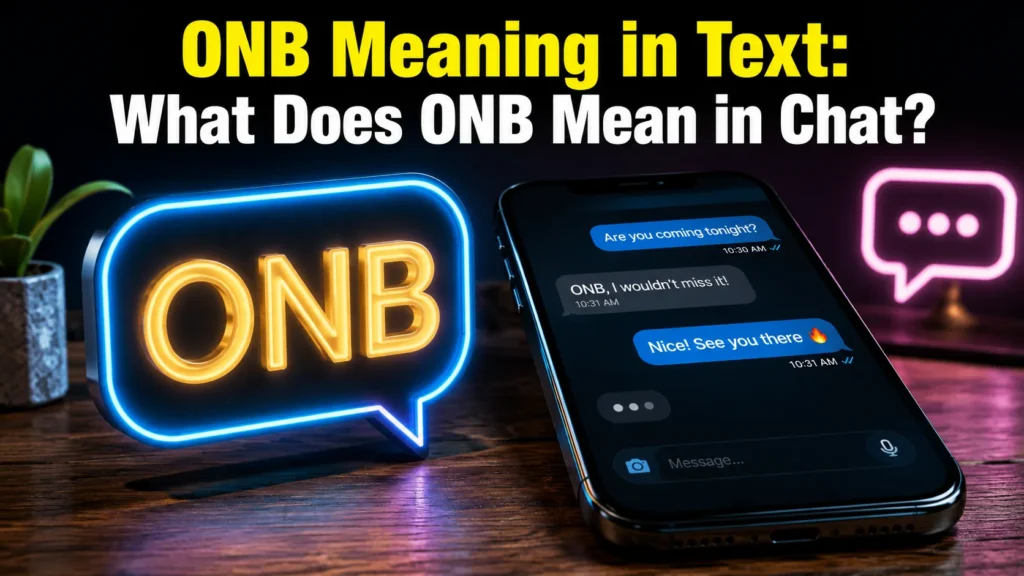

If someone suddenly sends you “ONB” in a text, comment, or DM, the three letters can look like a tiny puzzle. Modern texting moves quickly, and slang often compresses an entire phrase into a few characters. Fortunately, ONB meaning in text is usually straightforward once you understand the context.
In current casual internet slang, ONB most commonly means “On Bro.” People use it to emphasize that they’re telling the truth, standing behind a statement, or speaking seriously. Depending on the conversation, it can feel similar to “I swear,” “for real,” “I’m serious,” or “no lie.” Current slang references consistently identify “On Bro” as the main texting interpretation, although other meanings can exist outside casual conversation.
The interesting part is tone. ONB doesn’t always translate word-for-word into one English sentence. Someone might use it to defend a claim, agree with a friend, emphasize an opinion, or add weight to a reaction.
That’s why reading the surrounding message matters. Think of ONB as a verbal stamp of sincerity: the sender is putting extra emphasis behind what they just said.
Quick Answer: What Does ONB Mean in Text?
ONB in text usually means “On Bro.” It is casual slang used to emphasize that a statement is true, serious, or sincere.
Depending on the sentence, you can understand it as:
- “I swear.”
- “I’m serious.”
- “I’m telling the truth.”
- “For real.”
- “I promise.”
- “Believe me.”
For example:
“ONB, I didn’t know she was coming.”
This generally means:
“I swear, I didn’t know she was coming.”
Another example:
“ONB that movie was crazy.”
Here, ONB adds emphasis to the speaker’s opinion. The person isn’t necessarily making a literal oath. They’re stressing that they genuinely mean what they’re saying.
The slang reference Slang.net describes ONB as “on, bro” and explains that people use it to emphasize the truth of a statement or claim. It also notes that the abbreviation became popular in online messaging in the late 2010s.
Comparison Overview
Before getting deeper into ONB meaning in text, it helps to compare it with familiar expressions that perform a similar job.
| Expression | Common meaning | Main purpose | Tone |
| ONB | On Bro | Emphasizes sincerity or truth | Casual |
| ONG | On God | Strongly emphasizes truth or seriousness | Casual |
| FR | For real | Shows agreement or sincerity | Casual |
| NGL | Not gonna lie | Introduces an honest statement | Casual |
| No cap | No lie / I’m being truthful | Emphasizes honesty | Casual |
| ISTG | I swear to God | Strong emphasis, frustration, or sincerity | Casual |
| I swear | A direct statement of sincerity | Confirms truth | Casual to neutral |
These expressions overlap in function, but they’re not exact synonyms. For example, ONB literally points to “bro,” while ONG uses “God.” The emotional effect can also vary depending on the person, relationship, and conversation.
A Simple Way to Remember ONB
Think of it like this:
Statement → ONB → Extra emphasis
For example:
“That was the best burger I’ve ever had.”
becomes:
“That was the best burger I’ve ever had, ONB.”
The basic claim stays the same. ONB simply turns up the intensity.
What Does ONB Mean in Texting?
The primary ONB meaning in texting is “On Bro.” It belongs to informal digital slang rather than standard written English.
When someone types ONB, they’re often trying to make their statement sound more convincing or sincere. Texting doesn’t give you facial expressions, vocal emphasis, or body language. A person can’t raise their eyebrows, change their voice, or lean forward to show they’re serious.
Slang fills part of that gap.
Adding ONB can function like a digital version of saying:
“I’m being completely serious.”
For example:
“ONB, I thought you already left.”
The sender is emphasizing that they genuinely believed the other person had left.
Likewise:
“That game was insane ONB.”
The writer is reinforcing the strength of their reaction.
Current explanations of ONB describe this same function: the abbreviation adds weight to a claim and communicates honesty or seriousness.
Is ONB an Acronym or Slang?
In everyday online use, ONB is best understood as an abbreviation for a slang phrase rather than a formal acronym with one universally recognized definition.
That’s an important distinction.
Standard abbreviations tend to maintain relatively stable meanings. Internet slang is much more fluid. People shorten phrases, reshape expressions, and adapt them to different communities.
That’s why context remains essential.
What Does “On Bro” Mean?
To understand ONB meaning in text, you first need to understand the phrase behind the letters.
“On Bro” is an informal expression used to reinforce a statement. In practical conversation, it can communicate something close to “I swear on my bro” or simply “I’m serious, bro.”
The exact literal interpretation isn’t always the point. Slang often works through social meaning rather than strict dictionary definitions.
For example:
“ONB, I didn’t take your charger.”
The important message isn’t the exact construction of “on bro.” The sender wants you to understand:
“I’m telling you the truth.”
Another example:
“ONB, that was hilarious.”
This means something like:
“Seriously, that was hilarious.”
So, when you encounter ONB, don’t get trapped trying to translate each letter mechanically. Look at what the sender is trying to emphasize.
How Is ONB Used in Text Messages?
ONB can appear in several positions within a message. Its role usually stays similar, but the placement can change the rhythm and emphasis.
ONB at the Beginning of a Sentence
Starting with ONB can make the statement feel particularly emphatic.
“ONB, I didn’t see your message.”
The sender is essentially saying:
“I’m serious. I didn’t see your message.”
Another example:
“ONB, that was the funniest thing ever.”
The phrase immediately signals that the following statement carries strong personal emphasis.
ONB at the End of a Sentence
Some people place ONB after the main statement.
“That restaurant was amazing ONB.”
Here, the main idea comes first. ONB works almost like an emphasis tag.
ONB as a Standalone Reply
You may also see:
“ONB.”
A standalone ONB can make sense when the previous message gives it context.
For example:
Friend: “That teacher gives way too much homework.”
You: “ONB.”
In this case, the response can mean:
“Seriously. I agree.”
The surrounding conversation does most of the interpretive work.
ONB With Emojis
Emojis can change the emotional flavor without changing the basic slang meaning.
Examples include:
- “ONB 😂” — sincere agreement mixed with humor
- “ONB 😭” — strong emotional reaction
- “ONB 💀” — humorous disbelief or amusement
- “ONB fr” — extra emphasis on agreement or sincerity
The emoji isn’t part of the definition. It simply provides tone that plain text can’t always communicate.
Main Differences Between ONB and Similar Texting Slang
The ONB meaning in text becomes easier to understand when you compare it with related expressions.
ONB vs. ONG
ONB usually means “On Bro.”
ONG commonly means “On God.”
Both can emphasize sincerity, but they’re not literally the same phrase.
Example:
“ONB, I didn’t touch it.”
“ONG, I didn’t touch it.”
Both statements emphasize that the speaker claims to be telling the truth. However, the expressions carry different wording and cultural associations.
ONB vs. FR
FR means “for real.”
It’s usually used to show agreement, seriousness, or authenticity.
“That movie was actually good.”
“FR.”
ONB can perform a similar function, but it often carries a stronger oath-like or emphatic flavor.
ONB vs. NGL
NGL means “not gonna lie.”
It typically introduces an honest opinion.
“NGL, that outfit looks great.”
ONB works differently because it generally reinforces a statement rather than introducing an admission.
ONB vs. No Cap
No cap means “no lie” or “I’m being truthful.”
“No cap, that was the best concert ever.”
This can overlap strongly with ONB. Still, they’re separate slang expressions with different wording and cultural histories.
ONB vs. ISTG
ISTG stands for “I swear to God.”
It’s often stronger and can also express frustration.
“ISTG, if this happens again…”
ONB can emphasize seriousness without necessarily carrying the same religious wording.
How to Tell What ONB Means in a Conversation
Here’s where context becomes more useful than memorizing definitions.
If you see ONB and aren’t sure what the sender means, follow these clues.
Read the Entire Sentence
Never interpret an abbreviation in isolation if the message gives you more information.
Compare:
“ONB, I didn’t do it.”
with:
“ONB 😂 that was hilarious.”
The first focuses on defending a claim. The second emphasizes a reaction.
Look at What Comes Before ONB
The preceding message can reveal why the sender used it.
If someone questioned their honesty, ONB probably reinforces a denial or claim.
If someone made an opinionated statement, ONB may signal strong agreement.
Check the Tone
Punctuation and emojis can provide useful clues.
For example:
“ONB??”
doesn’t carry exactly the same tone as:
“ONB 😂”
The first could indicate surprise or disbelief. The second may be playful.
Consider the Relationship
A close friend might use ONB casually. A stranger could use the same abbreviation in a completely different conversational style.
Slang isn’t just vocabulary. It’s social language.
ONB Meaning on TikTok, Snapchat, and Instagram
The ONB meaning on TikTok, Snapchat, and Instagram generally follows the same casual slang interpretation: “On Bro.”
The platform may change how you encounter the term, but it doesn’t automatically give ONB a completely different definition.
ONB on TikTok
On TikTok, you might encounter ONB in:
- Comments
- Replies
- Captions
- Direct messages
- Reactions to videos
For example:
“ONB this is the funniest video I’ve seen today 😭”
The user is emphasizing their reaction.
ONB on Snapchat
Snapchat’s conversational style is particularly casual, so abbreviations can appear naturally in:
- Chats
- Story replies
- Friend-to-friend messages
- Casual snaps
A message such as “ONB I wasn’t there” would normally be understood as an emphatic claim of honesty.
Also Read This: 304 Meaning: What It Means in Text, Social Media, and the Internet
ONB on Instagram
On Instagram, ONB can appear in:
- DMs
- Comment sections
- Story replies
- Group conversations
Again, context matters more than the platform itself.
Current slang references specifically discuss ONB across TikTok, Snapchat, Instagram, and ordinary messaging.
ONB Examples in Real Text Conversations
The following examples are illustrative conversations designed to show how ONB works naturally.
Case Study: Defending Yourself
Alex: “Did you take my headphones?”
Jordan: “ONB, I didn’t touch them.”
Here, ONB strengthens Jordan’s denial. The intended meaning is close to “I swear I didn’t touch them.”
Case Study: Strong Agreement
Alex: “That was the best episode.”
Jordan: “ONB.”
Here, the standalone response expresses strong agreement.
Case Study: Emphasizing an Opinion
“ONB, that song is way too underrated.”
The sender isn’t necessarily making a factual claim. They’re emphasizing how strongly they feel about the song.
Case Study: Promising Something
“ONB, I’ll send you the money tomorrow.”
Here, ONB reinforces the promise.
Case Study: Reacting to Something Funny
“ONB 😂 why did he actually do that?”
The expression adds emphasis to the reaction.
Case Study: Expressing Surprise
“ONB, you actually won?”
Here, the sender may be emphasizing genuine surprise.
More Natural Examples
| Text message | What ONB communicates |
| “ONB, I didn’t know.” | I’m serious; I didn’t know. |
| “That movie was fire ONB.” | I genuinely thought it was great. |
| “ONB, you’re right.” | I seriously agree with you. |
| “ONB I saw him there.” | I’m telling you the truth. |
| “ONB 😂 that’s crazy.” | That’s genuinely crazy/funny. |
| “I was tired ONB.” | I’m emphasizing that I really was tired. |
| “ONB, trust me.” | I’m seriously asking you to believe me. |
| “ONB, that was wild.” | I’m strongly emphasizing my reaction. |
How Do You Respond to ONB?
You don’t need a special response every time someone uses ONB.
The best reply depends on what the person is actually saying.
If You Agree
Try:
- “For real.”
- “Facts.”
- “Exactly.”
- “I know 😂”
- “No cap.”
If You Believe Them
You could say:
- “I believe you.”
- “Yeah, I got you.”
- “Okay, fair.”
- “I hear you.”
If You’re Surprised
Natural replies include:
- “Seriously?”
- “No way 😭”
- “You’re kidding.”
- “For real?”
If You Don’t Understand
There’s nothing wrong with asking:
“What do you mean by ONB?”
That’s often better than guessing and accidentally replying to the wrong meaning.
Can ONB Have Other Meanings?
Yes. ONB isn’t restricted to one meaning in every possible context.
This distinction matters because an abbreviation can function as slang in one conversation and as an organizational or technical abbreviation somewhere else.
For example, a general abbreviation database lists “outward nose breath” as another meaning of ONB alongside “on, bro.”
However, that doesn’t mean you should automatically interpret a casual text as “outward nose breath.” The surrounding context should guide you.
In Casual Texting
The leading interpretation is:
ONB = On Bro
Outside Casual Slang
ONB may refer to something else depending on the subject.
The safest rule is simple:
Don’t force a slang definition onto a technical or professional conversation.
If someone writes ONB in a business report, medical document, academic paper, or technical discussion, examine the surrounding terminology before assuming it’s texting slang.
Is ONB Appropriate for Formal or Professional Messages?
Generally, no.
ONB is informal internet slang. It works best when the conversation is relaxed and the people involved understand the expression.
Avoid it in:
- Business emails
- Job applications
- Academic assignments
- Formal reports
- Customer-service communication
- Professional presentations
- Legal or official documents
For example, this might work between friends:
“ONB, I’ll finish it tonight.”
But a professional message should say:
“I can confirm that I’ll finish it tonight.”
The second version communicates the same confidence without relying on slang.
Why Context Matters at Work
Professional communication depends heavily on clarity. Slang can create unnecessary ambiguity, especially when readers come from different age groups, industries, or cultural backgrounds.
A three-letter abbreviation that feels obvious in a group chat may look like a typo in a business email.
Use ONB where it feels natural. Don’t force it into formal writing.
Common Mistakes People Make With ONB
Understanding the definition is only half the job. You also need to know what not to assume.
Assuming ONB Always Has One Meaning
This is the biggest mistake.
“On Bro” is the main casual texting meaning, but abbreviations can have unrelated definitions elsewhere.
Treating ONB and ONG as Identical
They serve similar purposes in some conversations, but ONB means “On Bro” while ONG means “On God.”
Similar function doesn’t mean identical meaning.
Using ONB in Formal Writing
Slang has a home. A research paper, business proposal, or formal email usually isn’t it.
Ignoring the Surrounding Message
The letters alone don’t tell you everything.
Compare:
“ONB, I didn’t do that.”
with:
“ONB 😂 that was hilarious.”
The first reinforces a claim. The second reinforces an emotional reaction.
Assuming Every Online Definition Is Equally Reliable
Search results for slang can be messy. Some websites list numerous speculative expansions without explaining how commonly people actually use them.
For a practical ONB meaning in text, prioritize the meaning supported by actual slang references and the immediate conversational context.
Why Does ONB Sound So Emphatic?
There’s a useful linguistic idea behind this.
People often use oaths, intensifiers, and identity-based expressions when they want others to trust a statement. “I swear,” “on my life,” “on God,” and “on bro” all perform versions of this social function.
ONB is therefore doing more than saving typing time.
It communicates stance.
The sender isn’t merely saying:
“That happened.”
They’re signaling:
“I’m standing behind the fact that it happened.”
That distinction explains why ONB often appears when someone is defending themselves, emphasizing an opinion, confirming a claim, or strongly agreeing with another person.
Is ONB Positive, Negative, or Neutral?
ONB itself isn’t inherently positive or negative.
Its emotional direction comes from the sentence around it.
Positive
“ONB, that was an amazing concert.”
The speaker is emphasizing a positive opinion.
Negative
“ONB, that was the worst service ever.”
The speaker is emphasizing criticism.
Neutral
“ONB, I didn’t see him today.”
The speaker is simply emphasizing a factual claim.
So, don’t read ONB as an emotion by itself. It’s an emphasis marker.
What Does ONB Mean From a Girl or Guy?
If someone asks, “What does ONB mean from a girl?” or “What does ONB mean from a guy?”, the answer usually doesn’t change based on gender.
ONB primarily communicates the same basic idea:
“On Bro” — I’m serious, I’m being truthful, or I strongly stand by what I’m saying.
What can change is the tone of the individual message.
For example:
“ONB you’re actually funny 😂”
may sound playful or complimentary.
Meanwhile:
“ONB I didn’t do it.”
sounds defensive.
The surrounding words tell you far more than the sender’s gender.
What Does ONB Mean in a Relationship or Dating Chat?
In romantic or dating conversations, ONB generally keeps its casual slang meaning when the context supports “On Bro.”
For example:
“ONB, I wasn’t ignoring you.”
Here, the sender is emphasizing sincerity.
Or:
“ONB you looked amazing tonight.”
Here, ONB adds emphasis to the compliment.
However, don’t automatically interpret ONB as romantic slang. The abbreviation itself doesn’t mean “I like you,” “I love you,” or anything romantic. The rest of the message determines that.
ONB Meaning in Text: Key Facts at a Glance
| Question | Answer |
| What does ONB mean in text? | Usually “On Bro.” |
| What does ONB stand for? | Most commonly On Bro in casual slang. |
| What does ONB mean in chat? | It emphasizes sincerity, truth, seriousness, or agreement. |
| Is ONB slang? | Yes, in its common texting use. |
| Is ONB the same as ONG? | No. ONB means On Bro; ONG means On God. |
| Can ONB mean something else? | Yes, depending on the context. |
| Can you use ONB at work? | It’s generally better to avoid it in formal communication. |
| Is ONB positive or negative? | Neither by itself. The sentence determines the tone. |
| Can ONB be used alone? | Yes, especially as an emphatic agreement or confirmation. |
| Does ONB have a romantic meaning? | Not inherently. Context determines whether a message is romantic. |
FAQs:
What does ONB mean in text?
ONB usually means “On Bro” in casual texting. People use it to emphasize truth, sincerity, seriousness, or strong agreement.
What does ONB mean on Snapchat?
On Snapchat, ONB generally means “On Bro” when used as casual slang. It can reinforce a statement or show that the sender is being serious.
What does ONB mean on TikTok?
On TikTok, ONB can appear in comments, captions, replies, and messages. In casual slang, it commonly means “On Bro” and adds emphasis to the user’s statement.
Is ONB the same as ONG?
No. ONB commonly means “On Bro,” while ONG means “On God.” Both expressions can emphasize sincerity, but they’re different phrases.
How do you respond to ONB?
Respond according to the conversation. If you agree, try “facts,” “for real,” or “exactly.” If you’re unsure what the sender means, simply ask them to clarify.
Conclusion:
The easiest way to remember ONB meaning in text is this: ONB usually means “On Bro,” and people use it to put extra weight behind what they’re saying.
If someone writes “ONB, I’m telling the truth,” they’re emphasizing sincerity. If they reply “ONB” to your opinion, they may be strongly agreeing. If they write “ONB 😂”, the expression may reinforce a funny or dramatic reaction.
The abbreviation doesn’t carry one fixed emotional mood. Context does the heavy lifting.
Most importantly, don’t confuse ONB with ONG, FR, NGL, or no cap just because these expressions can perform similar jobs. Each has its own wording and flavor.
So the next time you see ONB in a text, don’t treat it like a secret code. Read the sentence around it. In most casual conversations, the sender is simply telling you, “I’m serious. I’m being real with you.”