
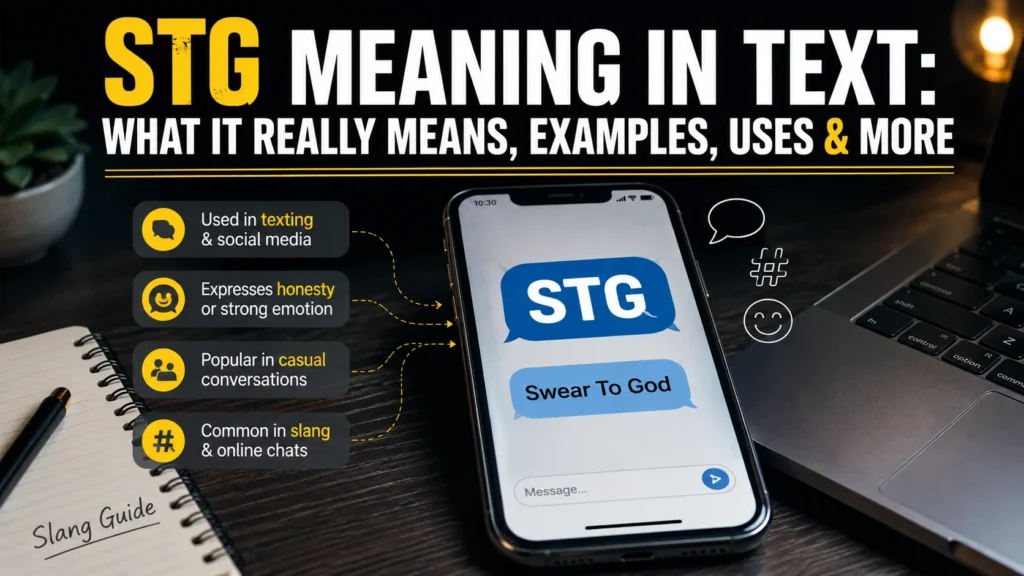

Have you ever received a text that simply says “STG” and wondered what those three letters actually mean? You’re not alone. Texting slang changes quickly, and short abbreviations can carry a surprising amount of emotion.
In most texting and social media conversations, STG means “Swear to God.” People use it to emphasize that they’re telling the truth, making a strong statement, expressing frustration, or reacting intensely to something. The same three letters can sound serious in one message and playful in another.
That difference comes down to context and tone. For example, “STG I didn’t take it” sounds like a firm denial, while “STG that movie was amazing 😂” sounds enthusiastic and casual. Current slang references consistently identify “Swear to God” as the primary meaning of STG in texting.
Quick Answer
STG means “Swear to God” in text messages, chats, comments, and most social media conversations.
People generally use STG to:
- Emphasize that they’re telling the truth
- Show that they genuinely mean something
- Make a promise or strong assurance
- Express frustration
- Show surprise or disbelief
- Add emotional intensity to a statement
- React dramatically or humorously
For example:
“STG, I didn’t eat your leftovers.”
This means roughly, “I swear to God, I didn’t eat your leftovers.”
Another example:
“STG that was the funniest thing I’ve ever seen 😂.”
Here, STG doesn’t necessarily signal a solemn promise. Instead, it intensifies the speaker’s enthusiasm.
So, if someone sends you “STG”, don’t interpret the abbreviation by itself. Look at the entire sentence. That’s where the real meaning and tone become clear.
Comparison Overview
| Term | Full Meaning | Typical Use | Tone |
| STG | Swear to God | Emphasis, honesty, strong reactions | Casual, serious, emotional |
| ISTG | I Swear to God | Strong personal emphasis | More direct or intense |
| FR | For Real | Agreement or sincerity | Casual |
| ONG | On God | Strong assurance or emphasis | Casual, emphatic |
| No cap | No lie / I’m being honest | Confirming truth | Casual |
| I swear | I swear | Assurance or emphasis | Depends on context |
Although these expressions can overlap, they aren’t perfect substitutes. STG specifically comes from the phrase “Swear to God,” while expressions such as FR and no cap emphasize truthfulness without using the same wording.
What Does STG Mean in Text?
The most common STG meaning in text is “Swear to God.”
It’s an abbreviation that compresses a familiar phrase into three letters. In fast-moving digital conversations, that makes the expression quick to type while preserving its emotional punch.
When someone writes STG, they may be communicating one of several closely related ideas:
- “I’m telling the truth.”
- “I really mean this.”
- “I promise.”
- “Believe me.”
- “I’m seriously saying this.”
- “I can’t believe this.”
The surrounding words determine which interpretation fits best.
Consider these two messages:
“STG I didn’t send that message.”
and:
“STG this pizza is incredible.”
The first message focuses on honesty and denial. The second emphasizes strong personal opinion or excitement.
That’s why translating STG as only “I promise” doesn’t always capture its full conversational function.
What Does STG Stand For?
The letters represent:
| Letter | Word |
| S | Swear |
| T | To |
| G | God |
Therefore:
STG = Swear to God
The abbreviation is usually written as STG, stg, or occasionally Stg. Capitalization normally doesn’t change the meaning. A lowercase “stg” is simply a more relaxed texting style.
How Is STG Used in Texting?
The most important thing to understand about STG slang meaning is that it adds emphasis.
Think of STG as a verbal highlighter. The sentence already contains the basic message, while STG tells the reader, “Pay attention. I really mean this.”
STG to Show Honesty
One of the most common uses involves defending yourself or confirming that you’re telling the truth.
“STG, I wasn’t there last night.”
The speaker wants the other person to believe the claim.
Another example:
“STG I left your charger on the desk.”
Here, STG reinforces the person’s certainty.
STG to Make a Strong Statement
Sometimes nobody is accusing anyone of lying. The sender simply wants to make a statement feel stronger.
“STG this is the best burger I’ve ever had.”
The person isn’t necessarily making a literal oath. They’re adding emotional weight to their opinion.
STG to Express Frustration
STG also appears when someone feels irritated, exhausted, or overwhelmed.
“STG, this computer keeps freezing.”
The abbreviation makes the complaint sound more forceful.
You might also see:
“STG if this happens one more time…”
In this structure, STG can signal a warning or rising frustration. The exact seriousness depends heavily on the relationship between the people involved.
STG to Express Surprise
A surprising event can also trigger STG.
“STG, you actually won?”
Here, the speaker isn’t necessarily promising anything. They’re reacting with disbelief.
STG for Humor and Drama
Internet conversations often exaggerate emotions for comedic effect.
“STG I almost died when I saw that picture 😂.”
The person usually isn’t making a literal statement about dying. They’re using exaggerated language to show that something was extremely funny or shocking.
That distinction matters. Texting slang often communicates emotion rather than literal meaning.
STG Meaning in Different Contexts
The phrase “Swear to God” stays the same, but its conversational purpose can shift dramatically.
| Context | Example | Likely Meaning |
| Honesty | “STG I didn’t do it.” | I’m telling the truth. |
| Promise | “STG I’ll call you later.” | I promise I’ll call. |
| Excitement | “STG that concert was insane!” | I really mean how amazing it was. |
| Frustration | “STG this app never works.” | I’m seriously frustrated. |
| Surprise | “STG you met her?” | I can’t believe it. |
| Humor | “STG I almost fell over 😂.” | That was ridiculously funny or surprising. |
| Warning | “STG, don’t do that again.” | I’m being very serious. |
The Words Around STG Matter
Suppose someone writes:
“STG you’re the funniest person I know.”
That’s probably affectionate or enthusiastic.
Now compare it with:
“STG, stop doing that.”
The second sentence sounds much more serious.
The abbreviation hasn’t changed. The surrounding language has changed the emotional temperature.
STG Meaning in Text Messages With Examples
Here are practical examples that show how people may use STG in everyday conversations.
Example: Proving Innocence
Friend: “Did you take my headphones?”
Reply: “STG, I didn’t touch them.”
Meaning: I swear I’m telling the truth.
Example: Strong Agreement
Friend: “That was the worst traffic ever.”
Reply: “STG. I was stuck there for an hour.”
Meaning: Seriously. I completely agree.
Example: Excitement
Friend: “Did you try the new restaurant?”
Reply: “STG, the food was incredible.”
Meaning: I genuinely thought it was amazing.
Example: Frustration
Friend: “The Wi-Fi went down again.”
Reply: “STG, this happens every single day.”
Meaning: I’m seriously frustrated about this.
Example: Surprise
Friend: “I got the job!”
Reply: “STG? That’s amazing!”
Meaning: I can’t believe it. That’s incredible.
Example: Funny Reaction
Friend: “I accidentally sent the screenshot to the person we were talking about.”
Reply: “STG 😂 You actually did that?”
Meaning: I can’t believe you did that.
STG Meaning on Snapchat
If you’re wondering what STG means on Snapchat, the answer is usually the same: “Swear to God.”
Snapchat encourages quick communication through chats, snaps, captions, and reactions. STG fits naturally into that environment because it takes only three characters.
For example:
“STG I saw him at the mall.”
or:
“STG 😂 you did not just say that.”
On Snapchat, emojis can provide important clues about the intended tone. A message containing 😂, 😭, 💀, or 🤣 may be playful or exaggerated, while a short message with no emoji may feel more serious.
However, emojis don’t create a new definition. They simply help communicate the sender’s mood.
STG Meaning on TikTok
On TikTok, STG commonly appears in comments, replies, captions, and conversations connected to videos.
Someone might comment:
“STG this is the funniest video today 😂.”
Another person might write:
“STG I need part 2.”
In these situations, STG works as an emphasis marker. It tells other users that the commenter feels strongly about what they’re saying.
TikTok’s fast comment culture also encourages short expressions that communicate a lot with very few characters. STG fits that style well.
Also Read This: ONB Meaning in Text: What Does ONB Mean in Chat?
STG Meaning on Instagram
On Instagram, you’ll most often encounter STG in:
- Direct messages
- Comments
- Story replies
- Group conversations
- Casual captions
For example:
“STG your dog gets cuter every day.”
This usually sounds like enthusiastic praise rather than a solemn promise.
In a private DM, STG can also help convey emotion that might otherwise get lost through plain text. Without facial expressions or vocal tone, a short abbreviation can act like a little emotional signpost.
Main Differences Between STG Meaning in Text and Similar Slang
Although STG belongs to the same broad family of internet slang as FR, ONG, and “no cap,” each expression carries a slightly different flavor.
STG vs. ISTG
STG means “Swear to God.”
ISTG means “I Swear to God.”
They overlap heavily. Some slang references treat them as essentially equivalent, while everyday usage can make ISTG feel more personal because it explicitly includes “I.”
Compare:
“STG this is ridiculous.”
“ISTG this is ridiculous.”
Both communicate strong emotion. The second can feel slightly more direct or heated.
STG vs. FR
FR means “for real.”
It’s commonly used to show agreement, sincerity, or seriousness.
“That movie was so good.”
“FR.”
STG has a stronger oath-like flavor:
“STG that movie was amazing.”
FR often means “I agree” or “seriously.” STG can carry more personal emphasis.
STG vs. ONG
ONG commonly means “on God.”
Like STG, it can emphasize sincerity or reinforce a strong statement.
“ONG, that’s true.”
and:
“STG, that’s true.”
These can communicate similar ideas. Still, they aren’t interchangeable in every sentence because their phrasing and cultural usage differ.
STG vs. No Cap
“No cap” means “I’m not lying” or “I’m being completely honest.”
For example:
“No cap, this is the best pizza in town.”
STG:
“STG, this is the best pizza in town.”
Both can reinforce honesty, but STG uses a stronger oath-based expression.
STG vs. ISTG: A Simple Comparison
| Feature | STG | ISTG |
| Full phrase | Swear to God | I Swear to God |
| Number of letters | 3 | 4 |
| Main purpose | Emphasis and sincerity | Strong personal emphasis |
| Common in texting | Yes | Yes |
| Can express frustration | Yes | Yes |
| Can express honesty | Yes | Yes |
| Can be playful | Yes | Yes |
| Basic meaning | Nearly identical | Nearly identical |
The practical takeaway is simple: if you understand STG, you’ll usually understand ISTG too.
Is STG a Bad Word or Offensive?
STG isn’t generally treated as a profanity by itself. However, it can still be inappropriate in certain situations.
The reason is straightforward: the phrase expands to “Swear to God,” which uses a religious reference. Some people are comfortable with that expression, while others may avoid it because of their personal beliefs.
Context also matters.
| Situation | Is STG Appropriate? |
| Texting a close friend | Usually |
| Casual group chat | Usually |
| Social media comment | Often |
| Private conversation | Depends on the people involved |
| School assignment | Better to avoid |
| Job application | Avoid |
| Professional email | Avoid |
| Formal report | Avoid |
A useful rule is this:
If you wouldn’t normally write “Swear to God” in the situation, don’t rely on STG either.
In professional communication, clearer alternatives usually work better.
Instead of:
“STG, I’ll send it today.”
write:
“I promise I’ll send it today.”
Or simply:
“I’ll send it today.”
The second version is often stronger because it sounds calm and professional.
How to Use STG Naturally in a Sentence
STG can appear in different positions within a message.
At the Beginning
“STG, I didn’t know about the meeting.”
This placement gives the statement immediate emphasis.
In the Middle
“I STG didn’t touch your laptop.”
This structure is common in informal texting, although the exact wording can vary depending on the speaker’s style.
At the End
“That was the funniest thing ever, STG.”
Here, STG acts almost like an afterthought that reinforces the statement.
Lowercase vs. Uppercase
Both forms generally mean the same thing:
- STG
- stg
- Stg
Lowercase tends to feel more relaxed because texting users often avoid capitalization. Uppercase can visually emphasize the abbreviation, especially in an emotional message.
However, capitalization doesn’t create a separate slang definition.
Case Studies: How Context Changes STG
Case Study: A Defensive Text
Imagine two friends disagreeing about who borrowed a charger.
Person A: “You took my charger yesterday.”
Person B: “STG I didn’t.”
Here, STG reinforces denial and honesty. The sender wants to make their claim sound credible.
Now imagine the same abbreviation in a completely different situation.
Case Study: Excited Reaction
Person A: “I finally got tickets to the concert!”
Person B: “STG that’s awesome!”
The meaning is still based on “Swear to God,” but the practical function is enthusiastic emphasis, not denial.
Case Study: Frustration
Person A: “The printer broke again.”
Person B: “STG this printer hates me.”
This is mostly an emotional reaction. The sender isn’t making a formal oath. They’re expressing exaggerated frustration.
Case Study: Humor
Person A: “I accidentally wore two different shoes today.”
Person B: “STG 😂 that’s actually hilarious.”
Here, the abbreviation adds dramatic emphasis to a playful response.
These examples show why dictionary-style definitions aren’t enough. STG is a context-sensitive expression.
How to Respond When Someone Texts “STG”
Your response should match the meaning behind the message.
If They’re Proving They’re Telling the Truth
You can reply:
- “Okay, I believe you.”
- “Fair enough.”
- “Got you.”
- “Alright, I trust you.”
If They’re Expressing Frustration
Try:
- “I know. That’s so annoying.”
- “Seriously 😭.”
- “Same here.”
- “I feel you.”
If They’re Excited
You might say:
- “Right?!”
- “I know 😂.”
- “Exactly!”
- “That’s what I’m saying!”
If They’re Joking
A playful response works best:
- “LOL.”
- “You’re dramatic 😂.”
- “No way.”
- “I can’t with you.”
If You Don’t Understand the Context
There’s nothing wrong with asking:
“What do you mean by STG here?”
Context beats guessing.
Common Mistakes When Interpreting STG
Assuming STG Always Means Anger
It doesn’t.
STG can communicate honesty, excitement, frustration, surprise, humor, or emphasis.
Treating It as a Literal Oath Every Time
In casual internet communication, STG frequently works as an emotional intensifier.
Someone saying:
“STG this song is amazing.”
may simply mean:
“I seriously love this song.”
Assuming STG and ISTG Are Completely Different
They aren’t.
Both expressions revolve around “Swear to God.” ISTG simply includes the first-person pronoun.
Ignoring the Rest of the Message
This is probably the biggest mistake.
Consider:
“STG you’re amazing.”
versus:
“STG stop doing that.”
The first sounds complimentary. The second sounds irritated or stern.
Using STG in Formal Writing
Texting slang has its place. A job application, academic essay, business proposal, or formal email usually isn’t it.
The problem isn’t that STG is universally offensive. The problem is register. Formal communication requires a different level of precision and professionalism.
Does STG Always Mean “Swear to God”?
In casual texting and social media, “Swear to God” is overwhelmingly the primary interpretation.
However, acronyms can have other meanings outside everyday texting. For example, reference sources list “Shoot ’Em Up” in gaming contexts and “Sterling” in some financial or currency-related usage.
That doesn’t mean you should assume one of these meanings when a friend sends:
“STG I didn’t do it.”
The conversation clearly points toward the slang meaning.
Context is the filter that separates one acronym meaning from another.
STG in Gaming
In gaming terminology, STG can refer to “shoot ’em up,” a type of action game. This is a different use from texting slang.
For example, a gaming discussion might use STG as a genre label rather than an emotional abbreviation.
So if you’re reading:
“I love old-school STGs.”
the gaming context could point toward shoot ’em up rather than “Swear to God.”
That’s why the topic and surrounding words matter.
Alternatives to STG in Texting
Sometimes STG isn’t the best choice. You may want something softer, clearer, or more appropriate for the audience.
Casual Alternatives
- I swear
- For real
- Seriously
- No joke
- No cap
- Honestly
More Polite Alternatives
- I promise
- I’m being serious
- I’m telling you the truth
- Honestly
- I genuinely mean it
Professional Alternatives
Instead of:
“STG I’ll send it today.”
try:
“I’ll send it today.”
Or:
“I can confirm that I’ll send it today.”
Professional communication rarely needs dramatic emphasis. Clear language usually carries more authority than slang.
Quick Facts About STG
- STG usually means: Swear to God
- Primary setting: Texting and casual online communication
- Common platforms: Text messages, Snapchat, TikTok, Instagram, DMs, and group chats
- Main purpose: Emphasis and emotional intensity
- Can express honesty: Yes
- Can express frustration: Yes
- Can express surprise: Yes
- Can be humorous: Yes
- Same as ISTG: Very closely related
- Formal writing: Generally avoid it
- Uppercase vs. lowercase: Usually no difference in meaning
- Other acronym meanings: Possible in specialized contexts
FAQs:
What does STG mean in text?
STG usually means “Swear to God.” People use it to emphasize honesty, seriousness, promises, frustration, surprise, or strong emotions.
What does STG mean on Snapchat?
On Snapchat, STG usually means “Swear to God.” It can appear in chats, snaps, captions, and replies. The exact emotional tone depends on the surrounding message.
What does STG mean on TikTok?
On TikTok, STG generally means “Swear to God.” Users may place it in comments or replies to emphasize agreement, excitement, disbelief, humor, or frustration.
Is STG the same as ISTG?
They’re extremely similar. STG means “Swear to God,” while ISTG means “I Swear to God.” Both can express sincerity or strong emotion. ISTG can sometimes feel more personal or intense because it explicitly begins with “I.”
Is STG rude or offensive?
Not necessarily. STG isn’t generally considered a profanity by itself. However, some people may dislike the religious reference, and the abbreviation can sound too casual or intense in professional settings.
Conclusion:
The main STG meaning in text is simple: “Swear to God.”
What makes the abbreviation interesting isn’t the definition itself. It’s the way people use it to add emotional weight to everyday conversations.
Someone might write “STG I didn’t do it” to defend themselves. Another person might say “STG this is hilarious” to emphasize a joke. A frustrated texter could write “STG this keeps happening” to vent. The abbreviation stays the same while the emotional meaning shifts with the sentence.
That’s the key to understanding STG.
Read the whole message, not just the three letters.
If the conversation is casual and the context involves honesty, emphasis, frustration, excitement, or disbelief, “Swear to God” is almost certainly the intended meaning. Current texting references consistently support this as the standard interpretation.
And when you’re deciding whether to use STG yourself, remember one simple rule: match the language to the audience. It’s perfectly natural among friends and in casual social media conversations. For professional, academic, or formal communication, a clear phrase such as “I promise,” “seriously,” or “I can confirm” will usually make a better impression.