
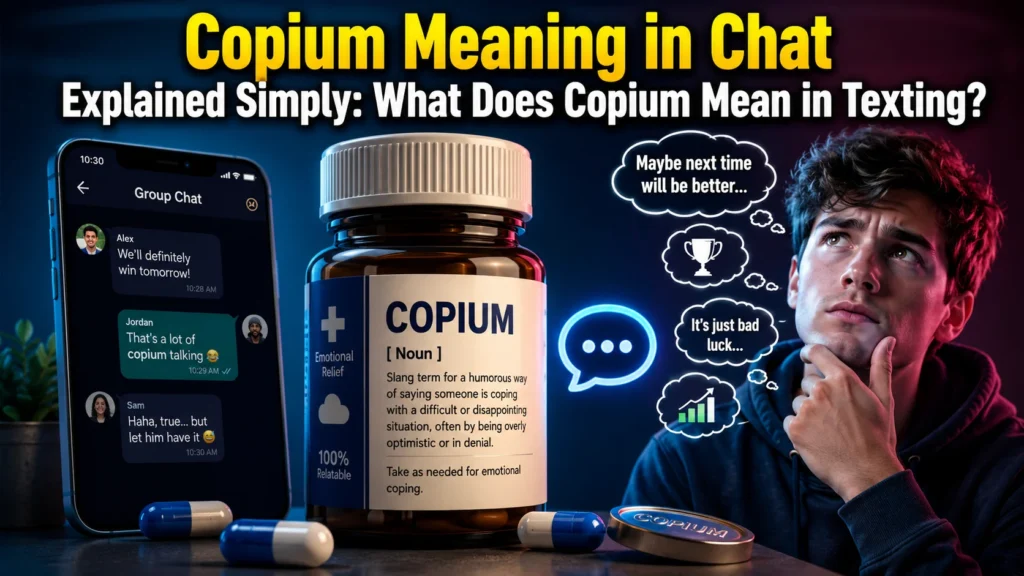

Have you ever seen someone type “copium,” “you’re on copium,” or “huffing copium” in a chat and wondered what they were talking about?
If so, you’re not alone. The term appears frequently in gaming communities, Twitch chats, sports discussions, Reddit threads, memes, and social media conversations. The copium meaning in chat is usually connected to denial, excuses, or unrealistic optimism after something goes wrong. When someone loses a game and immediately explains why the loss “doesn’t really count,” another person might simply reply, “Copium.” It’s a quick, sarcastic way of saying, “You’re trying really hard to convince yourself that everything is fine.”
The word itself combines “cope” and “opium.” The joke imagines that someone is taking a fictional substance called “copium” to make an unpleasant reality easier to accept. It isn’t a real drug in this slang usage. Instead, it’s an internet metaphor that turned into a widely recognized piece of online vocabulary.
Quick Answer
Copium means a humorous or sarcastic form of denial, rationalization, or unrealistic hope after a disappointing outcome.
In simple terms, if someone says “you’re on copium,” they’re usually suggesting that you’re making excuses or convincing yourself that a bad situation isn’t as bad as it really is.
For example:
Friend: “Our team only lost because the referee was biased.”
You: “Bro, that’s copium.”
Here, “copium” doesn’t mean anything literal. It means the speaker thinks the explanation is an excuse being used to feel better about the loss.
Copium at a glance
| Detail | Meaning |
| Term | Copium |
| Basic meaning | Denial or rationalization after disappointment |
| Word formation | Cope + opium |
| Type | Internet slang |
| Common tone | Sarcastic, humorous, teasing |
| Common settings | Gaming, Twitch, sports, Reddit, social media |
| “On copium” | Clinging to an excuse or unrealistic belief |
| “Huffing copium” | Heavily engaging in denial or rationalization |
| Opposite idea | Accepting an unfavorable reality |
| Related slang | Cope, hopium, delulu |
Comparison Overview
The easiest way to understand copium meaning in text is to compare it with similar internet expressions. Although these terms overlap, they aren’t interchangeable in every situation.
| Term | Meaning | Example |
| Copium | Rationalizing or denying an unfavorable outcome | “We only lost because of lag. Pure copium.” |
| Cope | Deal with something difficult | “I’m still trying to cope with the loss.” |
| Hopium | Excessive or unrealistic hope | “They’ll definitely win next season. That’s hopium.” |
| Delulu | Playfully unrealistic thinking | “She thinks her celebrity crush will marry her. She’s delulu.” |
| In denial | Refusing to accept reality | “He’s still in denial about the result.” |
| Making excuses | Offering reasons to defend a failure | “You’re just making excuses.” |
The important distinction is context. “Cope” can be completely neutral. “Copium,” however, normally carries a sarcastic edge.
For example, saying “I’m coping with the loss” simply describes an emotional response. Saying “You’re huffing copium” suggests that someone is refusing to accept what happened.
Main Differences Between Copium Meaning in Chat and Similar Slang
The copium meaning in chat becomes clearer when you understand what separates it from related expressions.
Copium vs. Cope
Cope is a normal English verb that means to deal with a difficult situation.
Copium is internet slang built around the idea that someone is using imaginary “copium” to avoid facing an unpleasant reality.
Consider these two examples:
“I’m trying to cope with losing the championship.”
This statement doesn’t necessarily contain denial.
Now compare it with:
“We didn’t really lose. The other team just got lucky. We’re still the best.”
A person might respond:
“That’s pure copium.”
The second example contains rationalization, which is the key idea behind the slang.
Copium vs. Hopium
Hopium focuses more heavily on unrealistic hope.
Copium usually appears after disappointment when someone tries to explain away what happened.
Think of the difference this way:
- Copium: “We lost, but it doesn’t mean we’re bad.”
- Hopium: “We’ll definitely win next time even though nothing has changed.”
The two expressions can overlap. However, copium is more closely tied to coping with an already disappointing reality, while hopium emphasizes hope for a desired future outcome.
Copium vs. Delulu
“Delulu” is another internet slang term derived from delusional. People often use it jokingly to describe unrealistic beliefs.
Someone can be “delulu” without having experienced a loss. Copium, on the other hand, usually appears around disappointment, failure, defeat, or an unwanted result.
For example:
“My favorite actor will notice my comment and ask me out.”
That might be called delulu.
“The game isn’t over because our team lost the first three rounds.”
That might be called copium.
What Does Copium Mean in Chat?
When someone types “copium” in a chat, they’re usually reacting to another person’s explanation, prediction, or excuse.
The word often functions almost like a complete sentence. Someone doesn’t need to write:
“You’re refusing to accept the result and you’re inventing reasons to make yourself feel better.”
They can simply type:
“Copium.”
That single word communicates the joke.
Example 1: Gaming
Alex: “We would’ve won if our healer hadn’t disconnected.”
Sam: “Copium 💀”
Sam is teasing Alex for explaining away the defeat.
Example 2: Sports
Mike: “Our team wasn’t actually worse. They just had one lucky goal.”
Chris: “Bro is on copium.”
Chris believes Mike is minimizing the loss.
Example 3: Fandoms
Fan: “The character definitely isn’t dead. The writers are setting up a surprise return.”
Reply: “Maximum copium.”
The reply suggests that the fan is clinging to an unlikely theory because they don’t want to accept the character’s apparent fate.
What Does “On Copium” Mean?
The phrase “on copium” means someone is supposedly relying on denial, excuses, or unrealistic optimism to deal with a disappointing situation.
It’s an extension of the fictional-drug metaphor.
Imagine someone saying:
“He’s on copium.”
The speaker isn’t claiming that the person consumed an actual substance. They’re joking that the person has mentally “taken” copium because they can’t accept reality.
Common forms of the phrase
| Expression | Meaning |
| On copium | Trying to rationalize an unfavorable situation |
| Huffing copium | Engaging heavily in denial or unrealistic thinking |
| High on copium | Extremely committed to an unrealistic explanation |
| Pure copium | An obvious excuse or denial |
| Maximum copium | Very strong or exaggerated denial |
| Pass the copium | A joking request for something that makes reality easier to accept |
| Copium levels are high | A group is heavily rationalizing a situation |
These expressions aren’t formal English. They’re casual internet slang, so their exact tone depends on the community using them.
What Does “Huffing Copium” Mean?
“Huffing copium” is a stronger version of “being on copium.”
It suggests that someone is deeply invested in an excuse or unrealistic belief.
For example:
“They lost four matches in a row, but fans still say they’re winning the tournament. They’re huffing copium.”
The humor comes from treating copium as though it were a substance someone could inhale.
The phrase can also be self-deprecating:
“I know the odds are terrible, but I’m still buying the limited-edition console. Let me huff some copium.”
Here, the person recognizes that their reasoning isn’t entirely rational. That self-awareness makes the joke less confrontational.
How Is Copium Used in Texting and Online Chats?
The slang works especially well in fast-moving digital conversations because it’s short, expressive, and easy to understand once you know the context.
1. After a gaming loss
Gaming is one of the clearest environments for copium.
Players regularly argue about:
- Lag
- Matchmaking
- Teammates
- Balance changes
- Character strength
- Server problems
- Bad luck
- Bugs
- Opponent skill
Not every explanation is an excuse. However, when someone keeps searching for reasons why a clear defeat “doesn’t count,” copium becomes a natural response.
“We lost because the map was terrible.”
“Copium.”
2. During sports discussions
Sports fans often use copium after a disappointing game.
“If our striker hadn’t missed that one shot, we’d have won.”
That statement might be completely reasonable. The term becomes more sarcastic when someone uses one small factor to dismiss the entire result.
“They had three injuries, terrible defense, and still say the loss means nothing. That’s copium.”
3. In movie and TV fandoms
Fandoms produce plenty of theories about characters, endings, sequels, and future plot developments.
When fans refuse to accept an unwanted outcome, other users may call those theories copium.
“The finale clearly killed him.”
“No way. He’ll return in the next season.”
“That’s some serious copium.”
4. In online arguments
Someone might use copium when another person repeatedly changes their explanation after receiving contradictory evidence.
For example:
“The product failed because consumers weren’t ready for it.”
Then:
“Actually, it failed because the marketing was too good.”
Then:
“It was never supposed to sell well anyway.”
A commenter might call this copium because the explanation keeps shifting to protect the original belief.
5. When joking about yourself
Copium isn’t always directed at someone else.
People often use the term about their own behavior:
“I definitely didn’t waste money. I’m supporting the developer. Copium.”
This use is often playful because the speaker admits that they’re rationalizing their decision.
Is Copium Positive, Negative, or Insulting?
The answer depends heavily on tone and relationship.
Most uses are informal and sarcastic. Still, the word can become insulting when someone uses it to dismiss a serious opinion without addressing the person’s actual argument.
Playful use
Friends may joke:
“You really think your team is winning the league? Copium 😂”
Nobody necessarily intends harm.
Mocking use
During a heated competition, someone might say:
“Keep huffing that copium.”
That sounds more confrontational.
Dismissive use
Someone could also label a legitimate explanation as “copium” simply because they disagree with it.
That’s why the term shouldn’t automatically replace an actual argument.
Calling something copium doesn’t prove that it is irrational. It only communicates that the speaker sees it that way.
Where Did the Word “Copium” Come From?
The history of copium is more complicated than the modern meme might suggest.
The word is a blend of “cope” and “opium.” Merriam-Webster lists 2000 as its first known use in its dictionary entry. The term also appears in earlier documented cultural contexts, including the title of rapper Keak da Sneak’s 2003 album Copium.
The modern internet meaning developed through online communities and meme culture. One particularly recognizable version involved Pepe the Frog using a mask or apparatus to inhale “copium.” That visual helped turn an obscure slang term into a recognizable internet joke.
A simplified timeline
| Period | Development |
| 2000 | Merriam-Webster records an early known use of “copium” |
| 2003 | The word appears in the title of Keak da Sneak’s Copium |
| 2010s | Internet communities increasingly use the term as slang |
| 2019 | Copium-related Pepe imagery helps popularize the meme |
| 2020s | The expression spreads across gaming, Twitch, sports, fandoms, and social media |
Because slang develops organically, it would be misleading to claim that one person single-handedly invented every modern use of the term.
Why Is Copium Popular in Gaming and Twitch?
Gaming communities provide an almost perfect environment for this slang.
Competitive games create constant emotional swings. One minute you’re celebrating a win. The next, you’re blaming a missed shot, a teammate, matchmaking, or a balance change.
That environment creates a steady supply of situations where people rationalize outcomes.
Twitch makes the term even more useful because chat moves quickly. A viewer may not have time to write a paragraph explaining why a streamer is making excuses.
Instead:
COPIUM
gets the point across immediately.
The word also fits naturally with gaming humor because players already use exaggerated language to describe losses, wins, predictions, and rivalries.
Copium Meme Meaning Explained
The copium meme meaning comes from the same central joke as the slang definition.
The meme portrays copium as a fictional substance that someone uses to escape the emotional discomfort of reality.
A typical meme might show a character wearing an apparatus and “inhaling” copium after a defeat.
The visual joke is straightforward:
Bad result → emotional discomfort → imaginary copium → denial
That’s why the meme works without much explanation.
The person isn’t literally taking a drug. The image exaggerates the idea of “I need something to help me believe my preferred version of events.”
Pepe the Frog became particularly associated with this imagery in internet culture, although the broader slang exists independently of any single meme image.
Is Copium a Real Drug?
No. Copium is not a real drug in the slang sense.
It’s a fictional substance created through wordplay.
The word combines:
- Cope — dealing with a difficult or painful situation.
- Opium — used as the basis for the imaginary-drug joke.
That combination creates the humorous idea of a substance that allows someone to “cope” with reality.
So if someone says:
“I need some copium after that loss.”
They’re making a joke. They’re not referring to an actual pharmaceutical or recreational substance.
Also Read This: STG Meaning in Text: What It Really Means, Examples, Uses & More
Is Copium the Same as Delusion?
Not exactly.
The terms can overlap in casual internet language, but copium has a more specific conversational flavor.
Copium generally refers to someone rationalizing or denying an unfavorable outcome. “Delusion” has a much broader meaning and can carry serious psychological or clinical implications.
For example:
“We lost because the other team got lucky.”
Calling this copium may simply be internet teasing.
Calling someone delusional is a much stronger statement and can carry an entirely different meaning.
For that reason, the two terms shouldn’t be treated as perfect synonyms.
Real-Life Examples of Copium in Conversations
The best way to understand the slang is to see how it behaves in different contexts.
Gaming example
Player A: “We only lost because my controller stopped working.”
Player B: “You missed every shot before that. Copium.”
The second player believes the controller excuse doesn’t explain the entire loss.
Sports example
Fan A: “Our team would’ve won if the referee hadn’t made that one call.”
Fan B: “That’s pure copium.”
The reply suggests that the fan is using one decision to explain away a broader defeat.
Fandom example
Fan: “The character is definitely coming back next episode.”
Friend: “Maximum copium.”
The friend is teasing the fan for holding onto an unlikely theory.
Shopping example
Person: “I didn’t overspend. The premium version is obviously a better investment.”
Friend: “Bro is huffing copium.”
The joke suggests the buyer is rationalizing an expensive purchase.
Self-deprecating example
“The job interview went terribly, but I’m sure they’ll call tomorrow. Copium.”
This version is more self-aware. The speaker knows they’re trying to stay optimistic despite signs that the situation didn’t go well.
How to Use “Copium” Correctly
Using slang naturally requires more than memorizing its dictionary definition. You also need to understand the social setting.
Use “copium” when:
- Someone is making excuses after a loss.
- Someone refuses to acknowledge an unfavorable result.
- Someone keeps defending an unlikely prediction.
- A friend is joking about their own unrealistic expectations.
- You’re participating in an informal online conversation.
- The discussion already uses internet slang and memes.
Avoid “copium” when:
- Someone is discussing genuine grief or serious hardship.
- The conversation requires professional language.
- Someone is sharing a sensitive personal problem.
- Your comment could trivialize a real emotional issue.
- You’re using the word instead of responding to a legitimate argument.
A little context goes a long way.
Calling your friend “copium” after losing a video game is very different from calling someone “copium” while they’re discussing a serious personal setback.
Common Phrases With Copium
Understanding the variations makes it easier to recognize the slang in different communities.
“That’s copium.”
This means:
“That’s an excuse or rationalization.”
Example:
“We would’ve won if we had picked a different character.”
“That’s copium.”
“You’re on copium.”
This means:
“You’re refusing to accept reality.”
Example:
“Our team is still the best even after losing five straight games.”
“You’re on copium.”
“Huffing copium.”
This suggests a stronger degree of denial.
“He’s still predicting a comeback after a 0–3 score. He’s huffing copium.”
“Pass the copium.”
This is usually a playful expression.
“The new update destroyed my favorite character. Pass the copium.”
“Maximum copium.”
This describes an especially unrealistic claim.
“They’ll reverse the decision tomorrow.”
“Maximum copium.”
Copium in Different Online Communities
The same basic meaning appears across different communities, but the subject changes.
| Community | Typical copium situation |
| Gaming | Losing a match or defending a weak character |
| Twitch | Streamer or viewer predicting an unlikely comeback |
| Sports | Explaining away a team’s defeat |
| Anime | Refusing to accept a character’s fate |
| Movies | Expecting an unlikely sequel or twist |
| Crypto | Defending a poor investment or unrealistic prediction |
| Social media | Rationalizing an unpopular decision or failed prediction |
| Fandoms | Maintaining hope despite evidence against a theory |
The underlying pattern remains the same:
Something disappointing happens, and someone finds a reason to believe it isn’t really a problem.
A Simple Case Study: Copium After a Gaming Defeat
Imagine a player loses a ranked match.
The scoreboard shows a clear defeat. Instead of accepting the result, the player says:
- The matchmaking was unfair.
- Their teammate played badly.
- The opponent had a stronger character.
- Their internet connection was slightly unstable.
- The map favored the opponent.
- They were distracted during the final round.
Any one of these explanations could be legitimate.
However, if the player uses every possible explanation to avoid acknowledging poor performance, another player might say:
“You’re huffing copium.”
This example highlights an important point: copium doesn’t mean every explanation is automatically false.
The slang targets the attitude of refusing to accept an unwanted outcome, not necessarily the factual accuracy of every individual explanation.
Common Misunderstandings About Copium
Copium doesn’t always mean lying
Someone can genuinely believe their explanation and still get called “copium.”
The term describes how the statement is perceived. It doesn’t establish whether the statement is objectively true.
Copium doesn’t always mean serious denial
Online communities often use the term for harmless jokes.
A fan might say:
“My team is definitely winning the next tournament.”
They may know perfectly well that the prediction is unlikely.
Copium isn’t the same as coping
Coping can be healthy and necessary. Everyone needs ways to deal with disappointment.
Copium is the sarcastic internet version that suggests the person is avoiding reality rather than simply processing it.
Copium isn’t limited to gaming
Gaming helped popularize the term, but modern usage extends well beyond games.
You can encounter it in:
- Sports
- Politics
- Entertainment
- Investing discussions
- Fandoms
- Social media
- Everyday online conversations
FAQs:
What does copium mean in texting?
Copium means denial, rationalization, or unrealistic optimism after something goes wrong. In texting, someone may reply “copium” when they think another person’s explanation is simply an excuse.
What does “you’re on copium” mean?
“You’re on copium” means “you’re trying to convince yourself that an unfavorable situation isn’t really as bad as it is.” The phrase is usually sarcastic.
Is copium an insult?
It can be. Between friends, it may be harmless teasing. In an argument, however, calling someone’s opinion “copium” can sound dismissive or insulting.
What does “huffing copium” mean?
“Huffing copium” means strongly engaging in denial, rationalization, or unrealistic optimism. The expression extends the joke that copium is a fictional substance.
What’s the difference between copium and hopium?
Copium usually involves rationalizing an existing disappointment, while hopium focuses on unrealistic hope for a desired future outcome.
Conclusion:
The copium meaning in chat is simple once you understand the joke behind it.
Copium is internet slang for denial, rationalization, or unrealistic optimism in response to an unfavorable situation. It’s especially common when someone loses a game, defends a disappointing result, predicts an unlikely comeback, or refuses to accept an outcome they dislike.
The word comes from “cope” + “opium.” It imagines a fictional substance that helps people deal with reality by making denial feel easier. Modern meme culture helped spread the expression across gaming, Twitch, sports, fandoms, and social media.
The most common expressions include:
- “Copium” — that’s denial or rationalization.
- “On copium” — you’re relying on unrealistic reasoning.
- “Huffing copium” — you’re heavily invested in denial.
- “Pure copium” — that’s an obvious excuse.
- “Maximum copium” — that’s an extreme example of unrealistic hope.
Ultimately, the easiest translation is:
Copium = “You’re trying really hard to convince yourself that everything is okay.”
The next time someone responds “copium” after your explanation, you’ll know exactly what they’re implying. They probably think you’re not accepting reality yet—and they’re having a little fun pointing it out.