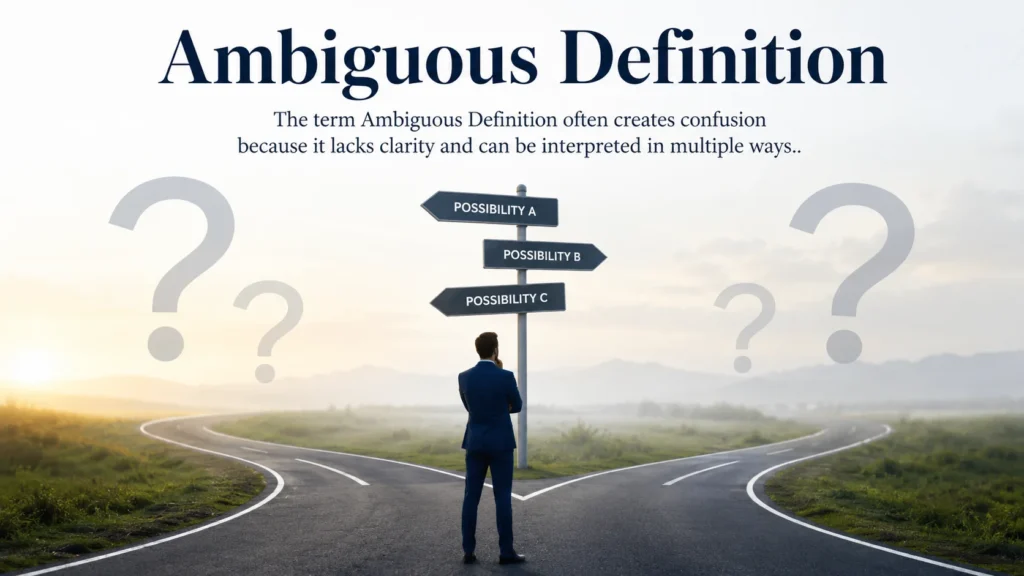

The term Ambiguous Definition often creates confusion because it lacks clarity and can be interpreted in multiple ways. In everyday language, academics, and digital content, ambiguity can lead to misunderstandings and miscommunication. In this article, we will explore what an ambiguous definition truly means, why it exists, and how it affects interpretation in writing, education, and real-world scenarios. By the end, you’ll clearly understand how ambiguity works and how to identify or avoid it when precise meaning matters.
Have you ever read or heard something that could be understood in more than one way? That’s exactly what an Ambiguous Definition refers to. Ambiguity occurs when a word, phrase, statement, or concept has multiple possible meanings, making its interpretation unclear.
Understanding ambiguous definitions is important in everyday communication, writing, law, business, and education because unclear language can lead to confusion, misunderstandings, and misinterpretations. In this guide, you’ll learn what an Ambiguous Definition means, why ambiguity occurs, common examples, and practical ways to identify and avoid it for clearer and more effective communication.
Why Ambiguous Meaning Confuses So Many People
Ambiguity sneaks into communication when you least expect it. One person reads a sentence and understands it one way. Another person reads the same sentence and walks away with a completely different meaning.
That gap causes problems.
- Emails spark arguments
- Contracts trigger lawsuits
- Instructions lead to errors
- Headlines mislead readers
The frustrating part? Most ambiguity isn’t intentional. People assume their meaning is obvious. It isn’t.
Understanding the ambiguous definition meaning gives you power. You spot confusion faster. You write with clarity. You communicate like a pro.
What Does Ambiguous Mean? (Simple Definition)
Ambiguous means having more than one possible meaning.
That’s it. Straightforward. No fluff.
When something is ambiguous, readers or listeners can interpret it in multiple ways. None of those interpretations is clearly correct without extra context.
Plain-English Definition
Ambiguous describes words, phrases, or statements that allow more than one reasonable interpretation.
What Ambiguous Does NOT Mean
Ambiguous often gets confused with other terms. Let’s clear that up.
- It does not simply mean unclear
- It does not always mean poorly written
- It does not always happen by accident
Sometimes, ambiguity appears on purpose. Other times, it slips in quietly.
The Origin of the Word “Ambiguous”
Understanding where a word comes from often sharpens its meaning.
The word ambiguous comes from the Latin term ambiguus, which means “having two sides” or “uncertain.” It traces back further to ambigere, meaning “to wander” or “to go back and forth.”
That history matters.
Ambiguous language makes meaning wander. It moves back and forth between interpretations. Readers don’t know where to land.
Even centuries later, the core idea hasn’t changed.
Ambiguous vs Similar Terms (Key Differences That Matter)
People often mix up ambiguous with vague, obscure, or confusing. These words overlap, but they are not the same.
Here’s a clear comparison.
| Term | Meaning | Key Difference |
| Ambiguous | Has multiple meanings | Interpretation splits |
| Vague | Lacks detail or precision | Meaning is weak, not multiple |
| Obscure | Hard to understand | Often due to complexity |
| Confusing | Difficult to follow | May not involve multiple meanings |
| Unclear | Not well expressed | Often fixable with context |
Quick rule:
If a statement can reasonably mean two different things, it’s ambiguous.
Real-Life Examples of Ambiguous Meaning
Nothing explains ambiguity better than examples you’ve actually seen or heard.
Everyday Conversation Examples
- “I saw her duck.”
- Did she lower her head?
- Or did you see her pet duck?
- “Let’s meet next Friday.”
- This Friday?
- Or the one after?
- “He told his friend that he was late.”
- Who was late?
Workplace Communication Examples
- “Finish the report quickly.”
- How quickly?
- Today? This hour?
- “Send the file to the manager.”
- Which manager?
Marketing and Headline Examples
- “Best phones under $500?”
- Under including $500?
- Or strictly less?
Ambiguity thrives where precision is missing.
Ambiguous Meaning in Grammar and Sentence Structure
Grammar plays a huge role in ambiguity. Even grammatically correct sentences can confuse readers.
Structural Ambiguity
This happens when sentence structure allows more than one interpretation.
Example:
“The manager spoke to the employee with a complaint.”
- Did the employee have the complaint?
- Or did the manager?
Pronoun Reference Problems
Pronouns often create ambiguity.
Example:
“When Sarah met Emma, she was nervous.”
Who was nervous? Sarah? Emma?
The sentence doesn’t say.
Ambiguity in Writing and Literature
Not all ambiguity is bad. In literature, writers often use it on purpose.
Intentional Ambiguity
Authors use ambiguity to:
- Encourage interpretation
- Create mystery
- Add emotional depth
Famous Example:
Many literary endings leave readers debating what really happened. That uncertainty keeps stories alive long after the last page.
Unintentional Ambiguity
In nonfiction, technical writing, and journalism, ambiguity hurts credibility. Readers expect clarity, not puzzles.
Ambiguity in Law and Contracts (Where It Gets Expensive)
Legal language demands precision. Even a small ambiguity can lead to massive consequences.
Why Lawyers Fear Ambiguity
- Conflicting interpretations
- Contract disputes
- Court battles
- Financial losses
Real-World Legal Insight
Courts often apply the rule of contra proferentem, which interprets ambiguous language against the party who wrote it.
In simple terms:
If you wrote the ambiguous contract, you may lose.
That’s why legal documents obsess over definitions.
Also Read This: Augusta Precious Metals Lawsuit: What Investors Need to Know
Types of Ambiguity Explained Clearly
Understanding the types of ambiguity helps you identify and fix problems faster.
Lexical Ambiguity
One word has multiple meanings.
Examples:
- Bank (riverbank or financial institution)
- Bat (animal or sports equipment)
Structural Ambiguity
Sentence structure creates confusion.
Example:
“Old men and women”
Are both old? Or only the men?
Semantic Ambiguity
Meaning changes based on context.
Example:
“She’s cold.”
- Physically cold
- Emotionally distant
Is Ambiguity Always a Bad Thing?
No. But context decides everything.
When Ambiguity Hurts
- Instructions
- Contracts
- Safety guidelines
- Academic writing
When Ambiguity Helps
- Poetry
- Fiction
- Branding slogans
- Humor
Famous Branding Example:
Short, open-ended slogans often rely on controlled ambiguity to spark curiosity.
The key difference is control. Uncontrolled ambiguity causes chaos. Controlled ambiguity creates intrigue.
How to Identify Ambiguous Statements Quickly
You don’t need to be a linguist to spot ambiguity.
Ask These Simple Questions
- Can this sentence mean more than one thing?
- Would two people interpret it differently?
- Does it rely too heavily on context?
Common Red Flags
- Unclear pronouns
- Missing time frames
- Broad adjectives like “soon” or “fast”
- Multiple nouns linked loosely
If you hesitate when answering, ambiguity may be present.
How to Avoid Ambiguous Language (Practical Tips That Work)
Clarity is a skill. You can build it.
Use Specific Language
- Replace “soon” with “by Friday at 5 PM”
- Replace “large” with measurable terms
Clarify Pronouns
Repeat the noun when needed. It feels repetitive. It saves confusion.
Break Long Sentences
Long sentences hide ambiguity. Shorter ones expose it.
Read It Aloud
If you stumble while reading, your audience will too.
Ask One Key Question
“Can this be misunderstood?”
If yes, revise.
Common Misunderstandings About Ambiguous Meaning
Let’s bust a few myths.
- Myth: Ambiguous means vague
Truth: Vague lacks detail. Ambiguous has multiple meanings. - Myth: Ambiguity is always intentional
Truth: Most ambiguity is accidental. - Myth: Only writers need to worry about ambiguity
Truth: Everyone communicates.
Understanding these differences sharpens your language awareness.
Ambiguous Meaning in Modern Communication
Digital communication magnifies ambiguity.
Text Messages
Short messages lack tone and context.
Example:
“Sure.”
Agreement? Sarcasm? Frustration?
Social Media
Character limits encourage brevity, not clarity.
AI-Generated Content
Ambiguity often appears when context is missing or prompts are unclear.
Clear input produces clear output. Ambiguous input doesn’t.
Case Study: Ambiguous Instructions at Work
Scenario:
A manager writes:
“Submit the revised proposal after reviewing feedback.”
Outcome:
- Employee A submits after their own review
- Employee B waits for manager feedback
Deadline missed. Frustration follows.
Fix:
“Submit the revised proposal by Thursday at 3 PM after incorporating client feedback.”
Clarity prevents conflict.
Helpful Quotes on Ambiguity and Clarity
“The single biggest problem in communication is the illusion that it has taken place.”
— George Bernard Shaw
“If you can’t explain it simply, you don’t understand it well enough.”
— Albert Einstein
These ideas still hold true.
FAQs:
1. What is an ambiguous definition?
An ambiguous definition is a term or concept that has more than one possible meaning or lacks clarity, making it open to multiple interpretations.
2. Why are ambiguous definitions problematic?
They can cause confusion, misunderstandings, and miscommunication, especially in academic writing, legal documents, and industries like sustainable fashion.
3. How can you identify an ambiguous definition?
If a word or phrase can be interpreted differently by different people or lacks a clear explanation, it is likely an ambiguous definition.
4. Are ambiguous definitions ever useful?
Yes, in creative writing or philosophical discussions, ambiguity can encourage deeper thinking and open interpretation.
5. How can ambiguous definitions be avoided?
Using precise language, clear context, examples, and standardized terminology helps reduce ambiguity and improves understanding.
Conclusion:
An Ambiguous Definition can create confusion, misinterpretation, and even misuse of important concepts, especially in fields where clarity is essential. Whether in language, education, or industries like sustainable fashion, unclear definitions weaken trust and understanding. By recognizing ambiguity and demanding precise, transparent explanations, readers and consumers can make better-informed decisions. Clear definitions not only improve communication but also promote accountability, credibility, and meaningful progress across all areas of discussion.