
When you stumble across the terms “bookend” and “hiatus”, you might think they only belong in books or academic writing. But these words appear everywhere—from TV shows and movies to music, business, and even daily conversations. Understanding their meaning and applications can give you a fresh perspective on storytelling, scheduling, and creativity.
This guide dives deep into bookend meaning, explores the concept of hiatus, and shows how they intersect in different contexts. You’ll get clear definitions, practical examples, and even tables to help you visualize how these concepts work.
What Does “Bookend” Mean?
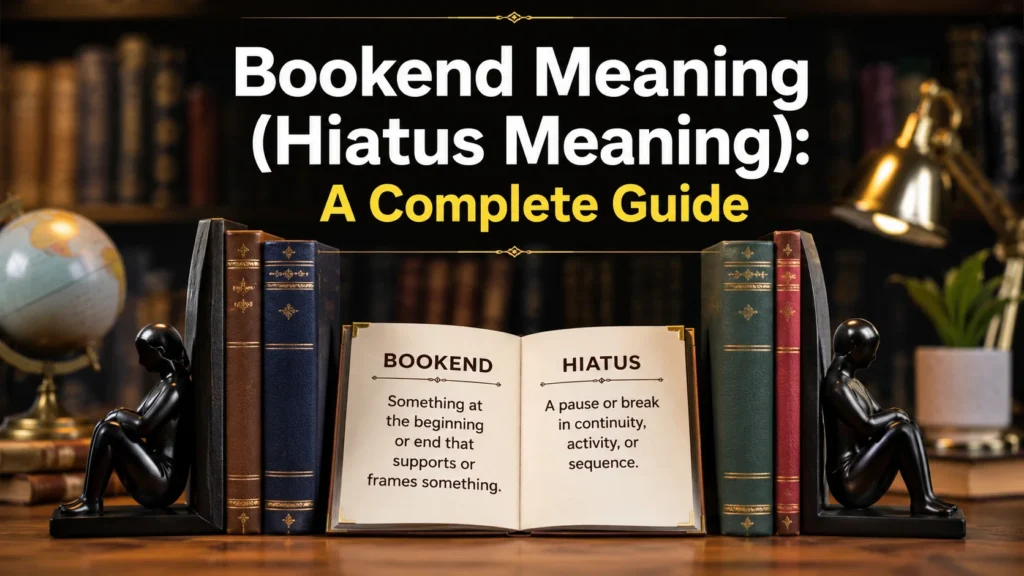
At first glance, a bookend seems simple: it’s a physical object that holds books upright on a shelf. But figuratively, it carries a much richer meaning. Bookends mark beginnings and endings—they frame a story, a project, or an event. Think of them as invisible brackets that create structure and cohesion.
Core Definition
- Literal Meaning: A support for books on a shelf to prevent them from falling.
- Figurative Meaning: Something that frames, starts, and ends a sequence of events, ideas, or creative works.
The figurative use of bookend appears often in writing, storytelling, music, and even in business strategies. They provide symmetry and help audiences or participants understand the scope of a project, narrative, or experience.
Uses of Bookends in Different Contexts
Writing and Storytelling
- In novels, authors often mirror the first and last chapters to create a sense of closure.
- Example: A story might begin with a character waking up in a stormy night and end with them facing a similar storm, completing the narrative arc.
TV Shows and Movies
- Directors often use opening and closing scenes as bookends to reinforce themes.
- Example: Breaking Bad begins with Walter White in a dire situation and ends with a mirrored visual of consequences and resolution.
Business and Work
- Projects often have “kickoff” and “wrap-up” events as bookends.
- Example: Product launches begin with a planning phase and end with post-launch review meetings.
Music
- Songs often repeat a melody or lyric at the beginning and end, creating an aural bookend.
- Example: Queen’s Bohemian Rhapsody uses recurring musical motifs at the start and end of the song.
Examples for Clarity
| Context | Example | Purpose |
| Writing | Novel opens with character leaving home, ends back home | Creates full-circle narrative |
| TV/Film | Opening scene mirrors closing scene | Reinforces theme and emotional impact |
| Music | Intro and outro share same melody | Provides cohesion and memorability |
| Business | Project kickoff and wrap-up meeting | Marks beginning and completion clearly |
Key Takeaway: Bookends give structure. They help the audience or participants feel a sense of completion and coherence.
What Does “Hiatus” Mean?
While bookend frames, a hiatus pauses. It is a temporary break, a deliberate pause in action. Unlike endings, a hiatus is never permanent—it allows for rest, reflection, or preparation for the next phase.
Core Definition
- Hiatus: A temporary interruption or break in a process, activity, or sequence.
Applications of Hiatus
TV & Entertainment
- TV shows frequently go on hiatus between seasons.
- Example: The Walking Dead paused mid-season to build anticipation.
Work & Business
- Companies may pause projects or product development to conduct research or adapt strategy.
- Example: Apple often pauses new product launches to refine features and marketing.
Education
- Hiatuses are common in academic calendars: semester breaks, summer vacations, and sabbaticals.
Health & Personal Life
- Taking a break for mental health, wellness, or reflection.
- Example: Professionals taking sabbaticals to recharge.
Examples in Real Life
| Context | Example | Purpose |
| TV Shows | Show pauses mid-season | Builds anticipation and manages production |
| Work Projects | Pause in product launch | Research and strategic planning |
| Education | Summer break for students | Rest and rejuvenation |
| Personal Life | Mental health day or sabbatical | Prevent burnout and improve creativity |
Key Takeaway: A hiatus is not a stop; it’s a pause to improve, reflect, or prepare.
The Connection Between “Bookend” and “Hiatus”
Bookends and hiatuses often appear together, especially in creative fields like writing, TV, and music. While bookends frame the start and end, a hiatus can occur in the middle, giving the audience or creators a necessary break.
- Storytelling Example: A TV series may bookend a season with key events, but episodes mid-season may go on hiatus to heighten suspense.
- Writing Analogy: Authors might structure chapters with bookends while inserting a hiatus (pause in narrative or time jump) to give depth to the story.
- Business Example: A project may have kickoff and wrap-up meetings as bookends, while internal development pauses serve as hiatuses.
Practical Insight: Recognizing how bookends and hiatuses work together allows creators to control pacing, engagement, and audience satisfaction.
Also Read This : Loitering Meaning, Hiatus Meaning, and What “Stand For” Means in Text
Common Misconceptions
Many people misuse or misunderstand these terms. Let’s clear that up.
- Bookend ≠ Only Physical Books: Bookend refers to a framing device in any medium, not just shelves.
- Hiatus ≠ Permanent Stop: A hiatus is temporary, unlike cancellation or completion.
- Overlap Clarified: While a hiatus may occur between bookends, they are distinct concepts. A bookend frames, a hiatus pauses.
Why Understanding These Terms Matters
Understanding bookend meaning and hiatus meaning isn’t just academic—it impacts writing, media, work, and life.
For Writers and Creators
- Properly using bookends enhances narrative cohesion and emotional impact.
- Strategic hiatuses build anticipation or allow for creative refresh.
For Students and Analysts
- Recognizing bookends and hiatuses improves comprehension and essay analysis.
- Critical for media studies and literature discussions.
For Everyday Life
- Understanding these terms improves vocabulary and communication.
- Helps in planning projects, personal goals, and work schedules.
Quick Tips to Remember
- Bookend: Think frames—start and end.
- Hiatus: Think pause—temporary break.
- Visual aids help solidify concepts:
| Term | Meaning | Example | Context |
| Bookend | Start & end framing | Chapters mirror opening & closing | Writing/TV/Music |
| Hiatus | Temporary pause | TV show breaks mid-season | Work/Education/Media |
Tip: Use real-life analogies. Your daily schedule can have bookends (morning and evening routines) and hiatuses (coffee breaks, meditation time).
Case Studies and Real-Life Examples
Case Study 1: TV Shows
- Game of Thrones often used opening and closing scenes as bookends for seasons.
- Mid-season hiatuses created suspense and allowed production to maintain quality.
- Result: Viewers experienced cohesive storytelling with well-timed breaks.
Case Study 2: Writing
- Harry Potter and the Deathly Hallows mirrors bookends with the first and final chapters.
- Hiatuses in the story (time skips) give characters space to grow, and readers time to reflect.
Case Study 3: Music
- Pink Floyd’s The Wall uses recurring motifs as bookends.
- Pauses in tracks serve as musical hiatuses, creating emotional tension and release.
Case Study 4: Business
- Apple’s product cycle: launches are bookended with announcement and availability events.
- Development hiatuses allow design iterations, testing, and marketing alignment.
Fun Facts About Bookends and Hiatuses
- The term “bookend” in figurative language first appeared in the 20th century.
- A hiatus can last hours, days, months, or even years depending on context.
- Musicians often use “musical hiatus” to describe a deliberate silence in a piece, a concept dating back to classical compositions.
FAQs:
Q1: Can a hiatus happen without bookends?
A: Yes. A hiatus simply pauses activity, but bookends are frames. Hiatuses don’t require a structured start or end.
Q2: Are bookends only used in stories?
A: No. They apply in music, TV, business, and everyday life—anywhere you want a clear start and end.
Q3: How long is a typical hiatus?
A: There’s no fixed length. It depends on context—TV shows might pause weeks or months, writers might pause chapters, and companies may pause projects until conditions improve.
Q4: Can a hiatus improve engagement?
A: Absolutely. A well-timed hiatus can build anticipation, refresh creativity, or allow audiences to digest content.
Q5: How do bookends enhance storytelling?
A: They create symmetry, reinforce themes, and provide emotional closure. Audiences naturally feel satisfied when a story starts and ends with mirrored elements.
Conclusion:
Bookends and hiatuses are powerful tools. Bookends provide structure, clarity, and cohesion. Hiatuses offer pauses for reflection, suspense, or rejuvenation. Together, they shape storytelling, music, TV, business projects, and personal routines.
Next time you watch a show, read a book, or plan a project, notice the bookends and hiatuses. They’re everywhere, quietly guiding your experience, helping you understand pacing, structure, and emotional impact.
By mastering these concepts, you can create content, schedules, and narratives that feel natural, engaging, and complete—just like the professionals do.