
Have you ever typed “eventhough“ and wondered why your spell checker immediately underlined it in red?
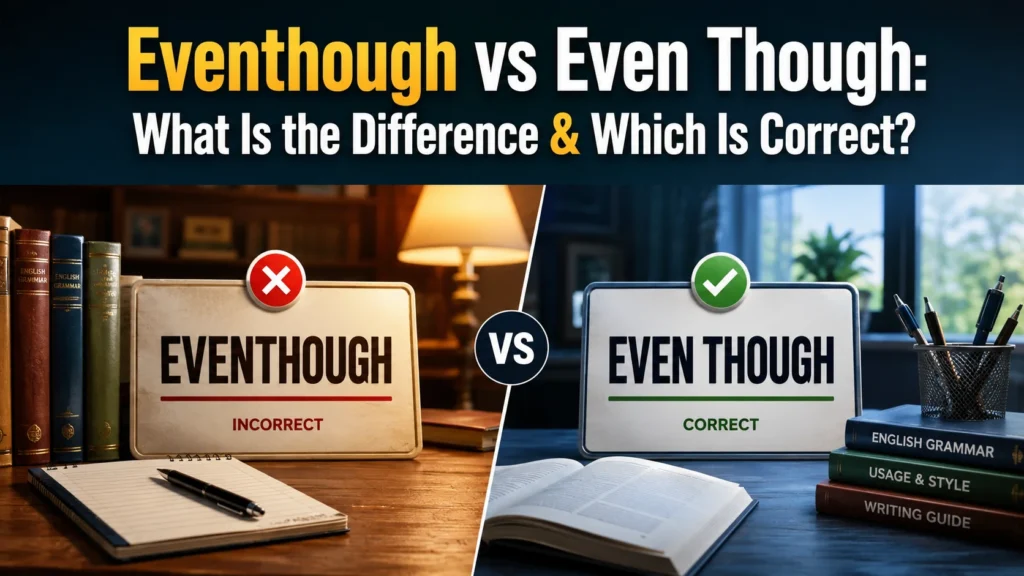
You’re not alone. Thousands of people search for eventhough vs even though every month because the two forms look similar at first glance. However, only one of them is correct in standard English.
The confusion usually happens because English contains many compound words such as everyone, everything, everywhere, and however. As a result, many writers assume that even though should also become one word. It doesn’t. In every major style guide and dictionary, even though remains two separate words.
Whether you’re writing an email, school essay, blog post, business report, or social media caption, using the correct spelling makes your writing look polished and professional. A small spelling mistake can distract readers and weaken your credibility. The good news is that once you understand the simple grammar rule, you’ll probably never make this mistake again.
Quick Answer: Is It “Eventhough” or “Even Though”?
If you’re looking for the fastest answer, here it is.
| Question | Correct Answer |
| Is eventhough correct? | ❌ No |
| Is even though correct? | ✅ Yes |
| Standard English spelling | Even though |
| Accepted in academic writing | ✅ Yes |
| Accepted in professional writing | ✅ Yes |
| Found in dictionaries | Only even though |
Correct Example
Even though it was snowing, the flight departed on time.
Incorrect Example
Eventhough it was snowing, the flight departed on time.
The answer is simple:
Always write “even though” as two separate words.
Is “Eventhough” a Real Word?
One of the most common questions people ask is whether eventhough has become an accepted English word.
The answer is no.
No major English dictionary recognizes eventhough as a correct spelling. That includes respected sources such as:
- Merriam-Webster
- Oxford English Dictionary
- Cambridge Dictionary
- Collins Dictionary
- Dictionary.com
Instead, they all list even though as a two-word phrase.
Why Does It Look Correct?
At first glance, eventhough doesn’t seem unusual.
English contains many merged words:
- everyone
- everything
- everyday (when used as an adjective)
- everywhere
- however
- whenever
Because of these examples, many people naturally assume even though should follow the same pattern.
English simply doesn’t work that way.
Some words combine over time while others remain separate forever.
Even though belongs to the second group.
Why Do People Write “Eventhough”?
If it’s incorrect, why do millions of people type it?
There are several practical reasons.
Fast Typing
When people type quickly, their fingers naturally join the words together.
For example:
- eventhough
- atleast
- alot
- incase
These are all common spelling mistakes.
Mobile Keyboards
Phones encourage speed rather than accuracy.
Many users type messages quickly without noticing small errors.
Sometimes predictive text doesn’t separate the phrase until later.
Confusing Similar Words
English includes many expressions beginning with even.
Examples include:
- even if
- even when
- even after
Some writers mistakenly think all of these eventually become one word.
They don’t.
Influence of Social Media
Social media favors quick communication.
People often ignore grammar while texting.
As a result, incorrect spellings spread rapidly.
That doesn’t make them correct.
English Learners
Many people learning English hear even though spoken naturally.
Because the words flow together in speech, they assume it’s written as one word.
This is completely understandable.
Fortunately, it’s also easy to fix.
What Does “Even Though” Mean?
Now that we’ve established the correct spelling, let’s understand its meaning.
Even though introduces a strong contrast between two ideas.
It tells the reader that something happened despite another fact that might suggest the opposite.
Simple Definition
Even though means despite the fact that.
It connects two ideas that seem surprising when placed together.
For example:
Even though she studied all week, she still felt nervous before the exam.
The expectation:
She studied.
The surprising result:
She still felt nervous.
That’s exactly what even though expresses.
Understanding the Contrast
Think of two ideas pulling in opposite directions.
Idea One
It rained all afternoon.
Idea Two
We played soccer anyway.
You connect them like this:
Even though it rained all afternoon, we played soccer.
The phrase highlights the unexpected outcome.
Everyday Examples of “Even Though”
Let’s look at practical examples.
Daily Conversation
- Even though I’m tired, I’ll finish the movie.
- Even though it’s cold, let’s go for a walk.
- Even though I forgot my umbrella, I stayed dry.
At School
- Even though the assignment was difficult, everyone completed it.
- Even though she missed one class, she passed the exam.
- Even though the lecture lasted two hours, students stayed engaged.
At Work
- Even though the deadline was tight, the team delivered excellent work.
- Even though sales dropped last month, profits remained stable.
- Even though traffic was heavy, I arrived on time.
Formal Writing
- Even though inflation increased, consumer spending remained resilient.
- Even though the sample size was limited, researchers identified meaningful trends.
Notice how naturally the phrase fits every type of writing.
Also Read This: Chromakopia Meaning: What’s The Correct Spelling?
Eventhough vs Even Though: Side-by-Side Comparison
The easiest way to remember the difference is through a comparison table.
| Feature | Eventhough | Even Though |
| Correct spelling | ❌ No | ✅ Yes |
| Recognized by dictionaries | ❌ No | ✅ Yes |
| Standard English | ❌ No | ✅ Yes |
| Academic writing | ❌ Never | ✅ Always |
| Business writing | ❌ Never | ✅ Always |
| Grammar | Incorrect | Subordinating conjunction |
| Recommended | ❌ No | ✅ Yes |
Whenever you’re unsure, choose even though.
Grammar Rule Behind “Even Though”
Grammar sounds intimidating, but this rule is surprisingly simple.
Even though belongs to a group called subordinating conjunctions.
These conjunctions connect a dependent clause to an independent clause.
Common subordinating conjunctions include:
- because
- although
- since
- while
- if
- unless
- even though
Their job is to explain relationships between ideas.
Understanding the Sentence Structure
Look at this sentence.
Even though the weather was terrible, we enjoyed the picnic.
The sentence contains two parts.
Dependent clause:
Even though the weather was terrible
Independent clause:
We enjoyed the picnic.
The first clause cannot stand alone.
The second clause can.
That’s why even though introduces the dependent clause.
Another Example
We enjoyed the picnic even though the weather was terrible.
The meaning stays exactly the same.
Only the order changes.
Punctuation Rules
Many writers wonder whether even though requires a comma.
The answer depends on where the clause appears.
When the Sentence Starts with “Even Though”
Use a comma.
Example:
Even though I practiced every day, I still felt nervous.
When the Clause Comes Second
Usually, no comma is needed.
Example:
I still felt nervous even though I practiced every day.
This pattern follows standard English punctuation rules.
When Should You Use “Even Though”?
You can use even though whenever you want to emphasize contrast.
Here are the most common situations.
Showing Unexpected Results
Even though he trained hard, he lost the race.
Comparing Expectations with Reality
Even though the restaurant looked expensive, the prices were reasonable.
Telling Stories
Storytelling becomes more engaging with contrast.
Example:
Even though everyone warned us about the weather, we decided to continue hiking.
Readers immediately become curious about what happened next.
Academic Essays
Professors expect precise grammar.
Example:
Even though previous studies suggested otherwise, the new research reached a different conclusion.
Professional Emails
Business writing often explains challenges.
Example:
Even though production slowed temporarily, customer orders continued without interruption.
The sentence sounds confident and professional.
Real-Life Examples of “Even Though”
Here are examples across different situations.
Family Life
- Even though my parents live nearby, we still video call every weekend.
- Even though dinner was simple, everyone loved it.
Travel
- Even though our flight was delayed, we enjoyed exploring the airport.
- Even though the road was long, the scenery made the drive worthwhile.
Business
- Even though competition increased, the company expanded successfully.
- Even though expenses rose, revenue continued to grow.
Education
- Even though mathematics challenged him, he never stopped practicing.
- Even though the project required extra work, the final presentation impressed everyone.
Health and Fitness
- Even though I skipped one workout, I stayed consistent the rest of the week.
- Even though healthy habits take time, the results last much longer.
FAQs:
Is eventhough ever correct?
No. Eventhough is not a correct spelling in standard English. Major dictionaries, grammar references, and style guides all recognize even though as the correct form. If you write eventhough, spell-checking tools such as Microsoft Word and Grammarly will usually flag it as a spelling mistake.
Is even though one word or two words?
Even though is always two separate words. It functions as a subordinating conjunction that introduces a contrasting idea.
Correct examples:
- Even though it was raining, we went for a walk.
- I enjoyed the movie even though it was longer than expected.
Never combine the words into eventhough.
What is the difference between even though and although?
Both expressions introduce contrast, but even though usually emphasizes a stronger or more surprising contrast than although.
| Expression | Meaning | Example |
| Even though | Strong contrast | Even though he practiced every day, he lost the match. |
| Although | General contrast | Although he practiced every day, he lost the match. |
In many situations, the two phrases are interchangeable. However, even though often adds extra emphasis.
Can you start a sentence with even though?
Yes. Starting a sentence with even though is completely correct.
When the dependent clause comes first, place a comma before the main clause.
Example:
Even though the weather was freezing, the children played outside.
If the even though clause comes after the main clause, you usually don’t need a comma.
Example:
The children played outside even though the weather was freezing.
Why do so many people write eventhough?
The mistake usually happens because people type quickly or assume even though follows the same pattern as words like everyone, everything, or everywhere. In spoken English, the two words often sound connected, which adds to the confusion.
Fortunately, the rule is simple:
- ✅ Even though = Correct
- ❌ Eventhough = Incorrect
Remember that even and though always stay as two separate words.
Conclusion:
The difference between eventhough and even though is simple once you know the rule. Even though is the only correct spelling in standard English, while eventhough is a common misspelling that should never appear in formal, academic, or professional writing.
Beyond the spelling, it’s also important to understand the purpose of even though. It introduces a strong contrast between two ideas and helps your writing sound smoother, clearer, and more natural. Whether you’re writing an email, an essay, a business report, or a social media post, using the correct form shows attention to detail and strengthens your credibility.
A helpful way to remember the rule is to think of similar expressions such as even if and even when. Just like those phrases, even though always remains two separate words. If you make it a habit to proofread your work before publishing or sending it, you’ll quickly eliminate this common mistake from your writing.
The next time you pause and wonder whether to write eventhough or even though, the answer is easy: always choose “even though.” It’s the correct spelling recognized by dictionaries, grammar experts, educators, and professional writers worldwide. Small grammar improvements like this may seem minor, but they make a lasting difference in the clarity, professionalism, and overall quality of your writing.