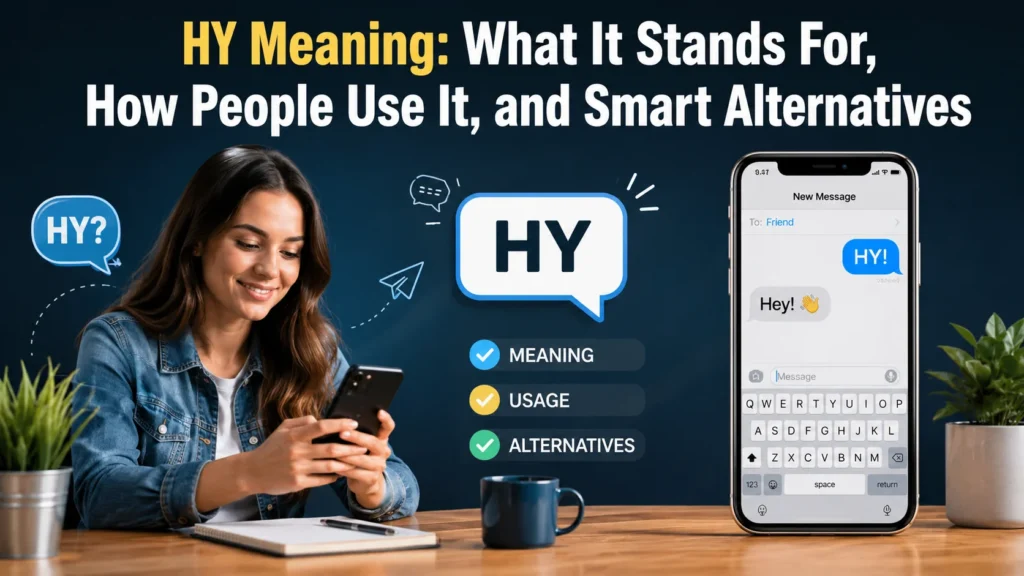

If you’ve ever come across the abbreviation HY in messages, social media, or online chats, you might have wondered what it really means. In this article, we’ll explore the HY meaning, its common uses, and contexts where it appears.
Whether you’re texting friends, reading online forums, or browsing social media, understanding this abbreviation will help you communicate more effectively and avoid confusion. By the end, you’ll have a clear grasp of HY and how to use it correctly in everyday conversations.
What HY Means — The Core Definitions
HY has three main, widely seen meanings:
- HY = “Hell yes” — A strong, enthusiastic yes. Fast, emphatic, often used online.
- HY = “Hiatus” — Short for a break or pause, usually used around content creators or projects.
- HY = “How you” — Informal shorthand for asking “How are you?” or starting casual chat. Less common today.
Each meaning sits in different social zones. Tone, platform, and capitalization often tell you which meaning fits. Below we unpack each meaning, where it shows up, and why it matters.
HY = “Hell Yes” — Enthusiasm Compressed
What it expresses
HY stands for “hell yes” when someone wants to show strong approval or excitement. It reads as louder than “yes” and quicker than a whole sentence. Use it when you want to be emphatic and casual.
Where you’ll see it
- Comments on short-form videos
- Group chats when deciding plans
- Replies to exciting news
Why people use HY instead of full words
- It’s fast to type.
- It shows tone better than “yes.”
- It fits modern conversational rhythms.
Real texting examples
- Friend: “Concert tickets for tomorrow?”
You: “HY — count me in.” - Comment under a hype video: “HY that beat, drop it again.”
When it works and when it doesn’t
- Works for friends, fans, casual audiences.
- Doesn’t work in formal emails or professional Slack channels. Use something else there.
HY = “Hiatus” — When HY Means a Pause
What it expresses
In content creation and team contexts, HY sometimes shorthand for “hiatus.” Creators use it to say they’re taking a break, or projects are paused.
Where you’ll see it
- Creator posts: “On HY for a minute.”
- Team notes: “Project X HY next quarter.”
Why this meaning appears
- Abbreviations thrive where people repeat phrases. “Hiatus” appears often in content updates. Shortening it to HY cuts typing time.
- Context helps. When a post talks about uploads or schedules, HY = hiatus is likely
Example usage
- YouTube description: “Two-week HY for uploads.”
- Instagram bio: “On HY rn. Back soon!”
Clarity tip
When using HY to mean hiatus, pair it with a date or duration. That prevents confusion.
HY = “How You” — Casual Greeting Shortened
What it expresses
HY can mean “How you” — a clipped version of “How are you?” This usage has roots in informal texting and some dialects.
Where it shows up
- Text threads among close friends
- Informal DMs that start a conversation
Why it’s fading
- It can feel awkward to those unfamiliar with it.
- Modern shorthand often favors “wyd” or “sup” instead.
Example
- “HY been? Missed you.”
- That reads like a casual check-in among people who already talk this way
How Context Changes the HY Meaning
HY cannot be decoded alone. Context decides. Platform, relationship, and sentence tone all matter.
Quick rules to deduce meaning
- If the message is excited or responds to an offer, read HY as hell yes.
- If it’s about schedules, uploads, or taking breaks, read HY as hiatus.
- If it starts a chat and looks like a greeting, read HY as how you.
Table: HY Meanings by Context
| Context | Meaning | Example |
| Group chat about plans | Hell yes | “Party Friday?” — “HY!” |
| Creator update or schedule | Hiatus | “Taking HY this month.” |
| Casual DM greeting | How you | “HY been?” |
HY in Texting and Messaging Apps
Texting keeps language tight. HY fits that pattern. But tone matters.
Why HY feels more expressive than “yes”
- It compresses enthusiasm into two letters.
- It looks intentional. A plain “yes” can feel flat.
When HY sounds natural
- Among friends planning something fun.
- In response to announcements that excite you.
When HY sounds awkward
- With people who don’t use slang.
- In messages where clarity matters.
Examples of texting tones
- Positive: “Got the promotion!” — “HY!!!”
- Sarcastic: “You forgot my birthday.” — “HY.” (Here punctuation makes it curt.)
- Mistake: “Want to split rent?” — “HY” (This confuses meaning; the sender likely meant yes but the topic is serious.)
Best practice
If the topic is serious, avoid HY. Use clear phrases like “Yes, I agree” or “I’ll do it.”
HY on Social Media: TikTok, Instagram, X, and YouTube
Social platforms shape slang. Each platform uses HY differently.
TikTok and Instagram comments
- HY often reads as reaction energy.
- Short comments show enthusiasm quickly.
X (Twitter) and longer replies
- You might see HY alone as a reply.
- Tone depends on the thread.
YouTube and creator updates
- HY can mean hiatus when paired with upload schedules.
- Creators sometimes tag “HY” in titles or descriptions to signal a break.
Gen Z vs Millennial nuances
- Gen Z favors short, expressive reactions. HY as hell yes works well.
- Millennials may prefer spelled-out words in semi-formal spaces.
Caption strategy for creators
- If you mean hiatus, write: “On hiatus until June 10.” Then add “HY” only if your audience knows the shorthand. That avoids confusion.
Is HY Professional or Informal? When Not to Use It
HY belongs to casual talk. Use it freely among friends. Avoid it at work unless your team already uses slang in chats.
Why it rarely fits professional messages
- It reads as overly casual.
- It may confuse people who don’t know the shorthand.
Exceptions
- Informal internal Slack channels where colleagues use slang.
- Teams with casual communication norms and established shorthand.
Safer alternatives for word
- Use “Absolutely”, “Yes, I can do that”, or “I’m on it.”
- For hiatus, use “On leave from [date] to [date]” or “Temporary pause scheduled.
Checklist: Should you use HY at work?
- Does your team use similar shorthand? If no, don’t use it.
- Is clarity critical? If yes, don’t use it.
- Is the channel informal? If yes and your team knows HY, you may.
Also Read This: InternetChicks: The Ultimate Guide to Online Relationships and Digital Influence
Alternatives to HY Based on Meaning
Choosing the right word matters more than shorthand. Below are alternatives arranged by HY meaning.
Alternatives for “Hell Yes” (enthusiastic agreement)
- Absolutely
- 100%
- Count me in
- Say less
- I’m in
Alternatives for “Hiatus” (pause or break)
- On hiatus
- Taking a break
- Pausing uploads
- Temporary pause
- Intermission
Alternatives for “How you” (greeting)
- How are you?
- How’ve you been?
- What’s up?
- You good?
How to choose the right alternative
- Match tone to audience.
- Be explicit if confusion would cause problems.
- For public posts, prefer full words to avoid misreads.
HY vs Similar Slang and Abbreviations
Language comes with neighbors. Here’s how HY stacks up against similar shorthand.
HY vs Y
- Y usually means “why” in shorthand.
- HY is rarely used for “why.” Confusion can happen though.
HY vs FR
- FR means “for real” or “frankly.”
- Use FR to express sincerity. Use HY to express strong yes or hiatus.
HY vs BET
- BET often signals agreement or a challenge.
- Use BET for casual affirmation. Use HY when you want louder excitement.
Why people pick HY
- It signals intensity in two letters.
- Its ambiguity gives flexibility. That flexibility can be a downside
Common Misunderstandings and Mistakes with HY
Some mistakes repeat. Here’s how to avoid them.
Assuming one fixed meaning
- Mistake: Treating HY as always “hell yes.”
- Fix: Read surrounding text or ask for clarification if stakes are high.
Using it in the wrong tone
- Mistake: Sending HY in a client email.
- Fix: Use full words in professional contexts.
Misreading sarcasm
- Mistake: Interpreting “HY.” as enthusiasm when it’s curt.
- Fix: Pay attention to punctuation and timing.
Overusing it
- Mistake: Replying “HY” to every message. It loses impact.
- Fix: Reserve HY for genuinely enthusiastic moments.
Decision Guide: Should You Use HY?
A quick guide helps decide when HY fits. Use this as your checklist.
Audience
- Close friends: yes.
- Casual followers: sometimes.
- Boss/client: usually no.
Platform
- TikTok/X comments: yes for reaction.
- Email: no.
- Slack (casual channel): maybe.
Tone
- Enthusiastic or playful: yes.
- Serious or formal: no.
Intent
- To show excitement: yes.
- To convey important info: no.
Bullet Checklist
- Is the person familiar with slang? If no, use full words.
- Is context clear? If no, add a clarifying phrase.
- Will misinterpretation cause problems? If yes, avoid HY
Case Study: HY in Creator Communities
Scenario
A mid-size YouTuber announced a break with the caption: “On HY for a few weeks. See you soon.” Comments flooded in. Fans debated if HY meant “hiatus” or “hell yes.”
What went wrong
- The creator used HY without context.
- Fans had mixed interpretations. Some thought it meant a break. Others thought it was celebratory.
What worked
- The creator followed up with a pinned comment clarifying dates. That restored clarity quickly.
Lesson
- Shorthand works when the audience shares meaning. When audiences vary, add clarity. A single sentence can prevent confusion.
The Evolution of HY in Digital Language
Language evolves fast in digital spaces. HY shows three traits that keep it alive or push it out.
Trait 1 — Brevity
Short messages win in mobile-first platforms. HY compresses tone into two letters.
Trait 2 — Flexibility
HY’s multiple meanings make it useful and risky. Use is creative. Misunderstanding rises too.
Trait 3 — Community
Meaning depends on community norms. HY will last where a community keeps using it. It will fade where new shorthand replaces it.
Will HY last?
Probably in pockets. It won’t become a universal term. Language will keep shifting. Expect HY to stick where quick, expressive reactions matter.
Shortcuts That Hurt: When Abbreviations Backfire
Abbreviations save time. They also risk clarity. Here are common pitfalls.
Problem: Ambiguity
- Abbrev like HY can mean many things. Misreads cause confusion.
Problem: Tone mismatch
- Casual shorthand in formal settings erodes trust.
Problem: Audience mismatch
- Younger users read HY differently than older users.
Fixes
- If in doubt, spell it out.
- Add a clarifying phrase.
- Use abbreviations only with audience alignment.
Quotes from Real Users (Paraphrased)
“I typed HY to show excitement about tickets. My coworker thought I meant we were taking a break.” — Social user
“Creators should stop assuming their shorthand is universal. A one-line clarification saves dozens of confused replies.” — Community manager
These comments show real friction. They also show how a small clarification prevents fuss.
Practical Examples and Scripts You Can Use
If you mean “hell yes”
- Text: “Road trip this weekend?” — Reply: “HY — let’s do it!”
If you mean “hiatus”
- Post caption: “Taking a short break.” Add: “On hiatus from June 1 to June 14.” Then add “HY” only if your audience knows it.
If you mean “how you”
- DM opener: “HY been? Wanna catch up?”
- Better: “How’ve you been? Wanna catch up?”
Quick Reference Table: HY Use Cases and Alternatives
| Intended Meaning | When to Use | Safer Alternative |
| Hell yes | Friends, fan reactions, hype replies | Absolutely; I’m in |
| Hiatus | Creator updates, project pause (with dates) | On hiatus [dates]; Taking a break |
| How you | Close friend DM | How are you?; What’s up? |
FAQs:
What does HY mean in texting?
HY most often means “hell yes” in texts. It can also mean “hiatus” or “how you” depending on context.
Does HY always mean “hell yes”?
No. It often means hell yes but sometimes means hiatus or how you. Look at the surrounding message.
Is HY slang or an abbreviation?
Both. HY works as slang in casual speech and as an abbreviation when people shorten longer words or phrases.
Can HY mean hiatus?
Yes. When used in content or scheduling conversations, HY can mean hiatus. Always include dates when you use it this way.
Is HY rude or informal?
HY is informal. It can seem rude if used curtly or in professional settings. Use it only with people who know your tone.
Conclusion:
Understanding abbreviations like HY is essential in today’s digital communication. Knowing its meaning not only helps you respond appropriately in chats and social media but also keeps you up-to-date with modern online language. Whether you’re texting friends, participating in forums, or browsing social platforms, recognizing and using HY correctly can make your messages clearer and more relatable. By keeping up with these common abbreviations, you stay connected, avoid misunderstandings, and communicate confidently in the fast-paced world of digital conversations.