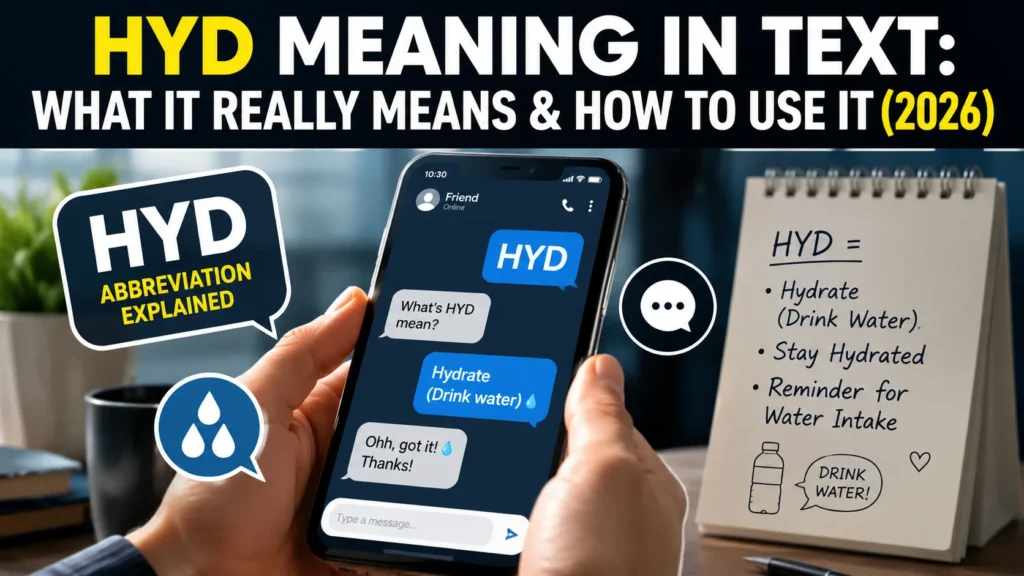

Have you ever received a message saying “HYD?” and wondered what it meant? You’re not alone. Every day, people use short abbreviations in text messages, social media posts, and chat apps to communicate faster. While some abbreviations like LOL, BRB, and WYD are easy to recognize, others can leave you guessing. One of those is HYD.
The good news is that HYD meaning in text is usually simple and friendly. In most conversations, it’s a casual way to check in with someone and start a conversation. However, context still matters. Depending on where you see it, the tone can range from polite to playful or even flirty.
In this complete guide, you’ll learn what HYD means in text, where people use it, how to reply naturally, when you should avoid it, and how it compares with other common texting abbreviations. By the end, you’ll know exactly how to use HYD with confidence.
What Does HYD Mean in Text?
The HYD meaning in text is most commonly:
HYD = “How You Doing?”
It’s a casual greeting that asks how someone is feeling or how things are going. Think of it as a shorter version of saying:
- How are you doing?
- How have you been?
- How’s everything going?
People often use HYD because it’s quick to type and fits naturally into fast-moving conversations.
Quick Definition
| Abbreviation | Meaning | Tone | Common Use |
| HYD | How You Doing? | Friendly | Texting, social media, messaging apps |
Unlike formal greetings, HYD sounds relaxed. It works best between people who already know each other.
For example:
Alex: HYD?
Jordan: Doing great! Just finished work. You?
Even though the message contains only three letters, it opens the door to a full conversation.
What Does HYD Stand For?
The full form of HYD is:
How You Doing?
The phrase became popular because digital communication favors speed. Instead of typing four separate words, many people simply write HYD.
Although the literal meaning is “How are you doing?” the real purpose often goes beyond asking about someone’s day.
Someone might use HYD to:
- Start a conversation.
- Check on a friend.
- Reconnect after a long time.
- Show concern.
- Begin a casual chat.
- Break the ice with someone new.
Because tone doesn’t always come across in text, emojis often help clarify the sender’s intention.
Examples include:
- HYD 😊
- HYD lol
- HYD today?
- HYD lately?
- HYD ❤️
Each version feels slightly different even though the meaning stays the same
How People Use HYD in Text Messages
One reason HYD remains popular is its flexibility. It fits almost any casual conversation.
Let’s look at the most common situations.
Starting a Conversation
Sometimes people don’t have a specific topic in mind. They simply want to talk.
Example:
Emma: HYD?
Lily: Pretty good! Just watching Netflix.
The conversation naturally continues from there.
Checking on Someone
If a friend has gone through a difficult experience, HYD becomes a caring question rather than simple small talk.
Example:
Mike: Hey, HYD after everything yesterday?
Chris: I’m feeling much better now. Thanks for asking.
Notice how the abbreviation still sounds personal despite being short.
Reconnecting After a Long Time
Many people begin conversations with old classmates or former coworkers using HYD.
Example:
Sarah: Wow, it’s been forever! HYD?
Anna: I’ve been great! What about you?
The abbreviation feels warm without sounding overly formal.
Casual Daily Chats
Friends often exchange HYD messages several times each week.
Example:
- HYD this morning?
- HYD after work?
- HYD today?
These greetings require little effort but help maintain friendships.
Flirting
Sometimes HYD carries a playful tone.
Example:
Alex: Hey 😊 HYD?
Taylor: Better now that you texted.
Here, the abbreviation becomes an easy conversation starter without sounding too serious.
Group Conversations
HYD can also address everyone in a group chat.
Example:
“HYD everyone?”
Instead of messaging each person individually, one greeting reaches the whole group.
HYD Meaning on Social Media
Although the definition usually stays the same, people use HYD differently across platforms.
HYD Meaning on Snapchat
Snapchat conversations move quickly.
Users often send:
- HYD?
- HYD today?
- HYD 😂
These messages usually begin casual conversations before sharing photos or videos.
HYD Meaning on Instagram
On Instagram, HYD commonly appears in direct messages.
Someone might respond to your story by saying:
“Nice vacation! HYD?”
The goal isn’t only to ask how you’re doing. It’s also to keep the conversation going.
HYD Meaning on TikTok
TikTok creators sometimes use HYD in comments or live chats.
Examples:
- HYD today?
- HYD everyone?
- HYD after watching this? 😂
The phrase creates interaction between creators and viewers.
HYD Meaning on Facebook
Facebook users often reconnect with old friends.
Example:
“Long time no see! HYD?”
The abbreviation feels natural because Facebook connects people from different stages of life.
HYD Meaning on WhatsApp
WhatsApp remains one of the world’s most popular messaging apps.
People frequently send:
- Morning! HYD?
- HYD today?
- HYD after your trip?
Family members, coworkers, and friends all use it.
HYD Meaning on Discord
Gaming communities often begin conversations with HYD.
Example:
HYD everyone? Ready for tonight’s match?
Because Discord emphasizes real-time communication, abbreviations fit perfectly.
HYD Meaning on X (formerly Twitter)
Although tweets have become longer over time, users still appreciate concise language.
HYD often appears in replies and direct messages as a friendly greeting.
Examples of HYD in Real Conversations
Seeing abbreviations in context makes them much easier to understand.
Friends
Jake: HYD?
Ben: Pretty good. Just got home.
Lisa: HYD today?
Emma: Busy but happy.
Family
Mom: HYD at college?
Son: Everything’s going well!
Brother: HYD after the exam?
Sister: It wasn’t as hard as I expected.
Coworkers
David: HYD this morning?
Rachel: Ready for another busy day!
Manager: HYD after the presentation?
Employee: Much more relaxed now.
Online Gaming
Player 1: HYD?
Player 2: Ready to win.
Teammate: HYD tonight
You: Let’s play!
Dating Apps
Alex: Hey! HYD?
Jamie: Doing well. Thanks for asking.
Chris: HYD?
Morgan: Great! How about you?
Also Read This:
How to Reply to HYD
Receiving HYD is easy.
Knowing how to answer naturally makes conversations smoother.
Friendly Replies
- I’m doing great!
- Pretty good. How about you?
- Everything’s going well.
- Can’t complain.
- Busy but happy.
Funny Replies
- Surviving Monday.
- Running on coffee.
- Better than my Wi-Fi.
- Still awake somehow.
- Living the dream… almost.
Humor often makes conversations more memorable.
Flirty Replies
- Better now that you texted.
- Missing you.
- Thinking about someone special.
- Guess who’s making my day?
- I’d be even better if we talked more.
These replies work only when the relationship already feels comfortable.
Also Read This: WTM Meaning in Text: What It Really Means? (2026 Guide)
Short Replies
Sometimes less is more.
Examples include:
- Good!
- Great!
- Awesome!
- Fine.
- Doing well!
Short answers keep conversations moving.
Detailed Replies
If someone genuinely cares, consider giving more information.
Example:
“I’m doing great! I started a new job this week and finally have some free time again. How are you?”
Detailed replies often lead to richer conversations.
Is HYD Formal or Informal?
HYD belongs firmly in casual communication.
Although it’s widely understood online, it doesn’t fit every situation.
| Situation | Should You Use HYD? | Reason |
| Friends | ✅ Yes | Natural and friendly |
| Family | ✅ Yes | Casual conversation |
| Classmates | ✅ Yes | Common in texting |
| Social media | ✅ Yes | Frequently used |
| Gaming chats | ✅ Yes | Informal environment |
| Workplace chat | ⚠️ Sometimes | Only if the culture is relaxed |
| Business email | ❌ No | Too informal |
| Academic writing | ❌ No | Use complete sentences |
| Job applications | ❌ No | Professional language is expected |
When in doubt, write the full phrase:
How are you doing?
It always sounds more professional.
Different Meanings of HYD
Although How You Doing? remains the most common definition, abbreviations occasionally take on different meanings in specialized communities.
For example:
| Meaning | Context | Frequency |
| How You Doing? | Texting and social media | Very Common |
| Organization-specific meanings | Internal company communication | Rare |
| Technical abbreviations | Industry jargon | Rare |
Whenever you encounter HYD, read the surrounding conversation before assuming its meaning.
In everyday texting, however, How You Doing? is almost always the correct interpretation.
HYD vs Similar Text Abbreviations
Texting slang changes quickly. Even so, several abbreviations have remained popular for years because they save time and keep conversations casual. Since HYD shares a similar purpose with other greetings, it’s helpful to know the difference.
| Abbreviation | Full Meaning | Purpose | Example |
| HYD | How You Doing? | Ask how someone is doing | “HYD today?” |
| HRU | How Are You? | General greeting | “HRU?” |
| WYD | What You Doing? | Ask about current activity | “WYD after work?” |
| HBU | How About You? | Return a question | “I’m good. HBU?” |
| SUP | What’s Up? | Casual greeting | “SUP?” |
| WSG | What’s Good? | Informal slang greeting | “WSG bro?” |
HYD vs HRU
At first glance, these abbreviations seem interchangeable. However, there’s a subtle difference.
- HYD often sounds warmer and more conversational.
- HRU directly asks about someone’s well-being.
Example:
HYD? → Feels like starting a friendly chat.
HRU? → Focuses more on how the other person is feeling.
HYD vs WYD
People often confuse these two abbreviations.
- HYD asks how someone is doing.
- WYD asks what someone is doing.
Example:
HYD?
I’m doing great!
WYD?
I’m watching a movie.
The answers are completely different because the questions ask different things.
HYD vs HBU
Unlike HYD, HBU doesn’t begin a conversation.
Instead, it continues one.
Example:
“I’m doing well. HBU?“
Here, HBU means How About You?
When Should You Use HYD?
Choose HYD when you want to:
- Start a friendly conversation.
- Check in with someone.
- Reconnect after a while.
- Keep your message short and natural.
- Sound relaxed instead of formal.
Why Do People Use HYD?
Modern communication moves fast. Whether you’re texting a friend, chatting on Discord, or replying to someone’s Instagram Story, shorter messages help conversations flow naturally.
Here are the biggest reasons people use HYD.
It Saves Time
Typing three letters is much faster than writing four complete words.
That small difference matters when you’re sending dozens of messages every day.
It Sounds Friendly
HYD feels relaxed and approachable.
Instead of sounding formal, it creates the impression of a casual conversation between friends.
It Fits Mobile Conversations
People spend much of their time chatting on smartphones.
Short abbreviations make texting easier with one hand or while you’re on the go.
It’s Part of Internet Culture
Text abbreviations have become part of everyday online communication.
From LOL to BRB, internet slang continues to shape how people communicate.
HYD simply fits into that trend.
It Starts Conversations Easily
Sometimes you don’t have anything specific to say.
A simple HYD? is enough to begin talking.
Common Mistakes When Using HYD
Although HYD is easy to understand, people occasionally misuse it.
Avoid these common mistakes.
Confusing HYD With WYD
This is the most common mistake.
Remember:
- HYD = How You Doing?
- WYD = What You Doing?
Mixing them up can confuse the other person.
Using HYD in Professional Emails
A job recruiter probably won’t appreciate receiving:
HYD?
Instead, write:
Hello, how are you doing today?
Professional settings call for complete sentences.
Assuming Everyone Knows the Abbreviation
Not everyone follows internet slang.
Older family members or people who rarely text may not recognize HYD.
When speaking with someone unfamiliar with texting abbreviations, write the full phrase instead.
Ignoring Context
Context always matters.
For example, if someone recently experienced a difficult situation, HYD carries genuine concern.
In a casual chat between friends, it simply starts a conversation.
Understanding the situation helps you interpret the tone correctly.
Overusing Text Slang
Messages filled with abbreviations become difficult to read.
For example:
HYD LOL WYD HBU IDC TBH
While each abbreviation has a meaning, using too many together can make your message confusing.
A balanced approach feels more natural.
When You Shouldn’t Use HYD
Although HYD works well in casual conversations, certain situations require more professional language.
Avoid using HYD in:
- Job applications
- Business proposals
- Professional emails
- Academic papers
- Customer service communications
- Legal documents
- Official government forms
Instead, write the complete greeting.
Examples include:
- How are you doing today?
- I hope you’re doing well.
- I hope you’re having a great day.
These alternatives sound polished and appropriate.
The Origins of HYD
Unlike some internet abbreviations with a well-documented history, HYD doesn’t have a single confirmed origin.
Most language experts agree that it developed naturally during the rise of:
- SMS text messaging
- Early online chat rooms
- Instant messaging platforms
- Mobile texting
- Social media conversations
As texting became more common in the late 1990s and early 2000s, people shortened everyday phrases to save time and fit within character limits.
Expressions like LOL, BRB, TTYL, and OMG gained widespread popularity during this period. HYD followed the same pattern by shortening “How You Doing?” into just three letters.
Today, the abbreviation continues to appear across messaging apps, gaming communities, and social media platforms because it’s quick, familiar, and easy to understand.
Did you know? Joey Tribbiani’s famous catchphrase, “How you doin’?” from the television sitcom Friends, helped popularize the phrase itself in everyday conversation. While the show didn’t create the abbreviation HYD, its cultural influence made the greeting more recognizable.
FAQs:
What does HYD mean in text?
HYD most commonly stands for “How You Doing?” It’s a casual greeting people use in text messages, social media chats, and messaging apps to ask how someone is feeling or how things are going.
Is HYD the same as HRU?
Not exactly. Both ask about someone’s well-being, but HYD sounds slightly more conversational, while HRU (How Are You?) is a more direct greeting. In everyday texting, either abbreviation works in casual conversations.
Can I use HYD on Snapchat, Instagram, or WhatsApp?
Yes. HYD is widely used on Snapchat, Instagram, WhatsApp, Discord, TikTok, Facebook, and X (formerly Twitter). Its meaning stays the same across these platforms, though the tone may vary depending on the conversation.
Is HYD appropriate for work or school?
HYD is fine in casual chats with classmates or coworkers if your relationship is informal. However, you should avoid using it in business emails, academic papers, job applications, or other professional communication. Writing the full phrase, “How are you doing?”, is a better choice in those situations.
How should I reply to HYD?
A natural reply depends on the conversation. You can keep it short with “I’m good, thanks!”, give more details such as “Doing great! Just finished work.”, or add a friendly follow-up like “How about you?” to keep the conversation going.
Conclusion
Understanding the HYD meaning in text makes online conversations much easier to follow. In most cases, HYD simply means “How You Doing?”—a friendly, informal way to check on someone or start a conversation. Whether you see it in a text message, a Snapchat chat, an Instagram DM, or a Discord server, the meaning remains largely the same.
Like many internet abbreviations, HYD works best in casual settings where speed and convenience matter. While it’s perfect for chatting with friends, family, classmates, or gaming partners, it’s not appropriate for professional emails, formal writing, or official communication. Choosing the right greeting for the situation helps you communicate clearly and leaves a positive impression.
As digital language continues to evolve, abbreviations like HYD remain part of everyday online communication. Knowing what they mean—and when to use them—helps you text with confidence, understand conversations more easily, and connect naturally with people across today’s most popular messaging and social media platforms.