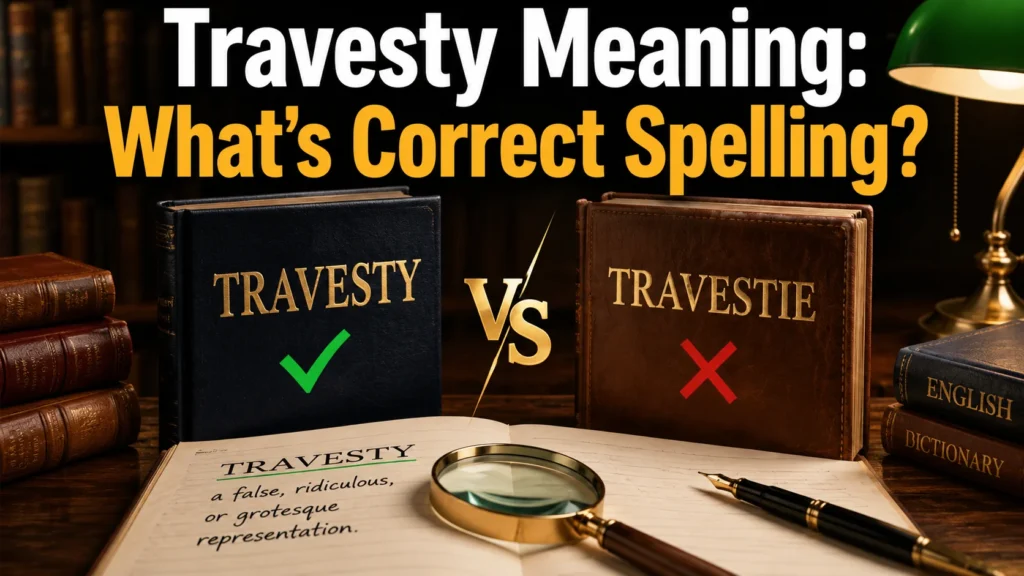

Understanding the travesty meaning can help you use this powerful word with accuracy. Many people use “travesty” to describe anything disappointing or bad, but the word carries a much stronger meaning. A travesty is not just a mistake, failure, or unfortunate event. It describes something that has been seriously distorted, unfairly represented, or turned into a poor imitation of what it should have been.
You might hear phrases like “a travesty of justice” in news reports, political discussions, or legal debates. You may also see critics describe a movie adaptation, decision, or public event as a “travesty” when they believe it fails to respect the original purpose or standards.
The word has an interesting history. It began with the idea of disguise and imitation before developing into the modern meaning of distortion and injustice. Today, it remains a strong term that expresses disappointment, criticism, and sometimes outrage.
This guide explains the meaning of travesty, its origins, examples, common uses, differences from similar words, and how to use it correctly.
Travesty Meaning: What Does Travesty Mean?
The word travesty is a noun that means a distorted, exaggerated, or unfair version of something that should have been treated seriously.
In simple terms, a travesty happens when something important gets changed into something inaccurate, ridiculous, or unacceptable.
For example:
- A serious historical event turned into a careless movie with false information could be called a travesty of history.
- An unfair court decision that ignores evidence could be described as a travesty of justice.
- A poor imitation of a respected work of art could be called a travesty of the original.
The word usually carries a negative meaning because it suggests that something valuable has been damaged or misrepresented.
Simple Definition of Travesty
Travesty: A false, distorted, or ridiculous representation of something, especially something serious or important.
A quick way to remember the meaning:
A travesty is when something that should be respected gets twisted into something unfair or absurd.
Travesty Definition Explained With Examples
The meaning of travesty depends slightly on the context. However, the central idea remains the same: something has gone wrong in the way something is represented or handled.
Here are common examples:
| Example | Meaning |
| “The remake was a travesty of the original film.” | The remake poorly represented the original. |
| “The trial was called a travesty of justice.” | People believed the legal process was deeply unfair. |
| “Turning this historic building into a parking lot would be a travesty.” | It would disrespect or damage something valuable. |
| “The report was a travesty of the facts.” | The report distorted the truth. |
A travesty often involves a gap between what something should be and what it actually becomes.
For example, a fair legal system should protect justice. If a court process becomes biased or ignores evidence, critics may call it a travesty of justice because the system failed to represent its purpose.
The Origin and History of the Word Travesty
The history of the word travesty explains why it has such a strong meaning today.
The word comes from the Italian verb travestire, which means “to disguise” or “to dress up.” The term entered English through French during the 17th century.
Originally, a travesty referred to a type of parody where a serious work was transformed into a humorous or ridiculous version.
For example, a writer might take an important poem or epic story and rewrite it in a silly style. The goal was often to create humor by lowering something serious into an exaggerated imitation.
Over time, the meaning expanded.
The word moved from:
A humorous imitation of something serious
to:
A distorted, unfair, or unacceptable version of something important
This change explains why the word can now describe both creative criticism and serious failures.
How the Meaning Changed Over Time
| Period | Meaning |
| 1600s | A comic imitation or parody of a serious work |
| 1700s–1800s | A distorted version of literature, art, or ideas |
| Modern usage | A serious distortion, injustice, or unacceptable failure |
The historical connection to disguise remains important. When something is “travestied,” it is almost like it has been dressed in the wrong clothing and presented as something it is not.
How to Pronounce Travesty
The correct pronunciation is:
Travesty: TRAV-uh-stee
Phonetic spelling:
/ˈtræv.ə.sti/
The word has three syllables:
- Trav
- uh
- stee
Example:
“The decision was a travesty.”
The emphasis falls on the first syllable: TRAV-uh-stee.
Travesty as a Noun and Verb
Most people use travesty as a noun, but it can also function as a verb.
Travesty as a Noun
This is the most common usage.
Examples:
- “The final result was a travesty.”
- “The article was a travesty of accurate reporting.”
- “Many considered the event a travesty.”
In these examples, “travesty” describes a thing or situation.
Travesty as a Verb
The verb form means to represent something in a distorted or unfair way.
Examples:
- “The documentary travestied the historical events.”
- “The speech was travestied by critics who removed important details.”
The verb form is less common in everyday conversation. Most people encounter “travesty” as a noun.
Common Phrase: Travesty of Justice Meaning
The phrase “travesty of justice” is one of the most common uses of the word.
It describes a situation where the legal system fails in a serious way.
This may happen when:
- Evidence is ignored.
- A person is treated unfairly.
- A trial lacks basic fairness.
- A punishment does not match the situation.
- Corruption influences the outcome.
For example:
“Many observers described the wrongful conviction as a travesty of justice.”
The phrase does not mean a normal legal mistake occurred. It suggests a deep failure of fairness.
A delayed court hearing might be frustrating. However, a case where innocent evidence is ignored and someone is wrongly punished may be described as a travesty.
How to Use Travesty in a Sentence
The best way to understand a word is to see how people actually use it.
Here are several sentence patterns.
“A travesty of + noun”
This is one of the most common structures.
Examples:
- “The decision was a travesty of fairness.”
- “The adaptation became a travesty of the original story.”
- “The false report was a travesty of the truth.”
This structure shows that something has failed to represent something correctly.
“A complete or absolute travesty”
People often add words like complete, absolute, or total to emphasize the seriousness.
Examples:
- “The investigation was a complete travesty.”
- “Ignoring the evidence would be an absolute travesty.”
These phrases make the criticism stronger.
“Calling something a travesty”
This means someone believes an outcome or situation is unacceptable.
Examples:
- “Fans called the remake a travesty because it changed the entire story.”
- “Residents called the decision a travesty because officials ignored their concerns.”
Real-Life Examples of Travesty in Context
The word appears in many areas, including entertainment, law, politics, and everyday conversation.
Travesty in Entertainment
Movies, books, and art often inspire strong opinions.
A remake or adaptation may be called a travesty when critics believe it damages the original work.
Example:
A classic novel is adapted into a movie. The film removes the central themes, changes the characters completely, and ignores the author’s message. Fans might describe it as:
“A travesty of the original book.”
This does not necessarily mean the movie is objectively bad. It means the speaker believes it failed to honor the source material.
Travesty in Law and Justice
Legal discussions often use the word because fairness is central to the justice system.
Examples include:
- Wrongful convictions.
- Corruption in legal decisions.
- Trials without proper evidence.
- Unequal treatment under the law.
When people say something is a travesty of justice, they are expressing that the outcome violates basic principles of fairness.
Travesty in Politics and Public Issues
The word is frequently used during debates about government decisions or public events.
For example:
- “Critics called the policy process a travesty because important voices were ignored.”
- “Opponents described the election process as a travesty.”
In these situations, “travesty” communicates strong disagreement. It is not a neutral description.
Also Read This: Mucho Gusto Meaning: What’s The Correct Spelling?
Travesty in Everyday Conversation
Although the word is often used for serious situations, people sometimes use it casually for emphasis.
Examples:
- “Charging extra for such a small portion is a travesty.”
- “Calling that instant coffee a premium drink is a travesty.”
In casual speech, people often exaggerate for humor.
However, remember that the word still suggests something has been badly misrepresented.
Travesty vs. Similar Words: Understanding the Difference
Many words overlap with “travesty,” but they are not identical.
| Word | Meaning | Main Difference |
| Travesty | A distorted or unfair version of something | Focuses on misrepresentation |
| Tragedy | A painful or disastrous event | Focuses on suffering or loss |
| Parody | A humorous imitation | Usually intentional and entertaining |
| Mockery | Ridicule or disrespect | Focuses on making fun of something |
| Farce | A ridiculous or absurd situation | Focuses on foolishness |
| Disaster | A major failure | Focuses on the negative outcome |
| Sham | Something false or fake | Focuses on dishonesty |
Travesty vs. Tragedy
These two words are commonly confused.
A tragedy involves sadness, suffering, or loss.
Examples:
- A natural disaster.
- A serious accident.
- The death of a loved one.
A travesty involves distortion, unfairness, or a failure to represent something properly.
Examples:
- A biased legal decision.
- A dishonest report.
- A disrespectful imitation.
A tragedy makes people feel sorrow.
A travesty makes people feel anger or disappointment.
Travesty vs. Parody
A parody and a travesty share a connection because both involve imitation.
However, the purpose differs.
| Parody | Travesty |
| Often created for humor | Often used for criticism |
| Usually intentional | May involve failure or distortion |
| Can be respectful | Usually negative |
For example:
A comedian copying a politician’s speaking style for laughs creates a parody.
A fake version of a serious historical account that twists facts may be called a travesty.
Common Mistakes When Using Travesty
Because the word sounds dramatic, people often overuse it.
Mistake 1: Using Travesty for Every Disappointment
Incorrect:
“My internet went down for five minutes. It was a travesty.”
This is usually too strong.
Better:
“The unfair decision was a travesty.”
A small inconvenience is not usually a travesty unless someone uses the word humorously.
Mistake 2: Confusing Travesty With Tragedy
Remember:
- Tragedy = suffering or loss
- Travesty = distortion or injustice
A hurricane that destroys homes is a tragedy.
A dishonest response that ignores victims may be called a travesty.
Mistake 3: Thinking Travesty Always Means Something Funny
The word has historical ties to parody, but modern usage is often serious.
Today, “travesty” frequently appears in discussions about:
- Justice.
- Ethics.
- Public responsibility.
- Accuracy.
Synonyms and Antonyms of Travesty
Synonyms
Depending on context, similar words include:
- Distortion
- Misrepresentation
- Mockery
- Sham
- Farce
- Caricature
- Parody
- Perversion
Antonyms
Opposite ideas include:
- Accuracy
- Authenticity
- Fairness
- Truthful representation
- Proper reflection
- Original version
FAQs
What does travesty mean in simple terms?
A travesty means a distorted, unfair, or ridiculous version of something that should have been represented properly.
Is travesty a negative word?
Yes. Travesty is almost always negative because it suggests that something important has been damaged, misrepresented, or handled unfairly.
What is an example of a travesty?
Examples include:
- A false representation of historical events.
- An unfair court decision.
- A poor imitation of a respected piece of art.
For example:
“The fake documentary was a travesty of real history.”
Is a travesty the same as a tragedy?
No.
A tragedy involves suffering, sadness, or loss.
A travesty involves distortion, unfairness, or a serious failure.
What does “travesty of justice” mean?
A travesty of justice describes a legal situation where fairness has failed badly.
It often refers to cases involving wrongful convictions, corruption, or unfair treatment.
Conclusion
The word travesty carries much more weight than a simple word like “bad” or “wrong.” It describes a situation where something important has been twisted into an unfair, inaccurate, or unacceptable version of itself.
Understanding the travesty meaning helps you use the word with confidence. Whether you are discussing a legal issue, a movie adaptation, a public decision, or everyday frustration, the key idea remains the same:
A travesty happens when reality falls far short of what something should have been.
Use the word carefully. It is powerful because it does more than criticize a result. It suggests that something valuable has been misrepresented or betrayed.