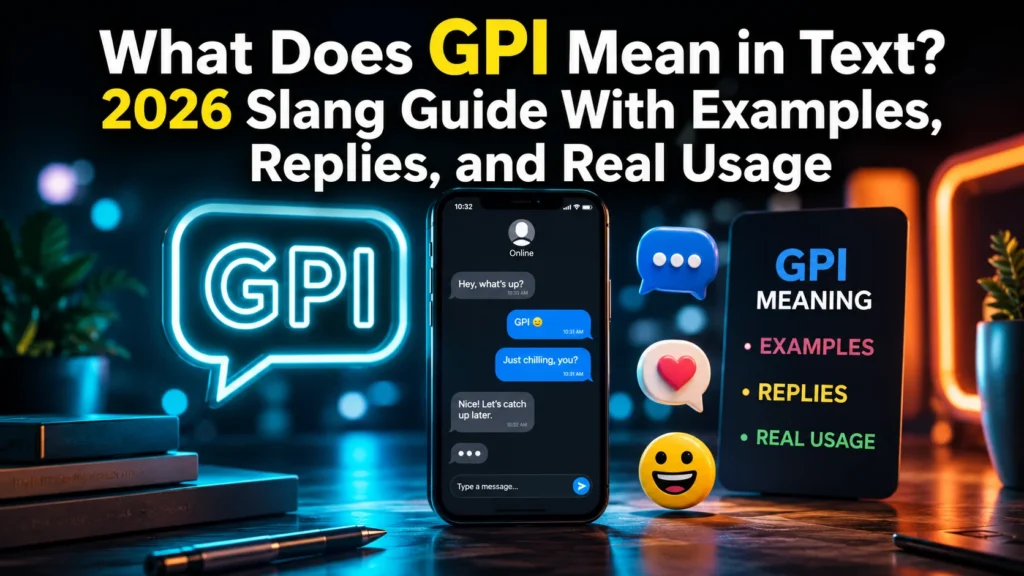

If someone sends you “GPI” after seeing your party photo, dinner story, or weekend plans, they probably aren’t thanking you. In casual texting, GPI usually stands for “Gracias Por Invitar,” a Spanish phrase that means “Thanks for inviting me.” The twist is that people often use it sarcastically when they weren’t actually invited. (N+)
That makes GPI a little more interesting than an ordinary abbreviation. Three letters can communicate “I saw what you did,” “Why wasn’t I invited?” or “Have fun without me!” depending on the relationship and tone. You may see it in WhatsApp chats, Instagram replies, TikTok comments, Facebook posts, or other casual online conversations. (N+)
Quick Answer
GPI means “Gracias Por Invitar,” which translates to “Thanks for inviting me.”
In texting and social media, however, GPI is commonly sarcastic. Someone may use it after discovering that friends went somewhere, attended a party, ate at a restaurant, traveled, or made plans without them.
Example
Friend: “We went to that new sushi place last night 🍣”
You: “GPI 😂”
Here, GPI doesn’t mean genuine thanks. It really means something like:
- “Thanks for inviting me… oh wait, you didn’t.”
- “Why didn’t you invite me?”
- “I see you guys went without me.”
- “Next time, don’t forget me.”
The phrase comes from Spanish, where “Gracias por invitar” literally means “thanks for inviting.” Spanish-language slang references and explanations describe the sarcastic use when someone wasn’t included in an event or activity. (SpanishPod101)
Comparison Overview
The easiest way to understand GPI is to compare its literal meaning with its actual online tone.
| Expression | Meaning | Typical Tone | Common Situation |
| GPI | Gracias Por Invitar | Sarcastic/playful | Someone wasn’t invited |
| Thanks for the invite | Thanks for inviting me | Can be genuine or sarcastic | An invitation or exclusion |
| FOMO | Fear of Missing Out | Emotional | Missing something exciting |
| Can I come? | Direct request to join | Straightforward | Plans are being made |
| Invite me next time | Request for future inclusion | Friendly | Someone missed an activity |
| HMU | Hit Me Up | Casual | Asking someone to contact you |
| LMK | Let Me Know | Neutral/casual | Waiting for information |
The important distinction is that GPI focuses on exclusion. It usually reacts to something that has already happened or is already happening. FOMO describes the feeling of missing out, while GPI turns that feeling into a short, often humorous message.
Main Differences Between GPI Meaning in Text and Similar Slang
GPI stands apart because it sounds like gratitude while actually calling attention to exclusion. That little contradiction gives the expression its sarcastic punch.
GPI vs. FOMO
FOMO means “fear of missing out.” It describes an emotional reaction to being absent from something enjoyable.
GPI, on the other hand, directly calls out the people who didn’t include you.
For example:
“Everyone’s at the beach and I’m stuck at home. FOMO 😭”
Compared with:
“You guys went to the beach without me? GPI 😂”
The first statement describes your feeling. The second addresses the people who left you out.
GPI vs. “Thanks for the Invite”
These expressions can mean almost the same thing.
The difference is style.
“Thanks for the invite” works naturally in English. GPI adds a Spanish-language internet slang flavor and is especially recognizable in Spanish-speaking online communities.
GPI vs. “Can I Come?”
These aren’t interchangeable.
“Can I come?” is a direct request.
GPI is usually indirect and playful. You aren’t necessarily asking to join. Instead, you’re jokingly pointing out that you weren’t invited.
GPI vs. “Invite Me Next Time”
“Invite me next time” clearly asks for future inclusion.
GPI can imply that request without stating it directly.
“GPI 😭 next time I’m coming.”
That message combines both ideas.
What Does GPI Stand For in Texting?
In the slang context, GPI stands for “Gracias Por Invitar.”
Here’s the word-by-word breakdown:
| Spanish | English |
| Gracias | Thanks |
| Por | For |
| Invitar | Inviting / to invite |
| GPI | Gracias Por Invitar |
The literal translation is close to “Thanks for inviting.” In natural English, people usually understand it as “Thanks for the invite.”
However, the internet meaning often flips the literal sentiment. If somebody wasn’t invited, saying “thanks for inviting” becomes obvious sarcasm.
That is the key to understanding GPI meaning in text.
Why Does GPI Mean “Thanks for Inviting” When Nobody Was Invited?
At first, GPI might seem contradictory. Why would someone say “thanks for inviting me” when they weren’t invited?
That’s exactly where the humor comes from.
Imagine your friends post pictures from a restaurant. You weren’t there. Instead of writing a serious paragraph about being left out, you comment:
“GPI 😭”
You’re pretending to thank them for an invitation that never arrived.
It’s similar to saying:
“Wow, thanks for remembering me.”
The words sound positive. The underlying message isn’t.
Spanish internet-slang references describe GPI as a sarcastic abbreviation used when someone learns about an event, trip, party, or gathering after being excluded. (SlangZone)
GPI Meaning in Spanish
The GPI meaning in Spanish comes from “Gracias Por Invitar.”
This phrase has a straightforward literal meaning. The slang use adds irony.
Spanish-language explanations identify GPI as an informal abbreviation used especially in social-media and messaging contexts. One Spanish reference describes it as a sarcastic way to point out that someone wasn’t invited to an event, gathering, or trip. (Wikipedia)
Literal vs. Slang Meaning
| Version | Meaning |
| Literal | Thanks for inviting |
| Sarcastic | Thanks for leaving me out |
| Playful | Hey, why wasn’t I invited? |
| Annoyed | I noticed you excluded me |
| Friendly | Next time, count me in |
So, don’t translate GPI word for word and stop there. Context supplies the real meaning.
How GPI Is Used in Text Messages
GPI works best when someone has a reason to believe they were excluded.
Common situations include:
- Friends going out without you
- A group having dinner without you
- Someone attending a party without mentioning it
- Friends taking a trip together
- Coworkers grabbing food without you
- A group watching a movie without you
- Someone posting vacation photos
- Friends attending a concert together
- A family member going somewhere without telling you
- People making plans in a group chat
Example: Dinner
Alex: “We tried that new burger place yesterday.”
Sam: “GPI 😂”
Sam isn’t thanking Alex.
Sam is jokingly saying, “You could’ve invited me.”
Example: Movie Night
Mia: “Movie night was so good!”
Jake: “GPI 😭”
The crying emoji makes the complaint feel dramatic and playful.
Example: Road Trip
Chris: “We’re heading to the lake tomorrow!”
Jordan: “GPI already? 😂”
This can even become preemptive sarcasm. Jordan is jokingly complaining before the trip happens.
GPI Meaning on Instagram
On Instagram, GPI can appear in comments, Story replies, captions, or direct messages.
The classic situation is simple: you see someone’s Story showing a fun activity that you weren’t part of.
For example:
“Dinner looks amazing. GPI 😒”
The message means:
“That looks great. Too bad nobody invited me.”
A Mexican news outlet explains that GPI can appear across Instagram, WhatsApp, Facebook, Twitter, and TikTok rather than belonging exclusively to one social platform. (N+)
Instagram Examples
- “Y’all went out? GPI 😂”
- “Cute party. GPI 😭”
- “That concert looked amazing. GPI.”
- “Next time I’m coming. GPI 👀”
- “Wow, nobody told me? GPI 😂”
Instagram makes the slang particularly natural because Stories often reveal social plans visually.
GPI Meaning on TikTok
TikTok gives GPI another useful setting.
Suppose someone uploads a video showing a group of friends having dinner. A viewer who knows the people might comment:
“GPI 😭”
The commenter is jokingly asking why they weren’t included.
You can also see the expression used when friends post:
- Trips
- Birthday celebrations
- Concerts
- Restaurant visits
- Beach days
- Sleepovers
- Group hangouts
The meaning doesn’t fundamentally change because the platform changes. The social context remains the deciding factor.
GPI Meaning on Snapchat
Snapchat is another natural place for GPI because the platform revolves heavily around personal updates and Stories.
Suppose your friend posts a Snap from a bowling night.
You reply:
“GPI 🎳😂”
That can mean:
“You went bowling without me? Seriously?”
The tone will usually depend on your relationship.
A close friend may read it as harmless teasing. Someone you barely know could interpret the same message differently.
GPI Meaning on WhatsApp
WhatsApp group chats make GPI especially useful.
Imagine three friends are discussing plans:
Liam: “We’re grabbing pizza at 8.”
Noah: “GPI?? 😂”
Here, Noah may be jokingly calling out the group for making plans without him.
In Spanish-speaking communities, informal abbreviations like GPI are well suited to fast messaging because they compress a longer phrase into three letters. SpanishPod101 specifically identifies GPI as a shortened form of “Gracias por invitar” and notes both genuine and sarcastic uses. (SpanishPod101)
GPI Tone: Is It Friendly, Sarcastic, or Rude?
Tone changes everything.
The same three letters can sound hilarious between close friends and passive-aggressive in another conversation.
Friendly GPI
“GPI bro 😂 next time I’m coming.”
This is clearly playful.
Sarcastic GPI
“Oh wow. GPI 😒”
The speaker noticed the exclusion and isn’t hiding their annoyance.
Hurt GPI
“GPI… I thought you would’ve told me.”
This isn’t really a joke anymore.
Flirty GPI
“You went without me? GPI 👀”
Depending on the relationship, this could sound teasing or lightly flirtatious.
The Tone Spectrum
| GPI Style | Likely Meaning |
| GPI 😂 | Playful teasing |
| GPI 😭 | Dramatic FOMO |
| GPI 😅 | Lighthearted complaint |
| GPI 👀 | Curious or teasing |
| GPI 😒 | Annoyance |
| GPI 💔 | Genuine hurt |
| GPI. | Potentially cold or serious |
An emoji doesn’t determine meaning by itself. Still, it provides a useful tone signal.
How to Know Whether GPI Is a Joke
Before replying, look at three things: relationship, context, and wording.
Look at Your Relationship
If your best friend sends “GPI 😂,” they’re probably teasing.
If someone you recently met sends only “GPI,” the intent may be less obvious.
Look at What Happened
Did you just post pictures from a party?
Did they discover you went out without them?
If yes, the sarcastic meaning becomes highly likely.
Look at the Emoji
Laughing and crying emojis often soften the message.
A period can make the same phrase feel more serious.
Also Read This: What Does SSA Mean in Text? Full Meaning, Slang, Uses & Examples
Read the Message Around It
Never interpret slang in isolation when the surrounding conversation is available.
For example:
“GPI 😂 save me some cake!”
is obviously lighter than:
“GPI. I would’ve appreciated knowing.”
The abbreviation stayed the same. The emotional meaning changed completely.
How to Reply to GPI
The best response depends on whether the sender is joking, genuinely upset, or asking to be included next time.
Funny Replies to GPI
If your friendship is playful, lean into the joke.
- “Your invitation got lost in the mail 😂”
- “You were on the VIP list!”
- “My bad. Next round is yours.”
- “We were literally about to call you 😭”
- “Don’t expose us like that 😂”
- “Next time, you’re getting first dibs.”
- “Okay okay, we messed up 😂”
Friendly Replies
When you want to reassure them:
- “You should’ve come!”
- “Next time you’re definitely invited.”
- “We missed you!”
- “You would’ve loved it.”
- “You’re coming with us next time.”
- “My bad! I thought you were busy.”
Flirty Replies
If the conversation has romantic energy, you can make the response playful:
- “I was waiting for you to ask 👀”
- “You would’ve gotten a private invite 😉”
- “Next time, you’re coming with me.”
- “Maybe I wanted an excuse to invite you myself.”
Use these only when the relationship already supports that tone.
When the Person Is Actually Upset
Don’t joke if their message sounds serious.
Try:
“Hey, I’m sorry. I didn’t mean to leave you out. We should’ve told you.”
A short apology can prevent a tiny slang joke from becoming a real argument.
25 Natural Replies to “GPI”
| Situation | Reply |
| Close friend | “Next time you’re coming 😂” |
| Funny | “Your invite is in the mail.” |
| Apologetic | “My bad! Seriously.” |
| Casual | “You should’ve come!” |
| Playful | “Don’t worry, VIP access next time.” |
| Group chat | “Okay, okay. We hear you 😂” |
| Party | “You’re officially invited next time.” |
| Dinner | “We saved you a virtual seat.” |
| Road trip | “You would’ve made the trip better.” |
| Concert | “Next concert is ours!” |
| Birthday | “You know you’re invited.” |
| Flirty | “I was saving you a spot 👀” |
| Teasing | “Someone’s feeling left out 😂” |
| Reassuring | “We honestly thought you were busy.” |
| Direct | “Want to come next time?” |
| Friendly | “Come with us next weekend.” |
| Funny apology | “Okay, we’re guilty 😭” |
| Dramatic | “The betrayal is noted 😂” |
| Warm | “We missed having you there.” |
| Casual apology | “Oops. That’s on us.” |
| Planning | “Let’s plan something together.” |
| Social | “You’re on the next guest list.” |
| Short | “My bad 😂” |
| Cheerful | “Next time, you’re first.” |
| Serious | “Sorry. We should’ve included you.” |
When Should You Use GPI?
GPI works best in informal conversations.
Use it when you know the people involved and understand the social context.
Good Situations
- Friends
- Family members who enjoy teasing
- Group chats
- Instagram Stories
- TikTok comments
- Snapchat replies
- Casual DMs
- Informal online communities
Situations to Avoid
Don’t rely on GPI in formal communication.
Avoid it in:
- Business emails
- Job applications
- Academic papers
- Formal customer service
- Official announcements
- Professional complaints
A manager isn’t likely to appreciate receiving “GPI 😭” after a meeting invitation.
When communication carries real consequences, write the message clearly instead.
Is GPI Always Sarcastic?
No.
This is an important detail that gets lost in many slang explanations.
SpanishPod101 notes that GPI can also be used when someone was genuinely invited and wants to express thanks. The sarcastic version becomes especially likely when the event already happened or the sender clearly wasn’t included. (SpanishPod101)
Compare these examples:
“GPI! See you tonight ❤️”
This can be genuine.
Now compare:
“You guys went without me? GPI 😂”
That’s clearly sarcastic.
So the best rule is:
If an invitation actually exists, GPI can be genuine. If there was no invitation, it usually carries irony.
Real Conversation Examples of GPI
Birthday Party
A: “Last night’s birthday party was crazy!”
B: “GPI 😭”
Meaning: “Thanks for inviting me… even though you didn’t.”
Restaurant Visit
A: “We finally tried that new Italian restaurant.”
B: “GPI 😂”
Meaning: “Why didn’t you invite me?”
Beach Trip
A: “Beach day was perfect 🌊”
B: “GPI 😒”
Meaning: “I noticed I wasn’t invited.”
Gaming Session
A: “We played for five hours last night.”
B: “GPI bro 😭”
Meaning: “You could’ve asked me to join.”
Movie Night
A: “That movie was actually amazing.”
B: “GPI 😂”
Meaning: “You watched it without me?”
Group Chat
A: “Dinner at 7?”
B: “GPI??”
Meaning: “Wait, are you making plans without me?”
Vacation
A: “Look at this view from our hotel!”
B: “GPI 😭”
Meaning: “That trip looks amazing. Why wasn’t I there?”
Preemptive GPI
A: “We’re thinking about going bowling Saturday.”
B: “GPI already 😂”
Meaning: “I’m jokingly claiming my invitation before you forget me.”
This version is especially useful because the exclusion hasn’t happened yet. The speaker is making a joke about the possibility.
Case Study: How Context Changes the Meaning of GPI
Consider one simple message:
“GPI 😂”
Now place it in three different conversations.
Case One: Close Friends
Your best friend posts a restaurant photo.
You reply:
“GPI 😂”
Likely interpretation: playful teasing.
Case Two: Someone You Barely Know
An acquaintance posts a private birthday celebration.
You reply:
“GPI.”
Likely interpretation: It could sound like a complaint or an awkward attempt to insert yourself into the event.
Case Three: A Close Friend Who Forgot You
Your friends regularly invite you to everything. Suddenly, they go somewhere without telling you.
You write:
“GPI…”
Likely interpretation: genuine disappointment disguised as sarcasm.
The abbreviation didn’t change. The relationship changed.
That’s why understanding GPI requires more than memorizing its full form.
Common Mistakes People Make With GPI
Mistake One: Assuming It’s an English Acronym
GPI isn’t primarily an English texting phrase. In the slang use discussed here, it comes from the Spanish “Gracias Por Invitar.” (SpanishPod101)
Mistake Two: Taking It Literally
Someone saying GPI after an exclusion usually isn’t genuinely thanking you.
The sarcasm carries the real message.
Mistake Three: Assuming It’s Always a Joke
Sometimes the sender really is hurt.
Pay attention to punctuation, emojis, and the broader conversation.
Mistake Four: Treating It Like a Formal Abbreviation
GPI has legitimate meanings outside slang. Context determines which definition makes sense.
Other Meanings of GPI
GPI isn’t exclusively a texting abbreviation. The acronym appears in economics, international affairs, education, science, and other fields.
Here are several established meanings.
| GPI Meaning | Field | What It Refers To |
| Gracias Por Invitar | Spanish internet slang | “Thanks for inviting” |
| Global Peace Index | International affairs | A measure of peacefulness |
| Genuine Progress Indicator | Economics | A broader measure of economic and social progress |
| Glucose-6-phosphate isomerase | Biology/medicine | An enzyme involved in glucose metabolism |
| Glycosylphosphatidylinositol | Biochemistry | A glycolipid-related structure |
The Global Peace Index, for example, is produced by the Institute for Economics & Peace and ranks 163 independent states and territories using 23 qualitative and quantitative indicators across three broad domains.
The Genuine Progress Indicator is an economic and well-being measure designed to capture social and environmental factors that GDP doesn’t fully represent. Academic research describes it as a multidimensional indicator intended to assess net benefits within broader social and environmental systems.
Meanwhile, Spanish references specifically identify GPI as “Gracias Por Invitar” when discussing informal online communication.
How to Tell Which GPI Meaning Applies
Use the surrounding words.
Social media post:
“Everyone went out last night. GPI 😂”
→ Gracias Por Invitar
Economics article:
“The study compares GDP with GPI.”
→ Genuine Progress Indicator
International affairs article:
“The country’s GPI ranking improved.”
→ Global Peace Index
The surrounding subject usually makes the correct meaning obvious.
Is GPI a Gen Z Slang Term?
GPI is best understood as internet and social-media slang rather than a formal English acronym.
Its use has roots in Spanish-language digital communication. Sources discussing Spanish texting slang identify it as a shortened form of “Gracias por invitar.” (SpanishPod101)
Social media helped make the expression useful because modern platforms constantly expose users to other people’s activities.
You see the party.
You see the restaurant.
You see the vacation.
Then comes the three-letter response:
GPI.
It’s short enough to type instantly while still carrying an entire social message.
Why GPI Works So Well as a Joke
There’s a clever linguistic trick behind the expression.
The sender says “thanks” while actually pointing out the absence of an invitation.
That contradiction creates irony.
It’s similar to the difference between:
“Wow, thanks for remembering me.”
and
“Wow, you remembered me.”
Depending on context, both can sound completely different from their literal wording.
GPI works because the recipient usually understands the hidden message immediately:
“I noticed you went without me.”
That makes it efficient, funny, and socially flexible.
GPI and FOMO: How They Connect
GPI and FOMO often appear in the same social situation, but they aren’t identical.
FOMO describes anxiety or concern about missing an enjoyable experience.
GPI turns that situation into a social response.
Think of it this way:
Someone posts a party → You realize you weren’t there → You feel FOMO → You comment “GPI 😂.”
The first three steps describe the experience.
The final step expresses it.
That’s why GPI can be viewed as a playful linguistic response to social exclusion, rather than a direct synonym for FOMO.
GPI Emoji Meanings
Emojis can dramatically alter the emotional temperature of a GPI message.
GPI 😂
Usually means:
“I’m joking. You guys are ridiculous.”
GPI 😭
Often exaggerates the feeling of being left out.
“I’m devastated that I missed this!”
GPI 😒
Can sound more annoyed.
“Seriously? You didn’t invite me?”
GPI 👀
Can sound curious, teasing, or slightly flirty.
“So… where was my invitation?”
GPI 💔
May signal genuine disappointment.
“That actually hurt.”
Use emojis carefully. If you don’t know the relationship well, a simple sentence may communicate your intention more clearly.
FAQs:
What does GPI mean in text?
GPI usually means “Gracias Por Invitar,” which translates to “Thanks for inviting.” In casual online conversations, people often use it sarcastically when they weren’t invited to an activity. (SpanishPod101)
What does GPI mean on Instagram?
On Instagram, GPI usually means “Gracias Por Invitar.” Someone may comment it on a Story, post, or photo showing friends at an event they weren’t invited to.
What does GPI mean on TikTok?
On TikTok, GPI can be used as a playful comment when someone sees friends, creators, or acquaintances doing something without them. The slang meaning remains “Gracias Por Invitar.”
Is GPI rude?
Usually, no. Among friends, it’s commonly playful sarcasm. However, GPI can sound passive-aggressive if the sender genuinely feels excluded. The relationship and context matter more than the abbreviation itself.
How should I respond to GPI?
Match the tone. If it’s clearly a joke, try “Next time you’re coming 😂” or “Your invitation got lost in the mail.” If the person sounds genuinely hurt, give them a sincere apology instead.
Concusion:
GPI means “Gracias Por Invitar,” or “Thanks for inviting,” in Spanish. In casual texting and social media, however, people frequently use it sarcastically when they weren’t invited to something.
You might see GPI after a party, dinner, vacation, concert, movie night, or random hangout. The phrase can communicate humor, FOMO, mild annoyance, playful jealousy, or genuine disappointment depending on the situation.
The biggest clue is context.
If someone posts a beach photo and you reply “GPI 😂,” you’re probably jokingly saying, “Looks fun. Thanks for leaving me out!”
Just remember that GPI has other established meanings in fields such as economics and international affairs. The Global Peace Index and Genuine Progress Indicator, for example, have nothing to do with texting slang. (Institute for Economics & Peace)
So when you see GPI in a casual chat, look at what happened immediately before it. If someone wasn’t invited, the meaning is usually crystal clear:
“Gracias Por Invitar” — thanks for the invite.