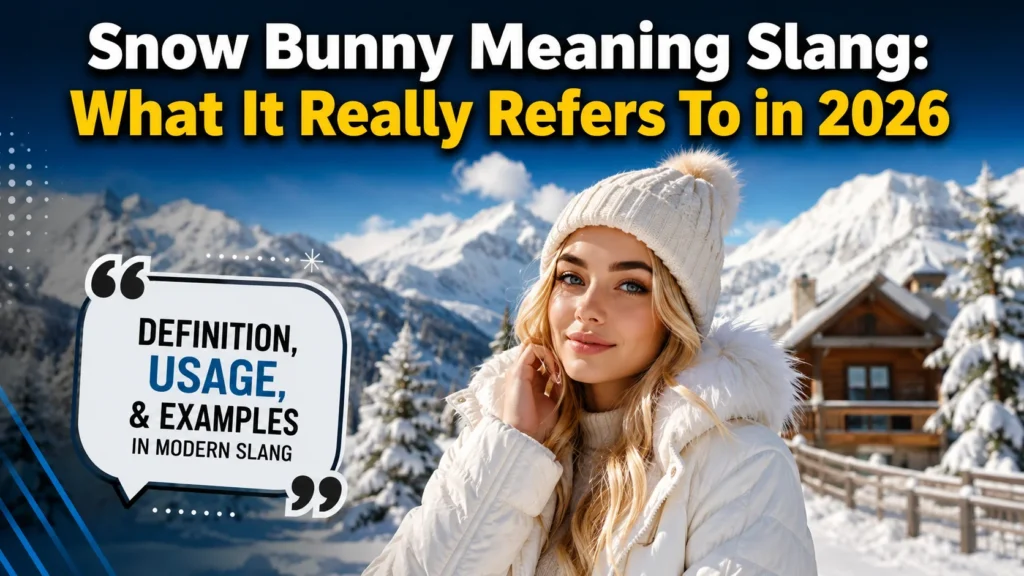

Wondering what “snow bunny” really means? You’re not alone. The phrase has become increasingly common on TikTok, Instagram, X, music lyrics, dating apps, and everyday conversations. Yet its meaning isn’t always the same. Depending on the context, “snow bunny” can describe a winter sports enthusiast, a playful nickname, or a slang term used in dating culture. Understanding the context is the key to interpreting it correctly.
Unlike many internet slang terms that have only one definition, Snow Bunny Meaning Slang has evolved over several decades. It started as an innocent phrase connected to skiing before gaining additional meanings through popular culture, music, and social media. Today, people use it in both casual and controversial ways, making it one of the most misunderstood slang expressions online.
This guide explains every major meaning of snow bunny, explores its history, shows real-world examples, discusses whether it’s offensive, and helps you understand when the phrase is appropriate to use.
Snow Bunny Meaning Slang (Quick Answer)
If you’re looking for a fast answer, here’s what snow bunny usually means.
| Context | Meaning |
| Winter sports | A person, often a woman, who enjoys skiing, snowboarding, or spending time at ski resorts. |
| Dating slang | A white woman who dates or is attracted to Black men. |
| Social media | Someone who loves snowy weather, winter fashion, or cozy seasonal aesthetics. |
| Informal nickname | A playful term for someone who enjoys winter activities or snowy vacations. |
The simplest definition
Snow bunny is a slang expression with multiple meanings. The original meaning referred to someone who loved spending time in snowy mountain resorts. Over time, the phrase developed new meanings, particularly in dating culture and online conversations.
That is why you should never assume one meaning without considering the context.
For example:
- “She’s a snow bunny who spends every weekend skiing.”
- Refers to winter sports.
- “He said he’s dating a snow bunny.”
- May refer to interracial dating slang depending on the conversation.
- “My inner snow bunny comes alive every December.”
- Means someone who enjoys winter.
The surrounding conversation usually makes the intended meaning clear.
What Does “Snow Bunny” Mean in Slang?
The phrase has changed significantly over the years. Instead of having one fixed definition, it now carries several distinct meanings.
Let’s explore each one.
Traditional Winter Sports Meaning
This is the oldest and most widely accepted meaning.
Originally, a snow bunny described someone who loved skiing or snowboarding. The phrase became popular in North American ski culture during the mid-20th century.
A snow bunny might:
- Spend weekends at ski resorts
- Learn skiing for fun
- Wear stylish winter clothing
- Enjoy mountain vacations
- Relax in ski lodges after a day on the slopes
Interestingly, the term didn’t necessarily imply that someone was an expert skier. Beginners who enjoyed the atmosphere at ski resorts also earned the nickname.
Example
“Emily became a real snow bunny after moving to Colorado.”
Here, the phrase simply means Emily enjoys skiing and winter recreation.
Common characteristics
Many traditional snow bunnies:
- Love snowy destinations
- Enjoy winter photography
- Drink hot chocolate beside fireplaces
- Visit mountain resorts every winter
- Participate in seasonal sports
There is nothing offensive about this original meaning.
Modern Dating Slang Meaning
The phrase later developed another meaning within dating culture.
Today, snow bunny may describe a white woman who dates or is attracted to Black men.
This meaning became increasingly visible through:
- Hip-hop culture
- Internet discussions
- Podcasts
- Social media
- Dating conversations
It’s important to understand that this definition is context-specific. Not everyone uses the phrase this way.
For example:
“He only dates snow bunnies.”
In many online conversations, people would interpret this as referring to interracial relationships rather than winter sports.
Why context matters
Imagine hearing:
“Sarah is a snow bunny.”
Without additional context, you don’t know whether Sarah:
- Loves skiing
- Enjoys snowy vacations
- Fits the dating slang definition
The surrounding conversation determines the correct interpretation.
A Playful Nickname for Winter Lovers
Another increasingly common use is much lighter.
Many people now call themselves snow bunnies simply because they love winter.
This usage often appears in Instagram captions like:
- “Official snow bunny season.”
- “Living my best snow bunny life.”
- “Weekend mountain escape.”
- “Coffee, snowflakes, and cozy sweaters.”
In these situations, the phrase has nothing to do with dating slang.
Instead, it reflects someone’s love for:
- Snowfall
- Winter vacations
- Ski lodges
- Cozy clothing
- Christmas markets
- Mountain scenery
This version has become especially popular among travel influencers.
Where Did the Term “Snow Bunny” Come From?
Understanding the history helps explain why the phrase has multiple meanings today.
The earliest known uses appeared in North American skiing culture during the twentieth century.
Back then, ski resorts attracted growing numbers of visitors every winter. Many newcomers weren’t professional skiers. They simply enjoyed the atmosphere, the scenery, and social events.
Locals started calling these enthusiastic visitors snow bunnies.
The nickname combined two ideas:
- Snow represented winter activities.
- Bunny suggested someone energetic, playful, and youthful.
Originally, the phrase carried a positive tone.
How the Meaning Changed
Language constantly evolves.
As music, movies, and internet culture expanded, many older expressions gained new interpretations.
During the late twentieth century and early twenty-first century, snow bunny appeared more frequently in:
- Rap lyrics
- Comedy shows
- Urban slang
- Online forums
- Dating discussions
Gradually, many younger audiences became more familiar with the dating-related definition than the skiing definition.
Today, both meanings exist simultaneously.
That explains why misunderstandings still happen.
Why the Phrase Became So Popular
Several cultural trends helped spread the expression.
Social media
Short videos introduced slang to millions of viewers.
Music
Artists used memorable phrases that listeners repeated.
Internet memes
Funny winter content often featured captions like:
“Certified snow bunny.”
Travel influencers
People visiting snowy destinations embraced the term as a playful winter identity.
The result?
A phrase that once belonged mostly to ski resorts now appears almost everywhere online.
Snow Bunny Meaning on Social Media
Every platform uses slang differently.
Here’s how snow bunny commonly appears across social media.
| Platform | Typical Meaning |
| TikTok | Winter aesthetic, skiing, dating slang |
| Snow vacations, fashion, travel | |
| X | Humor, slang discussions, pop culture |
| Snapchat | Casual texting, flirting |
| Family vacation photos or winter memories |
Snow Bunny on TikTok
TikTok trends often emphasize visual storytelling.
You’ll frequently see captions like:
- “Snow bunny weekend.”
- “POV: You’re finally at the mountains.”
- “Winter outfit check.”
- “Snow bunny aesthetic.”
Most creators simply mean:
- Ski trips
- Snowboarding
- Winter fashion
- Cozy vacation content
However, some dating discussions also use the slang meaning.
Again, context decides everything.
Snow Bunny on Instagram
Instagram generally favors the traditional interpretation.
Popular captions include:
- “Snow bunny mode activated.”
- “Fresh powder. Fresh air.”
- “Weekend in Aspen.”
- “Living for mountain mornings.”
Travel influencers often combine these captions with:
- Ski goggles
- Snow-covered cabins
- Mountain views
- Winter clothing
- Luxury resorts
In these cases, the phrase highlights a winter lifestyle rather than dating.
Snow Bunny on X (Formerly Twitter)
On X, conversations tend to move quickly.
Someone might post:
“I’m officially becoming a snow bunny.”
Without photos, readers may interpret the phrase differently depending on recent discussions.
That uncertainty explains why slang can sometimes create confusion online.
Snow Bunny in Memes
Internet humor often exaggerates the expression.
Examples include:
- Before snow:
- “I hate winter.”
- First snowfall:
- “I’m suddenly a professional snow bunny.”
The joke lies in someone’s dramatic personality change once winter begins.
Snow Bunny Meaning in Text Messages
Texting removes facial expressions and tone of voice.
That makes context even more important.
Let’s examine realistic examples.
Example One
Text
“She’s such a snow bunny.”
Possible meanings:
- She enjoys skiing.
- She loves winter.
- The speaker is referring to dating slang.
Without additional information, the meaning remains unclear.
Example Two
Text
“We’re taking the snow bunny to Aspen.”
Most readers would assume the skiing definition.
Why?
Because Aspen is famous for:
- Ski resorts
- Snowboarding
- Winter tourism
The location provides valuable context.
Example Three
Text
“He’s only into snow bunnies.”
Here, many people would interpret the phrase as dating slang.
The conversation focuses on romantic preferences rather than winter sports.
Example Four
Friend A
“Ready for the weekend?”
Friend B
“Absolutely. Snow bunny season starts tomorrow.”
Most likely meaning:
The speaker plans to ski, snowboard, or enjoy snowy weather.
Example Five
Instagram DM
“You really are a snow bunny 😂”
If the recipient recently shared ski photos, the message almost certainly refers to winter sports.
If the conversation involved dating, the meaning could change entirely.
Also Read This: Travesty Meaning: What’s Correct Spelling?
Why Context Is Everything
One of the biggest mistakes people make is assuming every slang term has only one definition.
That isn’t true.
Words evolve.
Meanings expand.
Communities adopt expressions in different ways.
The phrase snow bunny demonstrates this perfectly.
Before interpreting it, always consider:
- Who said it?
- Where was it posted?
- What was the conversation about?
- Were winter sports mentioned?
- Was dating being discussed?
- Were there photos or emojis providing additional clues?
Those details almost always reveal the intended meaning.
Is Calling Someone a “Snow Bunny” Offensive?
Whether “snow bunny” is offensive depends on how, where, and why someone uses it. Like many slang expressions, the phrase carries different meanings for different people.
When used in its original skiing sense, most people consider it harmless. Someone might proudly describe themselves as a snow bunny because they love skiing, snowboarding, or spending weekends in the mountains.
However, the dating slang meaning is more complicated. Some people view it as casual slang, while others feel it reduces someone’s identity to race or dating preferences. Because of that, it’s best to think carefully before using the phrase.
When the phrase is usually acceptable
- Talking about skiing or snowboarding
- Referring to winter vacations
- Using it as a playful nickname among friends who understand the context
- Describing yourself in a lighthearted way
When you should avoid it
- Professional conversations
- Workplace communication
- Speaking to someone you don’t know well
- Situations where the meaning could be misunderstood
- Conversations involving sensitive racial topics
Quick Reference Table
| Situation | Appropriate? | Reason |
| Talking about skiing | ✅ Yes | Original meaning |
| Winter vacation caption | ✅ Yes | Refers to snowy activities |
| Friendly conversation | ✅ Usually | If everyone understands the context |
| Workplace | ❌ No | Too informal and potentially confusing |
| Public speech | ❌ No | Different audiences may interpret it differently |
| Referring to strangers | ❌ Best avoided | Could sound disrespectful or stereotypical |
A good rule to remember
If you aren’t sure how your audience will interpret snow bunny, choose a more specific phrase instead.
For example:
- Winter sports enthusiast
- Ski lover
- Snowboard fan
- Mountain traveler
- Winter vacation enthusiast
These alternatives leave little room for misunderstanding.
Examples of “Snow Bunny” Used Correctly
Seeing the phrase in real conversations makes it much easier to understand.
Below are examples grouped by context.
Casual Conversations
Example 1
“I’ve become a complete snow bunny since learning to ski.”
Meaning: Loves winter sports
Example 2
“Every December she turns into a snow bunny.”
Meaning: She enjoys snowy weather every winter.
Example 3
“We’re heading to Colorado with our favorite snow bunny.”
Meaning: Someone who loves skiing.
Example 4
“My sister is definitely the snow bunny in our family.”
Meaning: She enjoys winter vacations the most.
Example 5
“He wasn’t interested in beaches. He’s a snow bunny.”
Meaning: Prefers snowy destinations.
Text Messages
Example 6
“Ready for another snow bunny weekend?”
Meaning:
Planning another ski trip.
Example 7
“Our snow bunny already packed her skis.”
Meaning:
The person enjoys skiing.
Example 8
“He’s always posting snow bunny photos.”
Meaning:
Pictures from snowy mountains.
Example 9
“Snow bunny season officially starts tomorrow.”
Meaning:
Winter has arrived.
Example 10
“She’s dating another snow bunny.”
Meaning:
Interpretation depends on the previous conversation.
Social Media Captions
Example 11
❄️ Living my best snow bunny life.
Meaning:
Enjoying winter.
Example 12
Coffee. Mountains. Snow bunny mode.
Meaning:
Relaxing at a ski resort.
Example 13
Weekend forecast: 100% snow bunny.
Meaning:
Planning snowy activities.
Example 14
Snow bunny energy all winter long.
Meaning:
Loving the winter season.
Example 15
Another powder day.
Certified snow bunny.
Meaning:
Excited about fresh snow.
Dating Conversations
These examples use the slang definition.
Example 16
“He says he only dates snow bunnies.”
Meaning:
Depending on context, it may refer to interracial dating preferences.
Example 17
“People online called her a snow bunny.”
Meaning:
Refers to dating slang rather than skiing.
Example 18
“That rapper mentioned snow bunnies in his lyrics.”
Meaning:
Likely uses the dating-related slang.
Winter Travel Examples
Example 19
“The whole group became snow bunnies after moving near the mountains.”
Meaning:
Everyone learned to enjoy winter sports.
Example 20
“I never liked snow until this vacation. Now I’m officially a snow bunny.”
Meaning:
Recently discovered a love for snowy adventures.
Similar Slang Terms You Might Hear
Many expressions overlap with snow bunny, although each has its own meaning.
| Term | Meaning | How Similar? |
| Ski Bunny | Someone who enjoys skiing | Very similar |
| Powder Hound | Passionate skier chasing fresh snow | Related |
| Après-ski | Social activities after skiing | Related |
| Snowbird | Someone who moves to a warmer place during winter | Different |
| Winter Lover | Someone who enjoys cold weather | Similar |
| Mountain Lover | Enjoys mountain destinations | Similar |
| Slope Junkie | Loves skiing frequently | Related |
| Snow Chaser | Travels wherever snowfall is best | Similar |
Understanding these terms helps you recognize subtle differences in conversations.
Snow Bunny vs. Ski Bunny
People often use these expressions interchangeably.
However, they aren’t always identical.
| Snow Bunny | Ski Bunny |
| Multiple meanings | Mostly refers to skiing |
| May describe dating slang | Rarely used in dating contexts |
| Common on social media | Common among skiers |
| Can simply mean someone who loves winter | Specifically connected to skiing |
The biggest difference
Ski bunny almost always refers to winter sports.
Snow bunny can refer to:
- Ski culture
- Winter travel
- Seasonal lifestyle
- Dating slang
That’s why context matters much more with snow bunny.
Common Misconceptions About Snow Bunny
Several myths continue circulating online.
Myth: Snow bunny always means interracial dating.
Fact: No. The original meaning relates to skiing and winter recreation. Both meanings exist today.
Myth: Only women can be snow bunnies.
Fact: Traditionally, the phrase often described women. Today, some people use it more broadly for anyone who loves winter sports, although usage still varies.
Myth: It’s always offensive.
Fact: Not necessarily. In skiing contexts, it’s generally harmless. Sensitivity arises mainly with the dating-related meaning or when used carelessly.
Myth: It started on TikTok.
Fact: No. The phrase existed decades before social media. TikTok simply helped introduce it to a younger audience.
Myth: Every rapper uses it the same way.
Fact: Artists use slang creatively. The intended meaning depends on the lyrics and surrounding context.
FAQs:
What does “snow bunny” mean in slang?
In slang, snow bunny has multiple meanings. It can refer to someone who enjoys skiing and snowy weather, or in certain contexts, it can describe a white woman who dates or is attracted to Black men. The intended meaning depends entirely on the conversation.
Does “snow bunny” always refer to interracial dating?
No. The phrase originally described people who enjoyed skiing and spending time at snowy mountain resorts. The dating-related meaning developed later and is only one of several current uses.
Can a man be called a snow bunny?
Although the term has traditionally been used more often for women, some people now use it informally for anyone who enjoys winter sports or snowy vacations. Usage varies by region and community.
Is calling someone a “snow bunny” a compliment?
It depends on the context. In skiing and winter travel, many people see it as playful or complimentary. In dating-related contexts, opinions differ, so it’s wise to consider your audience before using the term.
Why is “snow bunny” popular on TikTok?
TikTok creators often use snow bunny in videos featuring skiing, snowboarding, winter fashion, mountain vacations, and cozy seasonal aesthetics. The platform has helped revive the phrase among younger audiences.
Conclusion:
The phrase Snow Bunny Meaning Slang has evolved far beyond its original roots in skiing culture. While it first described someone who loved snowy mountains and winter sports, modern usage has expanded to include social media trends, seasonal nicknames, and a dating-related slang meaning. Because these definitions coexist, context is essential.
When you see or hear snow bunny, don’t jump to conclusions. Look at the conversation, the setting, and the speaker’s intent. A travel influencer posting ski photos almost certainly means one thing, while the same phrase in a discussion about dating may mean something entirely different.
Understanding these distinctions helps you interpret the phrase accurately and use it respectfully. As with many slang expressions, knowing the history and context allows you to communicate more clearly and avoid misunderstandings. Whether you’re chatting with friends, reading online comments, or planning your next mountain getaway, you’ll now know exactly what snow bunny can mean in 2026.